
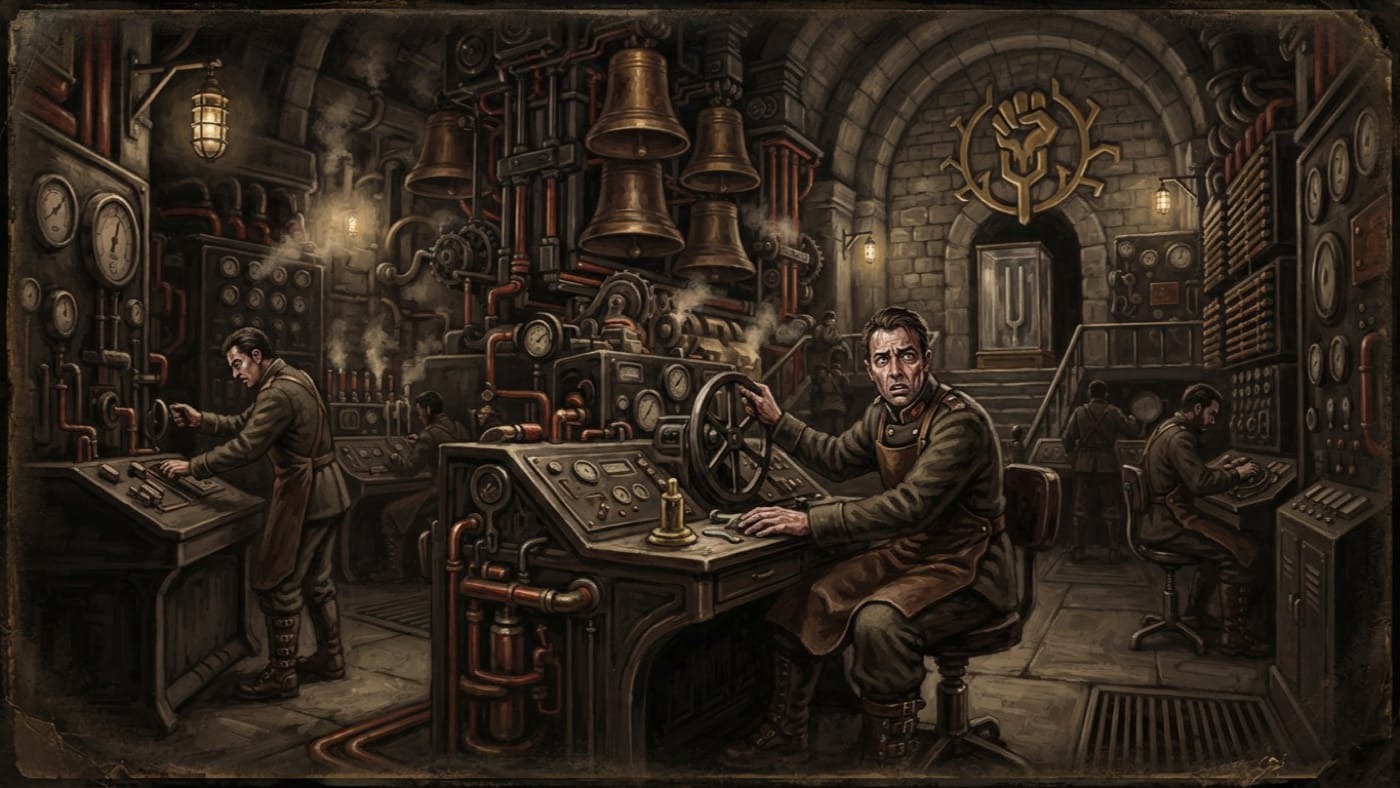
#On Mercy Before the Street Hears
A Bellwarden reports drift. Somewhere in the corridor a second voice has entered the bronze. It is faint. It may be a cracked plate, or a tired listener, or something that has learned the hour. The operator in the sub-tower vault has one hand on the timing wheel and the authority slug in the other. The street above has not yet noticed anything at all.
Loud Mercy is the school within the Counter-Toll Corps that answers that moment with bronze. Its doctrine would fit on a forearm in chalk: overwrite early. Drown the hostile command before the citizen recognises it as command, before the baker reaches for the shutter and the mother for the bolt. The school serves the Bureau of Bells, under whose seals every Counter-Toll vault operates. No file I have been shown gives it a separate charter, a headquarters, a membership roll or any insignia beside the dominance sigil on the belt plate. Absence from my desk does not prove absence from the world. The Bureau keeps many drawers.
What the school does possess is a definition. In its usage, mercy is the speed at which a city is spared the knowledge that, for a few breaths, it belonged to someone else.
#On Veyl's Inheritance
The Night of Borrowed Curfew supplies the grievance. A foreign peal entered Cologne's bell-grid and rang curfew three hours early. The city obeyed with exemplary piety. Doors locked, streets emptied, the garrison stood down, and something made use of the scheduled quiet. The dead number in the hundreds, and the report is sealed. Bells files the night in A.S. 134 (1844 CE), and the Bureau of Records files it in A.S. 136 (1846 CE). The Bureau of War keeps it under Pending Classification, where it has stayed admirably warm.
In A.S. 135 (1845 CE) the Corps was chartered under Canon Veyl “Iron Throat”, its first commander. That date belongs to the Corps. The name Loud Mercy has no birth certificate. I cannot say which vault first spoke it or which operator coined it, and I decline to invent a christening for readers who enjoy anniversaries.
The school claims Veyl as its sire. The claim is theirs, and I record it. Their evidence is a liturgy of his maxims, recited at shift-start between the throat phrase and the three test peals: louder is cleaner; dominance is mercy; do not negotiate with noise. Veyl formalised the Corps' graduated bands and held that panic under Synod authority was preferable to calm under the enemy's. Loud Mercy took the sentence and moved it earlier in the evening. Master-Carillonist Aldo Venn of Strasbourg later gave the Bureau its tidier formula: prevented, no; answered, yes. Loud Mercy hears only the second clause, and it hears it early.
Its rivals inherit Veyl too. Every operator in the Corps is his child. Loud Mercy is the child that kept his voice.
#On the Early Answer
Loud Mercy owns none of the equipment and none of the bands. Soft Drown is corridor-local suppression, Hard Dominance is district overwrite, and Full Wash is the city-wide act. All three belong to the whole Corps. What sets the school apart is its clock. A cautious node waits to see whether drift becomes command. Loud Mercy treats the drift as a command already issued and strikes while the hostile tone is still learning the street's name. The trade has a proverb for this, and the school has made it its own: drown it before it names you.
Early does not mean maximum. The school's critics like to pretend otherwise, and its own hotheads sometimes oblige them. The working sequence binds every operator, whatever their school. Two listeners verify the source before escalation, because the Corps also says never ring on a rumour. A peal rung on rumour is a small Cologne of one's own making. Authority is shown in wax and then in the throat: the slug is seated, and the voice phrase is spoken and logged against the timing window. Then the wheel turns. The strike actuators drop, the tuning banks hold the sanctioned pattern, and the multi-bell array speaks over the intruder. The operator watches two things, the decay of the hostile tone and the movement of the crowd. After that come the log, the certificate and the wear read.
The school's whole argument sits in the gap between verification and deployment. Shorten that gap, its adherents say, and Soft Drown is enough. The hostile peal dies in a corridor, and the district above never learns it was addressed. Lengthen the gap, and the enemy's curfew reaches the doors. The doors obey, and a corridor problem now needs Hard Dominance or worse. Delay is how corridors become districts. By the school's arithmetic, the operator who hesitates is the one who will eventually need Full Wash.
It is a respectable argument. In the school's reading, Cologne waited. Cologne is their proof text, and they wear its pages thin.
#On the Price of Dominance
The vault pays first. The friction brakes throw off heat, and the air carries hot oil and brass dust that settles in the gums. The stone hums up through the boot soles. Pressure gathers behind the eyes and in the roots of the teeth. The brass-and-leather ear-masks blunt the peal and do nothing for the bone. Throats crack in the middle of their own confirmations, which is awkward when the confirmation is the authority.
Bell-sickness follows the hours. First come phantom peals in quiet rooms, cadence tapped into tables, and sleep broken by bells nobody rang. At the end comes an intolerance of silence so complete that the sufferer goes brass and strikes walls, desks, teeth and skull for anything that will answer. A school that strikes earlier strikes more often. The ledgers do not record how many drift reports were only fatigue.
The street pays second. Soft Drown is meant to stay inside its corridor. Hard Dominance cracks windows, sours stomachs, sets infants screaming and makes old men clutch their jaws. Lawful business stops mid-transaction. Ears go.
Panic remains the standing hazard, and here Loud Mercy meets its own house rules coming the other way. Veyl blessed panic under Synod authority. The Corps' operating standard calls dominance that panics a failure. Both sentences hang in the same vaults. Loud Mercy settles the conflict with a promise: early dominance is gentle dominance, and a street spared the enemy's command will barely notice the Synod's. On a good night this is true. The trade's idea of excellence is a hostile tone that dies before anyone hears it, in a city that remembers only a normal day.
On a bad night, the certificate says CLEAN DOMINANCE all the same.
Loud Mercy's early answer has measurably reduced civilian casualties across the Corps' corridors.
Corrected. It reduces the enemy's acoustic success, which is what the logs measure. No comparative ledger in my possession shows that it kills fewer citizens than any rival method. The casualties of an early overwrite are filed under hearing, glass and panic, and nobody totals those columns.
#On Clean Silence's Objection
The rival tendency inside the Corps is called Clean Silence, and it prefers hush first. Its operators dampen, shutter and attenuate, and they spend bronze only when quiet fails. They wear the same masks, sign under the same seals and suppress the same hostile command. Their quarrel is with the price. Hearing, they say, is a finite issue from the Creator and should not be requisitioned twice a week on the strength of drift. Windows cost money. Civic trust costs more: a district rung into obedience every time a plate cracks will one day hear the true curfew and doubt it.
Loud Mercy replies that a muffled enemy is still in the room. An attenuated hostile tone lingers in the corridor, patient and present, while the vault admires its intact glass. Silence, its members point out, is exactly what Cologne was given. They cite the Bellwardens gladly. The wardens maintain the nodes, issue hush orders and tone quarantines, and are drilled to treat a failed peal as a breach.
Clean Silence answers that volume can be copied. Loud Mercy answers that delay is fatal. Each is right often enough to keep the quarrel alive. Neither school has won a ruling, and the Bureau has issued none.
#On the Answer That Comes Back
The Mimic Incident is where the school's confidence acquired a second throat. A hostile tone copied official patterns closely enough to redirect a garrison for seventeen minutes. The public record keeps the bastion and the year to itself, and so shall I. The Corps responded with living keys, voice-phrase confirmations bound to the operator's throat. They make an imitation harder to pass. Nobody competent claims they make it impossible.
For Loud Mercy, the incident is a sermon in two parts. The first part pleases them: an enemy given time learns your patterns, so strike before it learns. The second part does not. An answer struck early and hard is still an answer, and an answer can be answered. The trade calls this ring-back, when the hostile sound returns the overwrite in its own cadence. The rule is the same in every vault. If you hear ring-back, stop and call a marshal. If the city taps back, stop.
That is where Loud Mercy reaches its limit. At the decisive moment, the school that will not negotiate with noise must fall silent and wait for a superior. Its operators obey. The ones who cannot stop are carried out of the vault, sooner or later, with brass in their gums and their fingers still keeping time on the stretcher.
The doctrine remains in good standing. Recruits in Strasbourg still salute Veyl's fork in its glass case and learn the school's maxims. The bellways they guard still carry command, and the Bell Codex still defines the lawful hour they will defend at whatever volume they are allowed.