
#On the Chair of Prescribed Observance
"Form is Function, Function is Form." — Inscription above the Archive of Prescribed Gesture, Bureau of Rites, Strasbourg
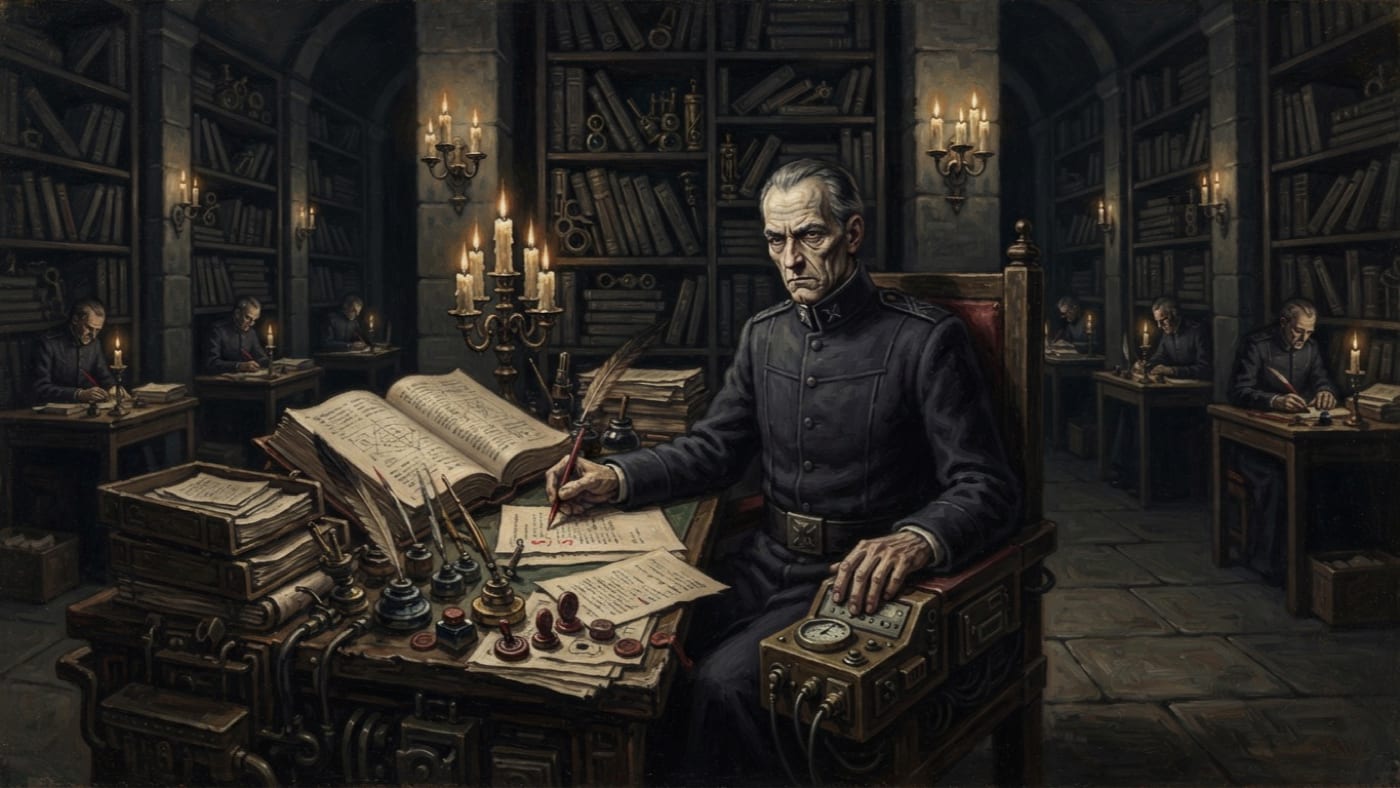
The Liturgist-Primus heads the Bureau of Rites and occupies the Chair of Prescribed Observance. The title belongs to the Chair. The man in it at present is Corvin Marche. A reader who confuses the two will be corrected, as I have been, in writing.
The office has no regiment of its own and keeps no granary. Its reach is narrow and total. It fixes the shape of the act: on which day a feast falls, how long a knee may rest on stone, which words a priest may say over bread and in what order he must say them. Every other organ of the Synod performs. The Chair decides what counts as a performance. In the Bureau's vocabulary, a campaign launched on an uncertified date is a march. A judicial oath sworn outside the certified form is a remark.
The Bureau calls itself the grammar of the Synod, and I have repeated the phrase in print. It is a large claim. It does not follow that the Liturgist-Primus outranks a Hierarch, a Cardinal or the head of any other Bureau, and I know of no instrument that says he does. He has never needed one. Rank matters little to a man who may return the sentences of his superiors.
#On the Instruments of Office
Three things are routinely confused, usually by persons who have never had to carry them.
The first is the Charter of Prescribed Observance. It has six hundred and fourteen articles and was ratified in A.S. 58 under the seal of Augustinus, with the countersignature of Kratz in a hand that history has kindly called enthusiastic. It was an act of the emerging Church authority. It came three years after the Common Allegiance and more than three decades before the Concordat of Strasbourg gave the Synod its formal constitution. The Charter is law. It is not the Codex, and the year it was ratified is not the year the Chair was founded.
The second is the Codex Liturgiae, the master reference for every authorized rite: eleven volumes and thirty-seven supplementary annexes. The Charter says that form binds. The Codex says what the form is.
The third is the inherited archive behind both. It holds superseded rubrics, condemned antiphons and local usages, each annotated. The Liturgist-Primus is its custodian, which is a polite word for its only complete reader.
Beneath him sit seventeen Sub-Priors of Form, in adjacent cells of identical arrangement. They do not converse. They exchange written ritual queries formatted under Bureau Standard 7-C, revised in A.S. 187. These are the arrangements of the present administration. The records I have seen do not say whether earlier holders kept seventeen Sub-Priors, or seven, or a single frightened deacon.
#On the Measure of Worship
The Bureau prescribes in seven fields: the Sacramental Calendar, the Codex of Gesture, the Canonical Texts, the Fasting Protocols, Penance, the Consecration Protocols and Supernatural Classification. The Chair answers for all seven. That does not mean Marche counts every fast or stamps every oath himself. It means that when a ruling is challenged, the challenge ends at his desk.
Take the genuflection. The knee touches the stone for no fewer than four seconds and no more than nine. An infirm worshipper may be granted eleven, provided the dispensation is documented in triplicate. Ten seconds without paper is an offence. Eleven with paper is devotion. The difference is a form, and the Chair issues the form.
The same arithmetic reaches the other Bureaus. The Bureau of War may plan any campaign it likes, but it may launch one only on a date Rites has certified as liturgically permissible. The Bureau of Bells operates the peal system and answers for the Bell Codex, ratified in A.S. 115. It may not alter a peal schedule without the countersignature of Rites. The Bureau of Purity cannot conduct a trial until Rites has certified the oaths of its judges. Bells keeps the hours, War spends the men and Purity tends the pyre. Rites tells all three when, and in what words.
#On the Occupants and Their Precedents
By the Bureau's reckoning, the longest tenure belongs to Aldric the Unbending, who held the Chair for thirty-one years. The Bureau says he was found dead at his desk with his quill still moving, and that the sentence he was completing was grammatically perfect when his hand finally stilled. I give the account as the Bureau gives it. I do not have the sentence, the dates of his tenure or any record of what killed him. I am not inclined to ask the Bureau of Medicine for an opinion that the Bureau of Rites would then have to classify.
Four occupants before Marche, a Liturgist-Primus whose name my sources do not supply settled the dispute over two fingers and three. The quarrel had consumed three years of Bureau labour and caused a schism that lasted a generation. The settlement prescribed three fingers for cathedral rites and two for field worship. It also produced a manual of exceptions three hundred pages long. The Bureau maintains that it never compromises. I record the three hundred pages without comment.
Then comes Marche: nineteen years in the Chair as of A.S. 201, a tenure exceeded only by Aldric's. He has memorized every rite in the Codex Liturgiae. He has also memorized the fourteen rites suppressed after the Schism of Avignon and three more whose suppression nobody troubled to explain. If pressed, he will recite them in a voice without emphasis. When I remarked that one could not tell whether he was demonstrating or performing, he answered: "There is no ambiguity. Recitation and performance are identical. The rite does not require your belief; it requires your compliance."
That is his doctrine of the rite. It is no evidence that he has ever enacted one of the seventeen, or that anything followed if he did. A memory of this order is his own accomplishment, not a requirement of the office. The next holder may have to look things up, like the rest of us.
#On the Consequences of Exactness
In A.S. 167, a Liturgist-Primus whom the record does not name moved the Feast of Saint Verena forward by two days. The Bureau of Tithes lost eight thousand Crowns in miscalculated harvest levies. The Bureau of War's spring offensive reached Bastion-Przemyśl forty-eight hours early and found no supplies and a garrison that had not been told. The calendar was correct.
That cost can be counted in Crowns and hours. The other cost is counted in tongues.
Devotional debt is the Bureau's name for what grace takes from the obedient. Every fast, tithe, service and vow draws against the soul, and the Bureau records the symptoms as carefully as an apothecary. With dulled taste, bread turns to ash on the tongue. With insomnia hymns, phantom bells ring in the ears at night. With brittle joy, laughter breaks like glass in the throat. Some communities fall so far into arrears that whole districts walk about gray-faced, unable to enjoy their rations. The Bureau keeps these districts on file. It does not explain why grace should carry a price, and neither will I.
I once asked Marche whether such debt could be forgiven. He considered the question for nine seconds. I counted, and nine is within the prescribed range. Then he said: "Debt is the structure of grace. To forgive the debt is to collapse the structure. The Bureau does not forgive. The Bureau balances."
The Chair cannot give a parish back its sense of taste. What it can do is schedule the parish's fasts, set its feasts, grade its arrears and certify, to the second, that everything the parish did before bread turned to ash was done correctly.
#On the Present Incumbency
Marche works from a chamber in the Strasbourg Cloister that has not been redecorated since A.S. 72. It holds a desk, a chair, an unoccupied cross and the Codex Liturgiae. It has no window. Marche excludes daylight as "an unregulated illumination source inconsistent with the prescribed candle-schedule." The candles burn on schedule.
From that room, the Chair has examined my work more thoroughly than any Inquisitor. Its seven-page correction of one of my Codex entries, annotated against four Councils and a commentary I had misquoted by a single syllable, reached my desk within the hour. My entry on his Bureau was returned twice: first for insufficient citation of canonical precedent, then for improper use of the subjunctive in a declarative liturgical context. My third attempt came back marked "Adequate. Narrowly."
This Codex has stated that Liturgist-Primus Marche "does not correspond with anyone."
The statement was too absolute. This office's own files hold a returned letter, a seven-page correction and two rejected drafts, all from the Chair. The Liturgist-Primus corresponds. He does it the way a red pen does.
I have checked the subjunctives in this entry four times. In the meantime, the candles in Marche's room have burned exactly as long as they were told to.