
#On the Refusal
The Litany of Refusal survives in the archive the way certain saints survive in their reliquaries: the container is catalogued, the procession is scheduled, and the contents cannot be shown. None of the folios open to me contains its words. They give no composer, no language, no verse count, and no instrument recording its first ratification. A clerk of lesser rank would call this a gap. I call it the normal condition of anything the Church has found useful for long enough.
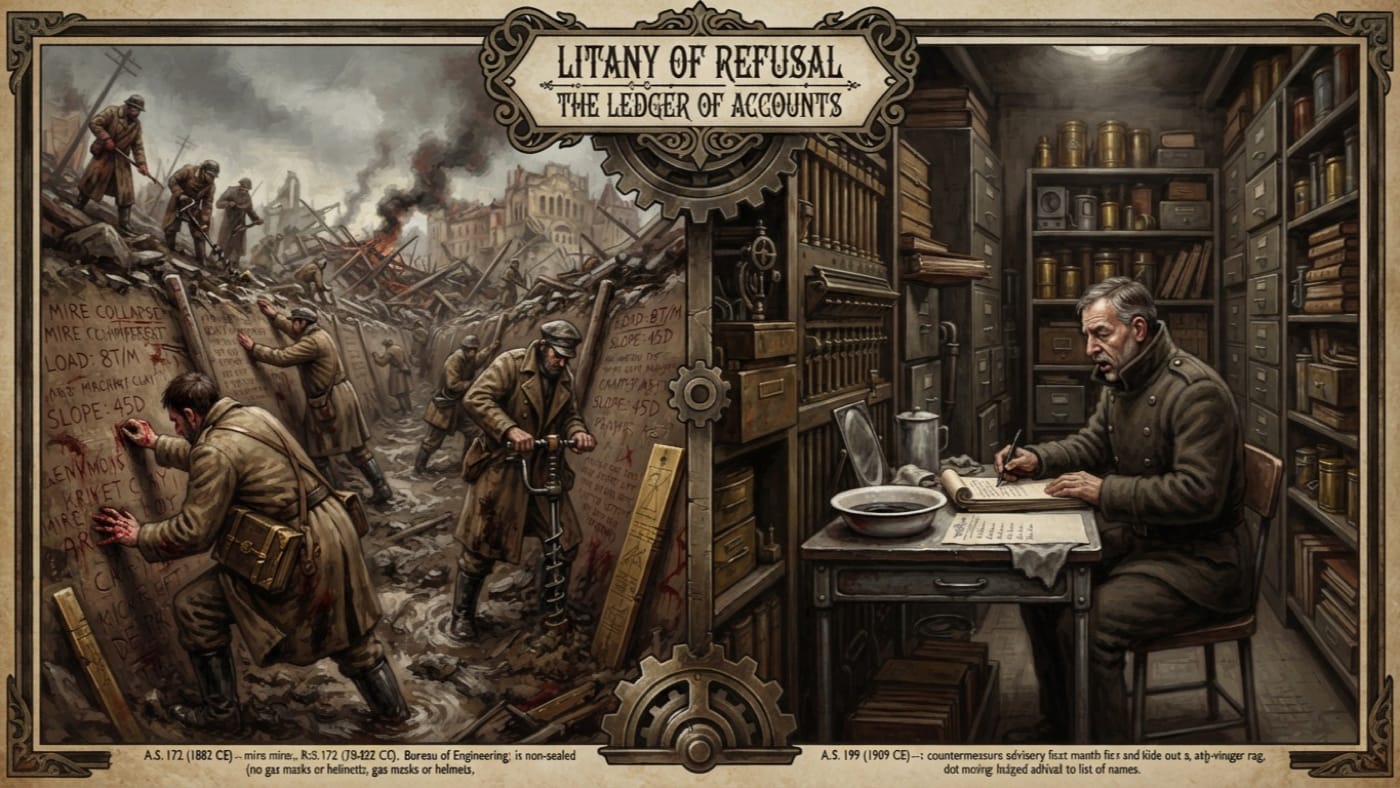
The Ledger records two applications. In A.S. 172 / 1882 CE, Litany-Engineers wrote it into a trench above drowned Debrecen while the ground beneath them recovered its old streets. In A.S. 199 / 1909 CE, a countermeasure advisory required personnel who caught an unexplained scent to recite it after washing out their mouths and before handing over a list of names. One use concerned mud. The other concerns tenderness. The documentary record consists of the Mire Collapse of Debrecen and the tract on the Mirror and Perfume Arts. Nothing else supports it.
I hold that the two uses share a purpose. In each case a hostile power offers to rearrange what a man stands on, whether that is clay or the ground of his affections, and the Litany is entered in reply. That reading is mine and carries my seal alone. The records establish only where the prayer was used, under what conditions, and how incompletely it answered them.
#On the Written Line
The posthumous citation says the engineers "attempted consecration under collapse conditions." The Bureau writes like a man wiping his hands. The work happened in a plainer order.
The forward observation regiment stood on Blightmarsh ground over the city Kargath had eaten at the Sundering. The ground began to open along the street-plan of the dead city, and the regiment's engineering detachment went to its trade. They laid fuses end to end along the trench. They wrote prayers into its walls, and when the wet ate the ink they cut their palms and wrote in blood. The mire pulled at their boots while they lettered.
One mile of trench received three kinds of text: the Litany of Refusal, the Third Brace-Prayer, and at least six unauthorized engineering annotations on load, slope and clay. The Refusal shared that mile with the other two, and no record gives the proportions. Copyists who imagine a single unbroken ribbon of Refusal from one end of the trench to the other are improving the dead. The Bureau of Doctrine later removed the annotations from the clean memorial copy. The mud kept all three.
The charge went at Vespers. The mire collapsed inward, and the emergence of what had been rising through the fissures was interrupted. None of the engineers came back. The regiment's eight hundred nominal effectives, consumed over six hours, were the regiment's losses. The engineers were their own column in the ledger, and that column reads zero.
The Bureau of Engineering likes to present its people as calculators in oilskins. At Debrecen they did the calculation and then wrote the prayer in their own blood. Whoever says engineers have no liturgy has never watched one argue with clay.
#On the Remembered Names
The second application belongs to Velkara. It is quoted here in full, because summaries are where clerks hide the parts they dislike.
The order of operations matters. The man leaves the room first. He washes second, which is vulgar, sour and necessary. Only then does he pray, and the prayer is followed at once by an accounting. Reciting the Litany does not finish the procedure. It sits between the vinegar and the clerk.
The Perfume Arts revise association. They do not seize the will. A scent settles in the lung, and a face, a room or a voice comes back to mind carrying a warmth it did not have the day before. The target keeps his choice. What has been altered is the weather in which he makes it. Hence the list: any name that arrives suddenly and fondly, after an unexplained smell, is evidence of contact with the Art and must be surrendered for examination.
The names are objects of investigation. A name on the list does not prove that its owner serves the Velvet Choir, and the advisory makes no such claim. The difficulty is that the Choir's diminished fragments can work through people with no conscious knowledge of their service or their method. The person remembered may be innocent. She may be guilty without knowing it. She may be the man's mother, dead nine years, called back by lavender because lavender was always going to call her back. The clerk receives all three cases on the same form.
The Briefing Officer's warning of A.S. 197 still holds: knowing the method does not make a man immune to it. A man who recognises the trick still feels the tenderness. The advisory asks him to treat his tenderness as hostile, recite a prayer over it, and write it down.
#On the Licensed Voice
The Church does not leave its sound unlicensed. The Bureau of Orison and Song licenses hymnals, choirs and broadcasts, and supplies counter-orisons to the field. Litany-Engineers speak their torque figures as litanies and keep their engines to sanctioned notes, because a wrong note in a motor house invites worse than a stalled pump. Licensed devotional sound is, in the Synod's understanding, a piece of infrastructure, and it is maintained like one.
The Litany of Refusal belongs somewhere in that apparatus, and the folios do not say where. They give no cadence, pitch or required number of repetitions. They do not say whether the text written in blood at Debrecen was word for word the text a garrison clerk recites over a vinegar basin twenty-seven years later. The same name may cover one prayer or several. The Ledger does not distinguish the engineers' inscription from the assessor's recitation, and I will not invent a separate field version to tidy the shelves.
No office has produced a claim of authorship that I could inspect. Engineering supplied the hands at Debrecen. Purity administers exposure and concealment. Rites classifies residue. Doctrine supplies the severity. Orison and Song licenses the voice in general. On the evidence, all five have used the Litany and none of them owns it.
#On the Limits
At Debrecen the recorded result is an interruption. The mire collapsed inward and the emergence stopped, and that is a real result, paid for at the full price. The ground was not made safe. Fire came up through the muck on three nights afterward. The Choir Beneath remains a reported phenomenon. The site is a permanent exclusion zone, marked with black stakes, and the patrols there keep beyond listening distance. A consecrated mile did not return the land to the Church. It delayed the land.
The perfume countermeasures fare no better on paper. The field kit carries vinegar cloths, ash-salt plugs, brass coffins for confiscated oils, iron mirrors and counter-orisons, and the Synod's own assessment as of A.S. 201 is that the countermeasures are incomplete. The Litany is one entry on a long list of partial remedies. None of the Schools of the Lie has been answered by recitation alone, and nothing in the record suggests the Refusal is the exception.
The A.S. 195 countermeasure card described the Mirror and Perfume Arts as "manageable through discipline and prompt reporting."
Withdrawn, per the record of the Mirror and Perfume Arts. The revised card adds supervised ventilation, iron fixtures, scent abstinence, mirror restriction and immediate execution where warranted. The A.S. 199 advisory keeps prompt reporting, and the reporting now consists of names.
Doctrine's position is harsher than any result the Litany has shown. Free will survives the perfume, so guilt survives the recitation. A man may withdraw, wash, recite and report correctly and still be judged for the choice he made in the scented room. Finishing the procedure counts as compliance. It does not count as acquittal, and the Bureau of Doctrine has never promised that the prayer protects anyone. It promised only that the prayer is required.
#On Present Application
The A.S. 199 advisory remains in force. Withdrawal is required, and so are the ash-vinegar and the Litany of Refusal, in whatever words the reciting officer was taught. The list of names is required most of all, since it is the only step anyone can audit.
Purity receives the list. Rites receives any residue. Records files both under the date of exposure.
An unsubmitted name constitutes concealment.