
#On the Attestation
One sentence in one account. The Codex has built cathedrals on less, and most of them leak.
The Litany Against Echoes appears in the record exactly once. It is in the account of the Black Census of Metz, during the demolition of an enemy bastion at the eastern Metz position in A.S. 144 (1854 CE). That year is the year of the attestation, when a named recital was heard and written down beside a screaming wall. It is no composition date, no first issue and no ratification. Any clerk who copies it into a field marked "Promulgated" will answer to me in his own ink.
The entry is short. One Inquisitor recited the Litany Against Echoes and missed three lines. That is the whole textual tradition so far as the Codex holds it: a title, a performer without a name, and a defect.
The title sounds like a promise. Against Echoes. Readers who like armour will hear a shield in it. A parish printer with a deadline will hear a pamphlet. The account supplies neither. A name tells you what a prayer is called. What it does belongs in another file, and this notice keeps the two apart the way a lictor separates brawling deacons.
#On the Wall at Metz
The demolition needs a little context, and the context is unpleasant.
Four hundred and eleven captured Thralls had been chained for census after the bastion fell. An Inquisitor noticed their teeth. The Bureau of Medicine traced the regiment, by methods better left in sealed appendices, to a single Ash-Mother. She had been dead for decades, and her descendants numbered in the thousands. The Lore Book records the same finding more plainly: one mother, an entire regiment, and her ashes mixed into the mortar of the enemy's bastion.
The engineers' samples confirmed it. The wall was made of her.
A preliminary Bureau of War abstract described the Metz structure as an "enemy bastion reinforced with ash."
Corrected, as in the parent account. The bastion was dependent upon her remains. A notice about a recital beside that wall must describe the wall correctly or say nothing.
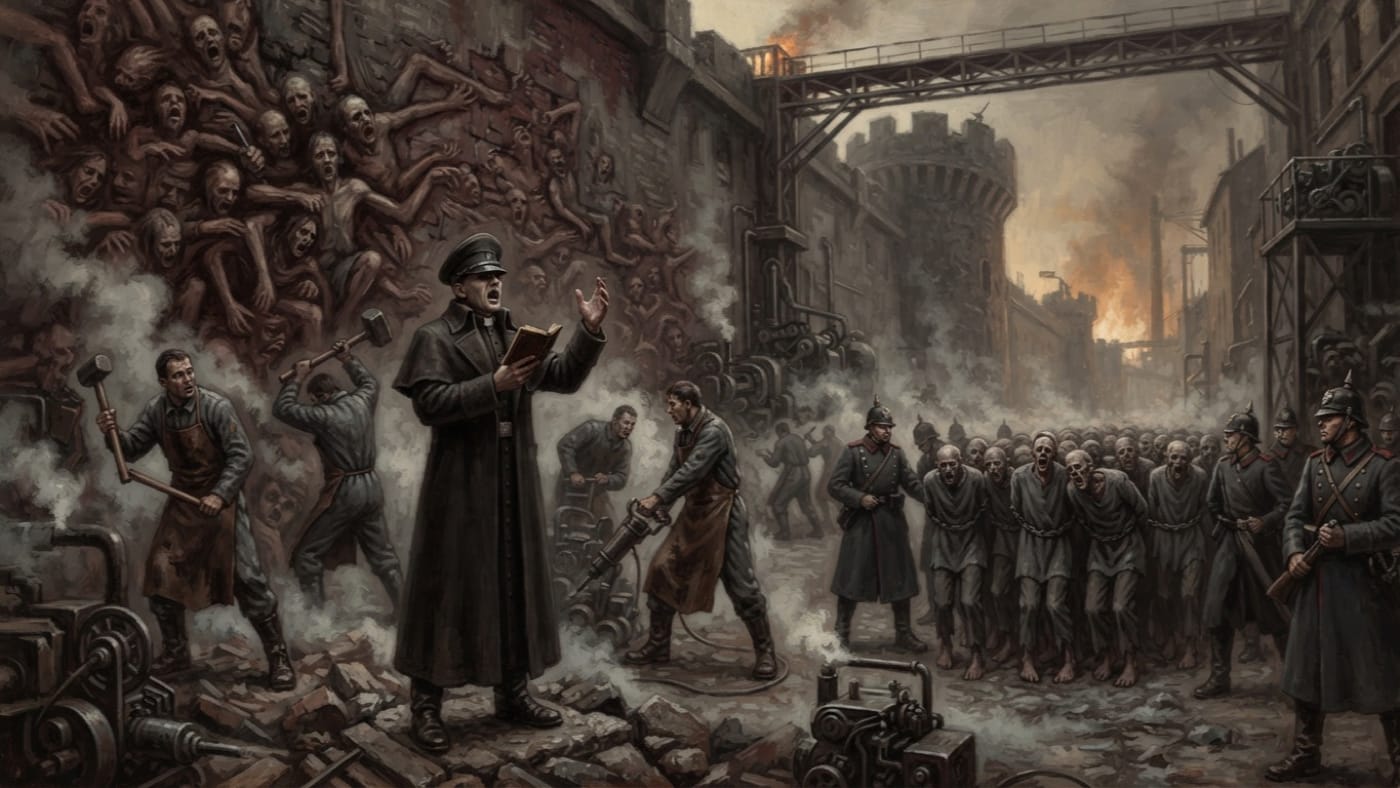
The Inquisitors ordered it pulled down. Purity allowed six hours. War wanted it sooner, Medicine wanted samples, and Doctrine approved demolition with sample retention. The offices quarrelled about everything else, but none of them disputed that the stones had to come down. Nor did anyone doubt that the men swinging the hammers would be standing very close to a woman.
That is the setting. The rest of the Ash-Mother's story belongs to the parent article, which has earned its length: the counting, the classification that followed, the vaults. This notice carries less.
#On the Three Missed Lines
The account gives the sequence in a few strokes. Hammers struck at first compline. The wall screamed. The sound began in the mortar seams and passed through stone. Men dropped tools. One Inquisitor recited the Litany Against Echoes and missed three lines.
Compline gives the liturgical hour of the first strike. It gives nothing of the month, the day or the clock, and it was never meant to. The Church keeps its hours for prayer. The record borrowed one to mark when the iron touched the wall.
What the record holds, then, is a performance. A man stood near a wall that was making a noise no wall should make, and he spoke a text he knew by name. This proves three things. The Litany existed in some form by A.S. 144. At least one Inquisitor had it by heart. And the one man whose choice we know thought it fit for that moment. It does not give us the text. A witness who writes "he recited the Creed" has given us the Creed's title and the evidence of his own ears. He has not copied out the Creed.
The three missed lines belong to that one recital. The account does not say which three, where they fell, whether they were consecutive, what they concerned or why they were lost. Fear explains a great many lapses. So do dust, noise, poor schooling, a tight throat, and the ordinary failure of a tired man in a bad place. The Codex chooses none of these, because the record chooses none.
The count does not tell us how long the Litany was, either. Missing three lines out of thirty is a stumble. Missing three out of five is close to saying a different prayer. We do not know which of those the man did.
#On the Silence of the Captives
The next sentence of the account is the one that tempts commentators. The captured Thralls, chained fifty yards away, opened their mouths together and made no sound at all. Their silence, the account says, was worse. It had discipline.
Put side by side, the recital and the silence look like cause and effect. A prayer against echoes is spoken, four hundred and eleven mouths open, and nothing comes out. A pamphleteer would have it in print by vespers.
The record will not bear that reading. The account puts the two events in the same moment and the same paragraph. It never says the silence followed the Litany, began with it, ended when the man stumbled, or responded to it at all. The Thralls were descended from the woman in the wall, and the wall had begun screaming before anyone prayed. Either fact supports a theory as well as the Litany does, and the account endorses no theory.
The Lore Book describes Thrall silence in general as the silence of obedience, an absence where faith should be. The parent account calls this particular silence disciplined. Those are two descriptions written for two purposes. Neither was written to measure a prayer.
Then the demolition went on. The screaming grew louder when the western face was breached, so whatever the Litany did or failed to do, the wall kept sounding. That proves no failure either. Nobody placed a second man, without a prayer, at the far end of the wall for comparison. The Bureau cannot judge what it never counted.
#On the Limits of the Record
This notice is filed under doctrine, and some readers will mistake the shelf for a seal. Filing a litany among doctrines records that the Church prays it. It says nothing about who wrote it or issued it. It does not say whether any office authorised it for the field, or whether its rubric survives in any cabinet the Bureau of Records can open. The account answers none of these questions, and a man reciting from memory proves no printed edition.
The Codex can record the following with full authority. A prayer called the Litany Against Echoes existed by A.S. 144. One Inquisitor spoke it at Metz as the first hammers struck an enemy wall built from a dead woman's ashes. He left out three lines. The captives went silent at the same time, and the wall kept screaming.
Most prayers get far less. Thousands of litanies have been said in the trenches without a single clerk writing down their names. This one was named because the man saying it stood beside something the Synod would spend years trying to classify. Someone noticed what he said and where he faltered, and wrote down both.
Every office of the Synod has an officer who reads "it was done" as "it worked." I have countersigned for such men before. This entry they will not get.