
Sources are read and the cross-link routes are checked. Here is the article:
#On the Book at the Examination Table
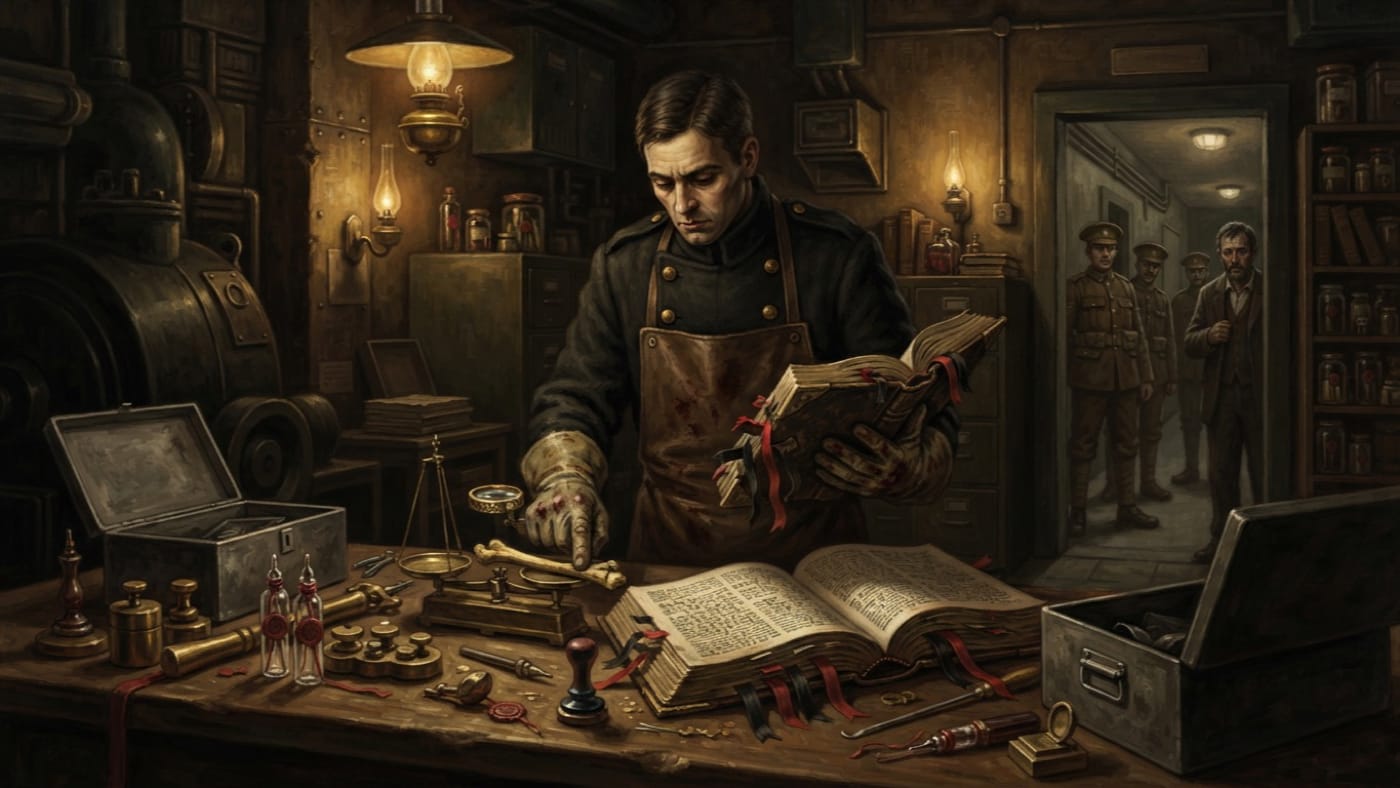
The bench is laid out the way the Bureau of Relics wants it. First come the brass scales, calibrated monthly by the Bureau of Engineering. Then the reagents, sealed in wax ampules, each pressed with the Bureau's counterseal. Then gloves, a magnifier, a seal press, and a lead-lined box with its lid already open, which is the Bureau's idea of candour. The room smells of wax, old bone and metal polish. Beside all this lies a prayer book, and the prayer book is the subject of this entry.
The Liber Examinationis is carried by the Examiner of the Third Degree, the officer who decides whether a bone in a parish reliquary is a saint or a confiscation. Its cross-references are so dense that the Bureau of Mercy has classified reading it as a Category Two Devotional Strain. That is the whole of its published description. I record the book as the Bureau's institutional survey of A.S. 201 (1911 CE) finds it: in use, on working benches, in working hands.
Its compiler, first issue, editions, binding and page count are all in files this Codex has not been shown. I have invented none of them. The Hieromnemon does not pad a ledger.
#On the Reader and the Writ
The Examiner is trained in osteology, liturgical history and chemical analysis. That schooling lets one person name a vertebra, date a rubric and smell a lead salt through a glove. The Examiner inspects the relic in person. Nobody asks the relic whether it wants the appointment.
The book is opened because somebody has asked for a verdict. A shrine, parish, cathedral or military chaplaincy that wants to display, transport or invoke a relic files an Authenticity Writ. The Writ must contain four things. The first is a provenance chain, unbroken, witnessed and notarized at every transfer. The second is a physical description of the object. The third is a theological justification citing at least two canonical sources and one reference from the Bureau of Doctrine. The fourth is a filing fee in Crowns of Grace. The Bureau of Tithes collects the fee on the Bureau of Relics' behalf, and the Bureau of Relics says it has never received it in full.
Those are the Writ's requirements. No record available to me says whether the Liber repeats them, comments on them, or rises above them into purer devotion. I will not have readers quoting chapters that may not exist.
The people waiting outside the examination room care little for any of it. A parish has knelt before the same bone for as long as its oldest members can remember. A chaplain has promised a company that the finger-bone in its trench niche is genuine. The Examiner reads, weighs and decides. Whatever the verdict, the parish's devotion and the soldier's nerve are entered in the ledger with it.
#On Prayer and Proof
The Examiner may test a relic by touch, by weight, by holding a flame near it, and by immersing it in consecrated water. In disputed cases the Examiner prays in the relic's presence and records any heat, light or sound that follows: warmth under the glove, a glow at the edge of the bone, a ringing where no bell has been struck. This is where the prayer book earns its place on the bench. The record does not say which prayers are read, in what order or for how long, and the Codex respects a silence it cannot unseal.
The Bureau holds two positions. A relic that produces phenomena passes. A relic that produces none may still pass, provided the provenance chain is unbroken and the fee has been received. The governing axiom covers both cases: a relic authenticated is a relic made holy. That is the Bureau of Relics' ruling. The Codex records the doctrine and does not hold a magnifier to it.
The trade knows something less comfortable. Authenticators say, "If it glows, it isn't clean," meaning that a response proves only that something responded. Malign things answer prayer too. An Examiner who takes every warmth for sanctity has mistaken a thermometer for a catechism.
So a perfect chain and a silent bone can lie on the same bench, and both can be satisfactory. The verdict comes from the file.
A relic that fails is confiscated. Confiscated relics pass into permanent Bureau custody, which the Bureau calls "retirement from service." Some are retired to the Vault of Sacred Custody beneath the close of Strasbourg Cathedral. Under the Saint-Bone Melting Acts, some fragments of insufficient provenance are retired into lime for mortar. Not every rejected bone goes to the kiln. Enough do that I no longer lean on the walls of Strasbourg.
#On the Devotional Strain
Category Two. The term is Mercy's, and Mercy has published nothing more: no symptoms, no treatment, no date of classification. It has said nothing about Category One, or about what a reader must survive to reach Category Three. I asked. Mercy replied that my inquiry had been logged.
Consider an Examiner's ordinary afternoon. An Examiner of the Third Degree tests a relic of the First Class while reading a book that Mercy rates a Category Two strain. That is three numbering systems, three Bureaus and one bone. The Third Degree is the Examiner's rank. The First Class is the relic's grade. Category Two is Mercy's rating of what the reading does to the reader. Mix them up in a filing and the Bureau of Records will send it back unread, with a fourth number of its own.
The cross-references are the cause the record names. A devotion that sends its reader somewhere else every second line is a devotion said on foot. The Examiner prays, turns pages, prays again and turns more pages, with a gloved thumb in one place and the eye already in the next. Mercy does not say whether the strain falls on the knees, the wrists or the soul. Mercy is a Bureau and sees no need to be specific.
#On Contradictory Authentications
During the Reliquary Schisms, roughly A.S. 140–160 (1850–1870 CE), the cathedrals of Cologne collected seventeen femurs attributed to Saint Aldebrand. Each one was notarized. Each arrived with an unbroken provenance chain. Each was authenticated by a different Examiner of the Third Degree, working with scales on the bench and a prayer book within reach. By the most generous anatomical reading, Saint Aldebrand had two.
The Fourteenth Doctrinal Congress settled the matter in A.S. 147 (1857 CE) with a principle: all femurs are authentic if notarized. The Femur Principle ended a dispute that had cost bishops their lives. It did so by making the number of femurs a theological question.
The consequence is plain enough. Once the chain is clean and the seal is dry, the Examiner's verdict outranks the skeleton. I find no record that the Liber was revised after the Principle, and none that anyone consulted it during the argument. I find almost no record of the Liber at all, which in the Bureau of Relics is true of most things worth reading.
The Principle governs the archive, but the Examiner still answers for each verdict at the bench. No later doctrine can return the tibia taken at Ulm, and no anatomist can uncertify a femur in Cologne. The Bureau now authenticates eleven relics a year. Its Examiners have learned the price of a signature.
#On Service Along the Line
Since A.S. 180 (1890 CE), counterfeit relics sent by Velmora have reached the southern Sagittal Line in documented incidents. A counterfeit does more than fail. It performs counter-miracles on the faith of whoever invokes it. The chaplains who witnessed this described it in language the Bureau of Doctrine has sealed.
The Bureau's answer was the Counter-Relic Examiners. They carry sanctified reagents, prayer-resonance rods and the Candle Proof. By the Bureau's working account, a genuine relic draws the taper's flame toward it, and a counterfeit drives the flame away. I have seen no roster confirming whether every specialist on the Line also carries the Liber. The candle needs no cross-references.
Every frontline relic is also re-authenticated each week. That is a separate, recurring job, and it has nothing in common with the eleven verdicts a year issued in Strasbourg.
Standing Order 88-R, issued in A.S. 182 (1892 CE), required all frontline relics to be re-authenticated monthly.
The correct frequency is weekly. The Bureau made this correction to its own Standing Order within the same season. No matching amendment to the Liber Examinationis is recorded, and the Codex does not supply one.
Certification does not guarantee performance. In A.S. 191 (1901 CE) the Bureau of War authorized a Vigil Ark for Constantinople, the Line's southern anchor. It was to be consecrated under Saint Uriel, using a tooth the Bureau of Relics had authenticated. The Ark failed to rise on four attempts. The tooth remains authenticated, and the cause of the failure remains under review.
In a forward chapel, the bench is whatever the chaplain can clear. The scales go down first, then the ampules in their wax, then the book. A finger-bone waits in its niche-box. Behind the Examiner, a company stands in the doorway with helmets off and opinions withheld. The Examiner opens the Liber at a page that refers the reader to another page, and begins.