
#On the Examiner's Authority
"A relic authenticated is a relic made holy." — Standing axiom of the Bureau of Relics
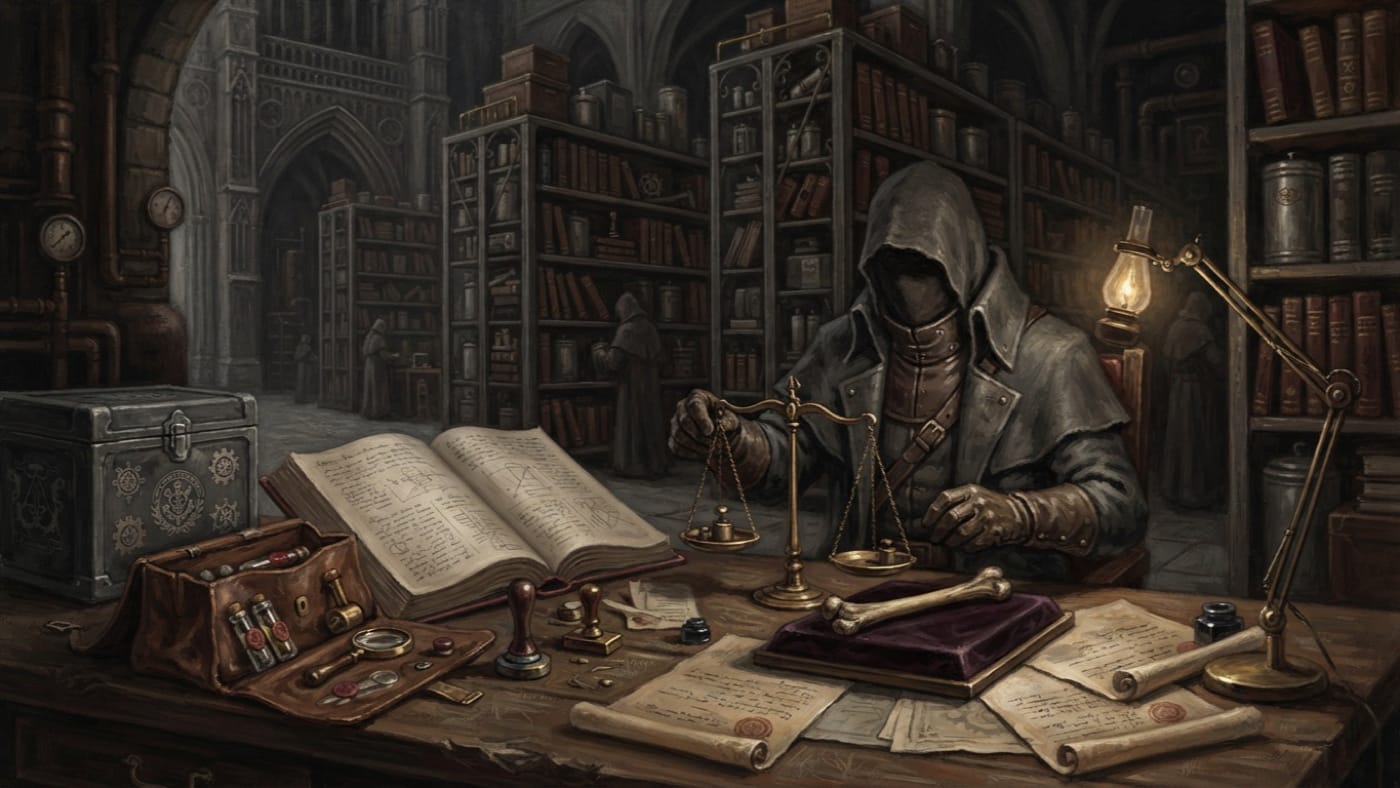
A bone leaves a parish in one of two conditions. It leaves sealed in red wax and certified for procession, or it leaves in a lead-lined box, and a receipt is left on the altar rail. An Examiner of the Third Degree decides which, using brass scales, a book and a signature.
The office belongs to the Bureau of Relics. Of the Bureau's four mandates (custody, authentication, classification and distribution), the Examiner carries the second out of the vaults beneath Strasbourg Cathedral and exercises it in person, in front of the people who will have to live with the result. Many hold the title. The Bureau's files do not record when the Third Degree was created or what its number counts. They record only that an Examiner of the Third Degree signed, and that the signature held. Within the wider trade of the Relic Authenticator, the Examiner stands in the middle ranks. Lamp hands and registry scribes are below, and the notaries who countersign are above.
Petitioners confuse one distinction every week, so it must be fixed at the outset. The Third Degree belongs to the Examiner. The Third Class belongs to the earth, water, oil and ash gathered from consecrated sites of confirmed miraculous activity. An Examiner of the Third Degree may sit in judgment on a saint's skull. A spoonful of Third-Class ash sits in judgment on no one.
#On the Writ and the Instruments
The Examiner does not go looking for work. Work arrives as an Authenticity Writ, filed by a shrine, a parish, a cathedral or a military chaplaincy that wishes to display a relic, transport it, or invoke it in service. The petition must carry four things. The first is a chain of custody that is unbroken, witnessed and notarized at every transfer since the bone stopped being a person. The second is a description giving the material, the weight, the dimensions and the saint to whom the object is attributed. The third is a justification citing at least two canonical sources and one reference from the Bureau of Doctrine. The fourth is a fee in Crowns of Grace. The Bureau of Tithes collects it on the Bureau of Relics' behalf, and the Bureau of Relics maintains that it has never received the fee in full.
The Writ asks the question. The Examiner's notarized verdict answers it in the form of a Sanctity Writ. The shrine will frame that certificate, copy it and show it to every visiting inspector until the paper turns brown.
The Bureau requires every object to be inspected in person, so the Examiner travels. Training covers osteology, liturgical history and chemical analysis. The satchel holds the rest. It contains brass scales, calibrated monthly by the Bureau of Engineering. It contains reagents sealed in wax ampules, each stamped with the Bureau's counterseal and opened only in the relic's presence. It contains the Liber Examinationis, a prayer book so dense with cross-references that the Bureau of Mercy classifies reading it as a Category Two Devotional Strain. The trade adds gloves, magnifiers, a seal press, a custody book whose pages are numbered against theft, and a lead-lined box. The box comes on every visit and is unpacked on most of them.
#On Judgment and Removal
An examination follows a sequence, but no fixed liturgy, and the Bureau has never agreed on how many steps it has. The lead box is opened before the reliquary, because a bone that answers badly must have somewhere to go. The trade's rule is to test the story before the object, so the chain of custody is read next, link by link, and every notary's hand is compared against the registry. Then the bone itself is examined. The Examiner touches it through the glove, weighs it and measures it against the dimensions the parish swore to. If the parish swore carelessly, the inspection ends there. Then comes doctrine: whether the attribution fits a saint the Church acknowledges, in a place that saint could plausibly have shed a tibia.
Only then is the object tested. The Examiner brings a flame close to it, immerses it in consecrated water, and, in disputed cases, prays in its presence while noting any heat, light or sound that follows. The Bureau's position is that a relic which produces phenomena passes. A relic that produces nothing may pass as well, provided the chain of custody is unbroken and the fee has been received. The trade itself is less cheerful than the Bureau about anything that glows, and it has kept a proverb older than any Standing Order: If it glows, it isn't clean.
The verdict assigns two things, and they are entered in two separate columns of the form. The first is class. First Class covers the bodily remains of canonized saints, Second Class covers objects associated with them, and Third Class covers the site-earth and site-ash already described. The second is grade: Ward-safe, Votive, Contaminant or Fraud. Class records what the object is said to be. Grade records what may safely be done with it. Neither column answers the other.
When the verdict goes against the object, it is confiscated. Confiscated relics pass into the Bureau's permanent custody and are never returned. The official phrase is retired from service. Retirement can mean a numbered casket in the Vault of Sacred Custody. For eligible fragments of insufficient provenance, it can mean rendering into lime for mortar under the Saint-Bone Melting Acts. Others operate the kilns. The Examiner signs, and the box leaves.
Near Ulm, I watched an Examiner declare a tibia "doctrinally insufficient." The parish priest wept, and so did the congregation. The Examiner completed the form. The tibia left in a lead-lined box, and the parish received a receipt. I have the receipt's wording by heart. It is correct in every particular.
#On Contradictory Bones
The Examiner's procedure has failed in only one way that the Bureau acknowledges: it succeeded too many times.
During the Reliquary Schisms, roughly A.S. 140 to 160, the networks of the Cellar Saints released relics their keepers had hidden through the Rationalist darkness. Their custody chains were immaculate, their wax was genuine, and their prayer-marks matched. The cathedrals of Cologne accumulated seventeen femurs of Saint Aldebrand. Each was notarized, each had an unbroken chain, and each was authenticated by a different Examiner of the Third Degree. None of those seventeen Examiners erred. Every one weighed, measured, read the chain and signed exactly as the Liber instructs. Their verdicts were individually sound, and together they described a saint who would have needed nine legs to stand.
The Fourteenth Doctrinal Congress settled the matter in A.S. 147 by ratifying what became known as the Femur Principle: all femurs are authentic if notarized. The Bureau of Records was afterward made co-custodian of every provenance chain. In practice this means an Examiner now reads each link under the eye of a second Bureau, which keeps its own copy and its own opinion.
The Bureau of Relics now authenticates eleven relics per annum. That is the Bureau's figure, for the Bureau as a whole. It says nothing about any one Examiner's output, and it does not count the re-examination of stock already sealed, which never stops.
#On Service Along the Line
Examiners serve on the Sagittal Line as well as behind it. The forward work centres on the taper. In the Candle Proof, a lit candle is held beside the relic. According to the Bureau's published working interpretation, the flame leans toward a relic of genuine provenance and draws back from a counterfeit. Soldiers in a southern trench chapel will watch a grey-robed functionary hold a candle beside a finger-bone in total silence, because the direction of that flame decides what will be in the niche when the shelling starts.
The flame matters because counterfeits come across the Line. Velmora, whose host presses Bastion-Sibiu, sends them. They do not come by assault. They come through dealers, bribed convoys, purchased patrons and contracts that no one read closely. A counterfeit relic does more than fail. Its counter-miracles sour the faith of everyone within earshot of its invocation. The Bureau documents three counterfeit relics that have reached frontline chaplains since A.S. 180. Each passed through human hands that were paid to pass it, and each was paid for in good coin.
For that reason the Bureau maintains Counter-Relic Examiners, a specialist cadre posted to every bastion south of Przemyśl and down to Constantinople. They carry sanctified reagent sets and prayer-resonance rods tuned to sorcerous contamination in bone. Not every Examiner of the Third Degree belongs to that cadre. Every Examiner of the Third Degree on the southern Line has held the taper.
Three different schedules govern this work. Custodians in armoured waggons rotate the trench-niche finger-bones once a quarter. Frontline relic stock is re-authenticated once a week. The Examiner aboard the Flotilla reports to Strasbourg once a quarter. Each schedule has a different ledger and a different set of people to blame.
Standing Order 88-R (A.S. 182) directed that all frontline relics be re-authenticated monthly.
The correct frequency is weekly. The original directive said monthly, and the Order was revised within the season. Three chaplains and one prayer-company learned the difference between the two frequencies in terms the Bureau does not reproduce.
The Bureau keeps one Examiner permanently aboard the Black Sea Reliquary Flotilla, where the relic-transit writs carry the Bureau's counterseal from barge to barge and the sea pays them no attention. That Examiner's quarterly reports reach Strasbourg water-stained, crusted with salt and late. The Bureau has not disciplined the Examiner. No other file arrives from that posting at all.
#On Responsibility
The seal on a Sanctity Writ belongs to the Bureau. The name beneath it belongs to one Examiner. The Bureau holds that its authentication makes the relic holy, and it has never needed the Examiner to agree. The Bureau requires only a legible hand.
The bone has its own business. It glowed before the Bureau existed, and it can glow after a confiscation order, or sit dark through a perfect chain. It has never once asked to see the Writ. The Examiner closes the satchel, signs the custody book, and leaves the parish with either a certificate or a receipt. At the next posting, the Examiner opens the lead box first.