
#On the City's Position
"A city may be suspect without being an enemy. Leiden has spent a long time profiting from the difference."
Leiden is a Dutch city. That settles who governs it and very little else. It lies in the Netherlands, the independent merchant state that the Synod's maps place in Zone 0 beside the British Crown. It is outside Synodal sovereignty and inside the western commercial sphere, and it appears on no list of declared enemies kept by any Bureau I can name. No Synodal garrison stands there, and no Bureau of Records clerk can compel a Leiden ledger to open. A junior cartographer who colours it in obedient ink will be corrected by the same embassy that corrected him over Amsterdam.
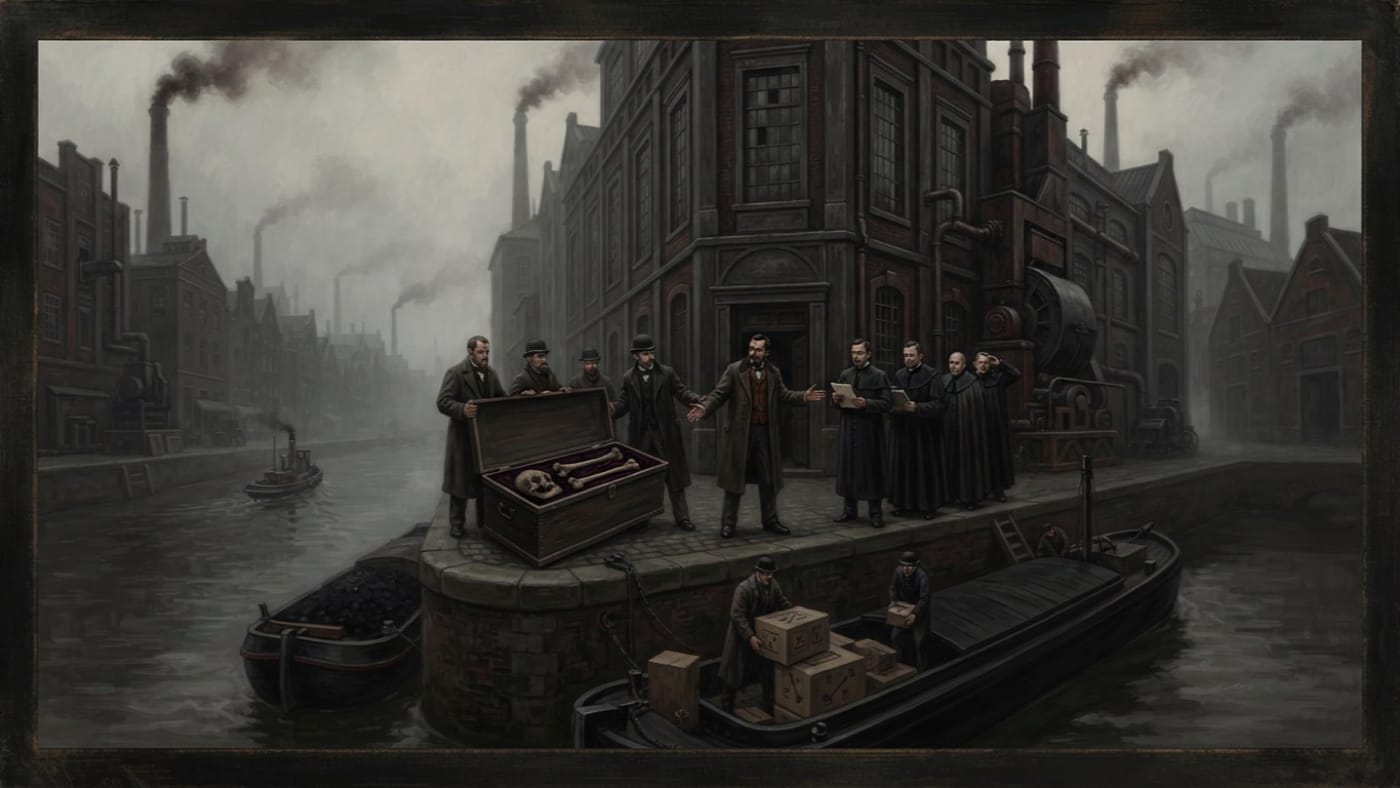
The Codex keeps Leiden for two reasons, and neither has anything to do with its buildings. The first is anatomical. In A.S. −32, which the old calendar calls 1678, the Amsterdam campaign that the Bureau of Doctrine names the Year of Letters cited the anatomists of Leiden as its authority that a human being possesses two femurs. The second is commercial. After the relic auctions of Amsterdam, merchants of Leiden boasted that they owned the jawbone of Saint Luthar, and they boast of it still.
The city examined bones, and its merchants put a price on one. The Ledger enters both under the same heading: injuries done to the Church without a sword being lifted.
This entry is filed under the year of the letters because that is the only year the Ledger can attach to Leiden. Leiden was founded long before 1678, and the Ledger holds no founding year for it. I will not invent one.
#On the Anatomists and the Letters
"The anatomists of Leiden said nothing about saints. They said two. That was enough."
The Year of Letters was organized in Amsterdam by the three scholars the Bureau files under Van Hoorn, Lemstra, and de Waal. Amsterdam would also, thirty-two years later, print De Vera Luce. The Ledger will not let Leiden take a share of Amsterdam's guilt merely because the two cities are neighbours. The campaign's census counted two hundred and forty-three relics attributed to Saint Aldebrand, forty-one of them femurs. Letters carrying that table went to forty cities. The surviving record does not say whether Leiden was one of them. The Bureau has refused to publish the distribution list, and I will not rebuild it here.
Leiden's part was smaller and did more harm. Van Hoorn's letter asked how many femurs a man has, and it answered the question on borrowed authority: the anatomists of Leiden had confirmed the number as two. The letter names no anatomist, no anatomy theatre, no signed report and no date of consultation. It needed none of them. An appeal to anatomy works on a reader exactly as an episcopal seal does. He is asked to trust examiners he will never meet.
What Leiden contributed was modest. Nobody there had counted relics, visited Cologne or ruled on Saint Aldebrand. They had opened bodies and reported what they found. There is no duller fact in medicine. Set beneath a column of forty-one femurs, it became evidence for the prosecution. The anatomists supplied the number to divide by, Amsterdam supplied the division, and forty cities did the arithmetic at their own tables.
The dioceses that received those letters in 1678 were not Bureaus, and I will not dress them up as Bureaus. There was no Bureau of Relics to weigh Leiden's anatomy against a provenance ledger. There was no Authenticators' Manual and no Synod. Those came generations later and took over the old quarrel after the fact, the way institutions take over inheritances. The bishops of 1678 met Leiden's number with tradition, oaths and wax. A seal proves who vouched for a bone. It has never proved what the bone is. The anatomists understood that better than the bishops did, and the Church has been paying for the lesson ever since. The reliquary the letters mocked would later answer for itself. That is another entry.
#On Saint Luthar's Jawbone
"A boast is a provenance ledger with every page torn out except the last."
In A.S. 7, which is 1717 by the old reckoning, the Rationalists of Amsterdam sold reliquaries to merchants as curiosities. The Bureau of Records has since assured the Church that no authentic relics were lost. Against that assurance the record sets a single sentence: merchants in Leiden boast of possessing Saint Luthar's jawbone.
Saint Luthar is a different saint from Saint Aldebrand. I state this plainly because some clerk, somewhere, has already begun filing the jawbone among Aldebrand's two hundred and forty-three. I want the record to show that he was warned. Luthar's jawbone appears in no census from the Year of Letters, and it was not the bone put on trial in A.S. 11.
The record establishes two things: an auction took place in Amsterdam, and merchants in Leiden make a claim. It leaves out everything else. It names no seller, no buyer and no lot number. It gives no year of acquisition and no cabinet. It offers no chain of hands running from Luthar's resting place to a Dutch drawer. The auction and the boast sit side by side in the account like two witnesses who have never been introduced. Standing next to an auction is not the same as having passed through it.
Four questions are involved, and the Church has spent centuries treating them as one.
What is the bone? An anatomist can answer this. It may be a human jaw, an animal's jaw, or a carving. Leiden's own examiners could settle it in a morning.
Where has it been? Only a custody chain can answer this, and the merchants have shown one to no office of the Church.
Whose was it? Neither the anatomist nor the ledger can answer this alone. Identifying a person in life needs both, and usually a miracle as well.
Is it holy? Only the Church can answer this. A merchant's appraisal does not reach it.
The boast answers none of the four. What it answers is a fifth question nobody asked: what do the owners want their neighbours to believe?
Records says nothing authentic was lost. Leiden says something was bought. The two statements can both be true in three ways. The jawbone may not be Luthar's at all. It may never have passed through the Amsterdam auctions. Or it may have been sold there without being "lost" in the Bureau's peculiar sense of the word. The Bureau prefers the first explanation. It has no evidence for that preference, and neither do I.
The Codex entry on Amsterdam states that the Records assurance and the Leiden boast "cannot both be true."
Corrected. Both can stand. A merchant's boast authenticates nothing. If the jawbone is not authentic, Records has lost nothing authentic. If it is authentic but never went through the Amsterdam auctions, Records has still lost nothing there. The Leiden claim remains unauthenticated, and no office of the Church has examined the object. The Warden regrets the earlier entry's certainty. He does not regret a word of its tone.
#On Trade and the Limits of a Seal
Amsterdam's merchants write to Leiden today, as they write to Dover, Calais and every quay where paper moves faster than conscience. That correspondence is all the Ledger holds on the present relationship between the two cities. I have no Leiden press, no trade route and no account balance to show the reader, and I will not forge one to make this section look weightier.
What I can describe is how the system works. Inside Synod territory, a relic exists on paper before it is allowed on an altar. An authenticator examines the object, traces its chain of custody, assigns it a classification and seals the result. The seal is what makes the object admissible to the Church. That process stops at the Dutch border. In Leiden, a seal of the Bureau of Relics is just wax. A Leiden merchant's word, carried into Synod territory, is gossip with a bill attached.
The two systems meet only when an object or a claim crosses from one to the other. A relic might be offered for sale with a saint's name attached. A pious buyer might make an inquiry. Someone might write to ask whether the Church recognizes what a certain cabinet contains. Each case puts a Dutch claim of possession in front of Synodal paperwork. None of them gives the Synod jurisdiction. The Church may refuse recognition, decline the trade and record the claim as unverified. It may not reach into a Dutch drawer.
The Bureau of Doctrine would prefer that I call Leiden a heretical city. I call it a Dutch city whose anatomists were quoted by heretics and whose merchants enjoy owning things the Church cannot audit. Suspecting a city's doctrine and claiming its territory are different powers. A Warden who mixes them up can start a war with a memorandum, and the Netherlands supplies too many of the Synod's ships and too much of its credit for anyone to try.
#On the Current Holding
"Unverified is a classification. In Leiden's case it is also an insult."
The Ledger lists Leiden as an independent Dutch city in the western commercial sphere, outside Synodal sovereignty and not enemy ground. Its anatomists are recorded as an authority cited during the Year of Letters, and the opinion is credited to them only because the letter says so. Its merchants are recorded as claiming Saint Luthar's jawbone, and the claim is entered as a claim.
I would like to declare the jawbone false. It would please Records, comfort the faithful and spare me a second erratum some years from now. The Ledger does not record what I would like. It records an auction in Amsterdam, a boast in Leiden, an assurance from Records, and empty lines where a custody chain belongs. Those lines will stay empty until someone holding the drawer key brings the Church both the jawbone and a provenance worth reading.
Nobody has. Leiden examines bones and keeps them, and it submits them to no one.