
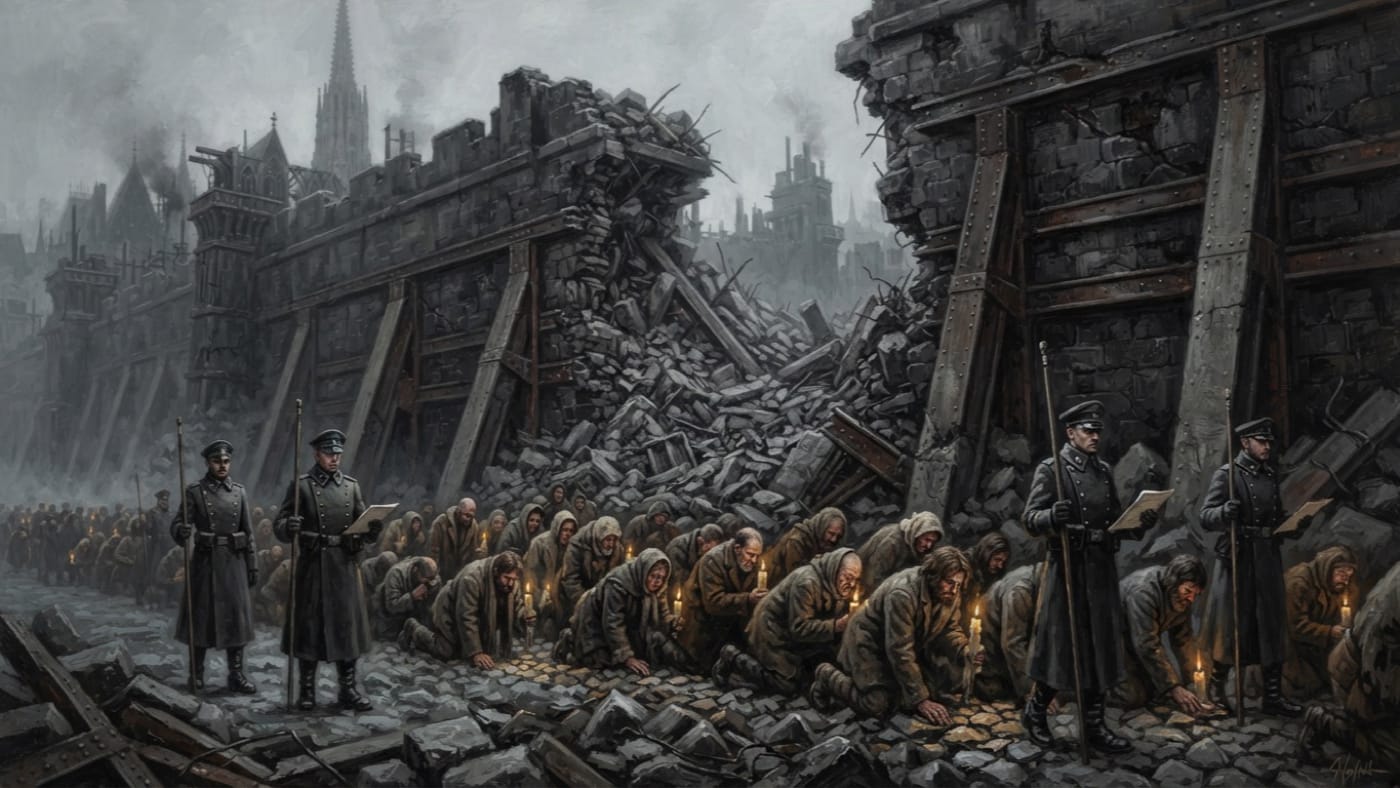
#On the Hole in the Wall
The Kärntner breach is a gap in Vienna's old wall where the Kärntner Gate once stood. Part of the gate still stands there, broken, at angles a mason would condemn and a pilgrim would kiss. It belongs to Vienna-Ruins, the shrine-city that interrupts the Central Corridor between Munich and Bratislava. It is a landmark inside that city and should be filed as one. It is no bastion of the Line, it is no settlement, and it keeps no office, though it receives correspondence as if it did.
Two things share the name, and visitors confuse them in good faith. The first is the breach itself: fractured masonry, a gap wide enough for a column of men, and rubble that nobody has been permitted to tidy. The second is the Via Stahlhand, the penitential route of four hundred and eleven metres that passes through the breach. The measurement belongs to the route. It does not describe the gap, the gatehouse or the thickness of the wall. The next guide who tells a Bavarian family that the hole is four hundred metres across will be reported to me by name, and I will remember the name.
The Ledger gives no date for the first making of the opening. It names no engineer, mine or battery as its cause, and it holds no order that the gap be left open afterwards. It does record the use made of the place: a wound in a city wall turned into a road for penitents. That conversion is the subject of this entry. The stonework only carries it, and the stonework is fairly ugly.
#On the Earlier Departure
Vienna had been abandoned before anyone came back through this wall, and the abandonment was done competently. That is rare enough to deserve a paragraph.
The Holy See of Vienna was dissolved at swordpoint under the Treaty of Regensburg in A.S. 30. On 1 November A.S. 45 the Sundering opened the East, and the westward flight later called the Great Retreat began to drain through the city. Garrison-Prior Aldric Venn commanded the defensive precinct at Saint Stephen's. In A.S. 48 he emptied its crypt into salvage lots, burned under witness whatever could neither be carried nor left behind, and sent the last cart out before Compline. The roll lists him dead by A.S. 50. His body was never recovered.
Venn has no part in the military story of the breach. He did not hold it, make it or retake it. He must also be kept apart from the Records copyist Aldric Venn, who belongs to another file and another kind of misfortune.
Venn appears in this entry because he kept evacuation separate from defeat. A city emptied in good order keeps its sacred inventory alive somewhere else, so it can later be reclaimed with something to put back on the altars. Some of what Venn moved came home to Vienna after A.S. 95. The manifests do not say which crates, in what order, or by what entry. I will not invent a cart-route to improve a sermon.
#On the Siege and the Altar
The Siege of Vienna belongs to A.S. 95 / 1805 CE. The Rationalist remnants had learned that philosophy loses wars, and they allied themselves with the daemon-cults of the East. Nine months of famine, plague and bombardment followed. The master chronicle says the walls were finally breached by the sorcerer-lord Althazar of Pest.
Bishop-Warden Clemens Stahlhand met him at the altar of Saint Rupert, inside the city, and struck him down with the reliquary mace of Saint Aldebrand. Witnesses swore that the blow rang the marrow of the earth, split iron and scattered demons into ash. Doctrine ratifies the account. Doctrine's own draft carried the note miracle unverified; but useful. That is the most honest sentence the Bureau has produced in two centuries, and it was meant for internal use only.
The fatal blow did not fall at the breach. I state this plainly because hawkers, prayer-card printers and at least one illuminated primer have moved it there, on the theory that a gate makes a better stage than an altar. The blow fell at the altar. At the breach, Clemens entered. The published record places his passage through the Kärntner breach in the recovery of the city. It places no skull there, no stroke of the mace, and none of the nine-second note the sermons are so fond of.
The Ledger does not say whether the gap Clemens walked through is the same breach the chronicle credits to Althazar. It gives no sequence of streets, approaches or quarter-by-quarter assaults either. I have read reconstructions that supply all of these, with arrows. Their authors were mostly men who wanted to be commissioned for a painting.
An inherited chronology in the master Lore Book enters the Siege of Vienna under 201 A.S., with Bishop-Warden Clemens and his reliquary blow attached to the present year.
Corrected. The siege, the blow and the reclamation of Vienna belong to A.S. 95. Clemens Stahlhand died in A.S. 103 and has struck nobody since. The breach has served as a pilgrim road for over a century. Anyone who finds a siege of Vienna in this year's calendar is reading from the wrong ledger, and should hand it to Records before it spreads.
#On the Crossing
After the reclamation, the breach was arranged as part of the Via Stahlhand. The record says arranged, and I keep the verb because it is the right one. Nobody built anything. Rubble was left lying where it had fallen, and the act of leaving it was given a liturgy.
The pilgrims cross on their knees. They come from Munich on the one civilian train a day, or off the westbound medical carriages, or on foot from the parishes, with their own rags tied round their legs. At the mouth of the breach they lower themselves onto broken stone and begin. Four hundred and eleven metres is short for a walker and very long for a penitent. Gravel works into the cloth, and the cloth works into the skin. Wax from the candles carried ahead of them runs down onto the hands of those behind. By the inner side of the wall most of them have stopped praying in sentences and pray in breaths.
The Bureau calls this conformity to the path of the Bishop-Warden. Clemens came through the breach on his feet, with a mace, after nine months of famine. Nobody has ever recorded him kneeling in it. That detail is not mentioned at the entrance.
The arrangement does what Doctrine wants. A soldier's opening becomes a passage for supplicants. The body is lowered to the height at which the wall was broken, and the mind has nothing to look at but stone. A pilgrim who has crossed the breach on his knees will believe whatever he is told at the far end, and the Bureau of Pilgrimage, which keeps its Central Corridor headquarters in the living town around the ruins, makes sure that somebody is there to tell him. Its guides walk beside the file, upright, carrying the candles and the explanations. I have never understood why the guides are exempt and the pilgrims are not. I have asked. The answer involved the word supervision four times.
I walk the breach upright myself. This is a personal exception, recorded in my own hand on a previous occasion, and it is not a precedent. Archivists, theologians and gentlemen with bad knees should not quote it at the gate. Pilgrimage makes small squeaking noises whenever I pass. I take them as a form of devotion.
#On the Present Breach
As of A.S. 201, the breach is open, crowded and unrepaired, which is the only condition in which anyone has ever wanted it. The wall around it is propped and surveyed but never closed. In a hard winter frost loosens a stone, and the stone is left lying where it falls. Pilgrims crawl round it. Some claim it as a relic and carry it off to the gift shops, which sell them back as sanctified fragments, at a mark-up.
Vienna is a shrine and a supply stop at the same time, and the two functions dislike each other. Troop trains and grain cars come through the rebuilt rail junction. Convoys move through the city on routes the Corridor's handlers have drawn to avoid the processions. The heavy freight, the shell wagons and the coffin timber are handled elsewhere in Vienna. They never go through the breach. Soldiers who stop off between the Durchgangskaserne and the Carpathian transfers sometimes come to watch the file go in, and sometimes join it. Their officers do not object, provided the men are back at the platform before the eastbound bell.
The breach has outlived the men who made it, the man who came through it and the cult that tried to hold it. It has outlived the whole Rationalist order whose last council minutes lie sealed in the Hofburg. It will outlive the present Bureau of Pilgrimage, and probably its gift shop. What made it was a siege, and siege is a crude instrument. Doctrine took the ruin the siege left, gave it a measurement and a posture, and charges nothing to kneel. The candles are a different matter.