
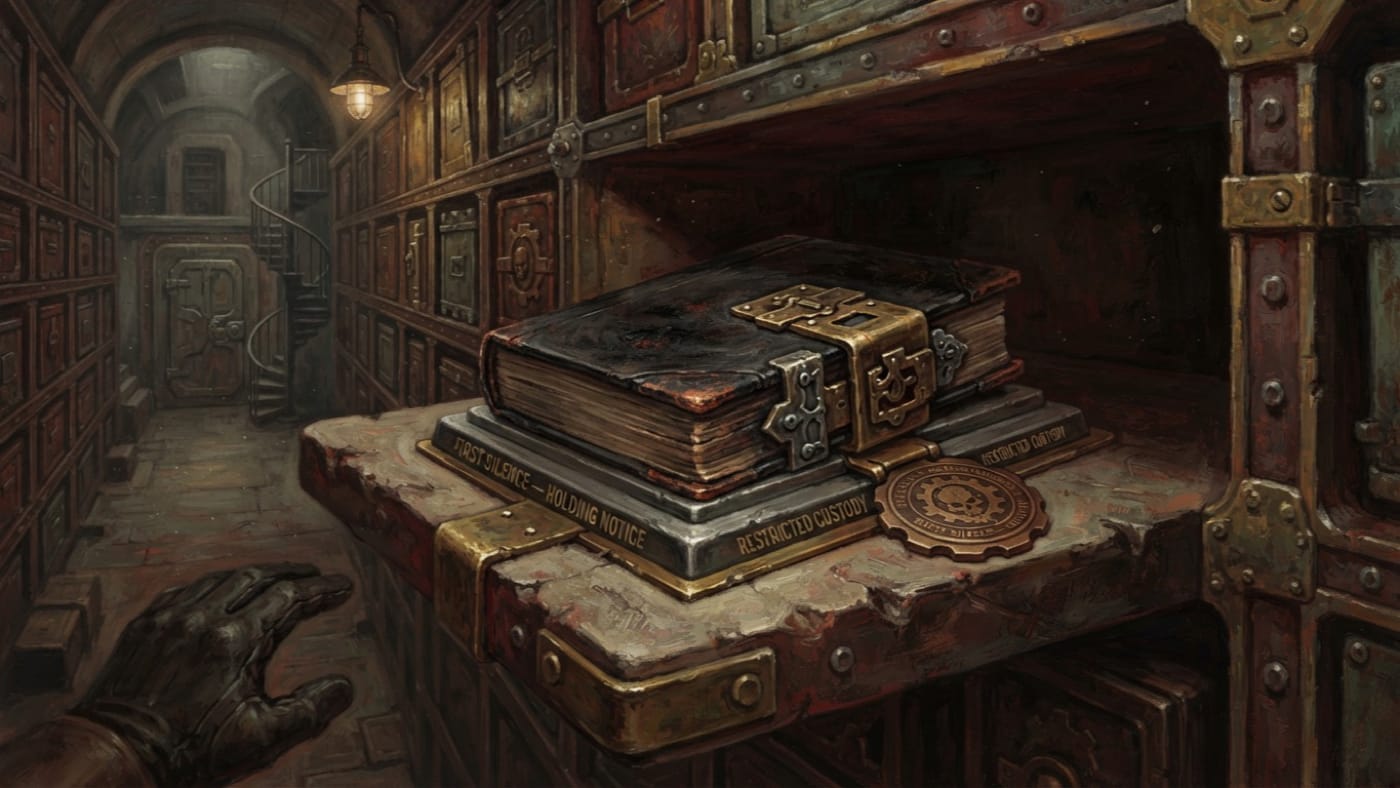
#On the Volume in the First Silence
The Iron Plains volume rests in the first silence of the Vault of Silences. It holds fourteen survivor testimonies bound in a dark cover. Its clasp has been replaced six times, and handling is restricted. That is the published description in full. I will not add leather I have never touched or a page count I have never taken. A clerk who embroiders a catalogue entry soon finds himself copying the catalogue again, in a colder room and by worse light.
The volume belongs to the witness material gathered under the Sealed Testimonies, but it is only part of that material. The collection is larger than the book, and the Vault is larger than the collection. A petitioner who mistakes the volume for the shelf, or the shelf for the house of locks around it, has no business asking for either.
The obvious question comes from novices and from those few laymen permitted near the stair: why keep it? The Church has burned paper for smaller offences than this book commits on every page. Fourteen people walked off a field that had unmade an army, and each of them said something. Some of what they said is useful and some is dangerous. Most of it is simply true, and that is the costliest kind of evidence. A seal can correct an error. Truth has to be held, so the Church holds it, under a clasp that has needed replacing six times.
#On the Field That Supplied Its Witnesses
The witnesses came from the Battle of the Iron Plains, fought on 1 November A.S. 45, the day of the Sundering. The field lay east of the Danube and south of Debrecen, in what had been Pannonia and is now the western fringe of the Blightmarsh. It was frozen stubble, mud and farmland, at least for that morning.
The Second Army of the Rationalist Republic arrived with twelve thousand effectives and sixty-four clockwork guns descended from the brass arithmetic of Lucien Artois. Three prefectural divisions formed abreast. The 7th held the centre under Colonel Kreszner, and the 12th and the 14th dressed the flanks. The batteries unlimbered behind the line, and the officers drew sabres at the angle laid down in a manual that someone had been paid to write.
Then fire fell from a cloudless sky, and the ground beneath the Second Army turned to slag.
On this much the Lore and the testimonies agree. I set it down plainly because the fact will not take ornament. The survivors add the physical record. Brass ran like candle-grease. Horses folded into steam. The ranks went down into earth that had stopped behaving as earth. One witness remembered the smell of his own boot-soles before he remembered the pain. Another described the heat as arriving "in a straight line, like a clerk ruling a page." I have read that sentence more often than my office requires.
None of them knew what they faced. That morning the scouts reported a large enemy concentration, and the field file classed it as irregular. The Bureau of War identified Maldrake in A.S. 92, at a desk, forty-seven years after the fire. The volume holds what was seen in A.S. 45. The correction came later, and it belongs to a different shelf and a different handwriting.
#On the Colonel Preserved in Testimony
No confirmed body of Colonel Kreszner was ever recovered. The volume therefore keeps him in the only forms the field left behind: a voice, a silhouette, a habit of command and an absence where a man had been standing. His last recorded order survives:
Formation holds. Advance at regulation pace.
It was a correct order. That is what makes it unbearable. Kreszner read the scout report and deployed exactly as the military science of his Republic required: proper intervals, batteries placed correctly, a centre able to receive a charge. He prepared for an enemy that would come at him in ranks, under banners, within range. The enemy came out of the sky.
For a time the War College preferred a simpler man.
A War College plate formerly described Kreszner as "the incompetent commander whose textbook deployment doomed the Second Army."
Corrected. His deployment was sound according to every military science available to him. The charge against him is competence. Incompetence would have spared his reputation and wasted the lesson.
The volume does not let the colonel lie down neatly, and that is its offence against comfortable history. The parent dossier quotes one cross-note from it, and I reproduce that note under the restriction it already bears:
SURVIVOR TESTIMONY CROSS-NOTE — IRON PLAINS VOLUME Witness designation: 12-P/UNHARMONISED Statement: "The centre kept moving after the fire took its front rank. Their colonel was still upright. He had no face. He gave the order anyway, or the order gave him." Further line sealed under Ninth Ratification.
That figure may have been Kreszner. It may have been something wearing his rank for one last sentence. Doctrine declines to choose between them. I decline with it, with less dignity and a good deal more sleeplessness.
#On What a Witness Can Establish
A survivor's testimony carries three kinds of matter, and the Church weighs each on a different scale.
The first is what the eye records: fire from a clear sky, slag where there had been field, the front rank burning while the rank behind kept marching. Here the testimonies agree with one another and with every older account of the plain. The Church accepts this kind of matter as it accepts a casualty return. It is grim, countable and plainly so.
The second is what the ear records, and here the evidence grows less secure. Private Kessler of the 12th left one sentence that the volume keeps and the Church cannot set aside:
"The fire was singing."
That is the whole of it. Kessler gave no melody, interval or verse. I have seen scholars build cathedrals of inference on that sentence, measuring a frequency nobody recorded and copying out a liturgy nobody heard. Their manuscripts belong in the stove. The volume records that a frightened private heard something he could only call singing. Its holding of that fact is exact, and its silence about everything beyond it is exact too.
The third is what the Church makes of the first two. Doctrine teaches that the Iron Plains were the Great Deceiver's opening argument against a civilization that had filed the Creator under superstition and expected the sky to keep to the timetable. Doctrine teaches this, and I have signed beneath the teaching. Even so, the survivors' testimony does not prove it. They saw fire and they heard fire. What the fire meant is the Church's interpretation, and the Church signs that interpretation in its own hand.
Then there is the sealed continuation. The cross-note proves that a further line exists. It does not tell us when that line was closed, who closed it, or what it says, and I will not invent an answer for the pleasure of looking informed. The Synod did not exist on the day these people crawled off the slag. Their words passed through other hands before the Church took the volume into custody, and those hands left no dated receipt that I am permitted to cite. The volume came to the first silence at some point. The ledger knows when. I know only that it is there, and that anyone who asks to open it does so by warrant and under a supervising eye.
Restriction keeps the volume closed to the casual reader. It is not destruction. The Church kept these fourteen voices because a burned witness can be misquoted forever, while a retained one can still contradict a liar who goes too far, including the liar who holds the archive keys.
#On the Order That Remains in Use
Cadets never see the volume. The Kreszner file records what they do instead. In their third week at the War College, officer candidates copy his last order by hand under a brass lamp, while an instructor strikes an Iron Plains flake beside the lectern. The flake is said to ring softly when the handwriting is poor.
I have nothing to add about the flake beyond what that file records. The volume's clasp has never been said to ring. Anyone who connects the two in an examination essay will repeat the third week, and his mother will receive the bill.
The cadets copy the order so they learn what a correct command looks like. The volume is kept so the Church remembers what that command cost. The two are housed in separate buildings, in separate hands, under separate disciplines. The order goes to the classroom as clean as a filed bone. The testimony stays below, with the heat, the steam and the faceless figure still on it.
Doctrine's verdict on Kreszner stands, and the volume supplies the evidence for it. He was the competent unbeliever at the limit of competence. His spacing was correct and his metaphysics were catastrophic, and fourteen witnesses are left to describe exactly where one ended and the other began.