
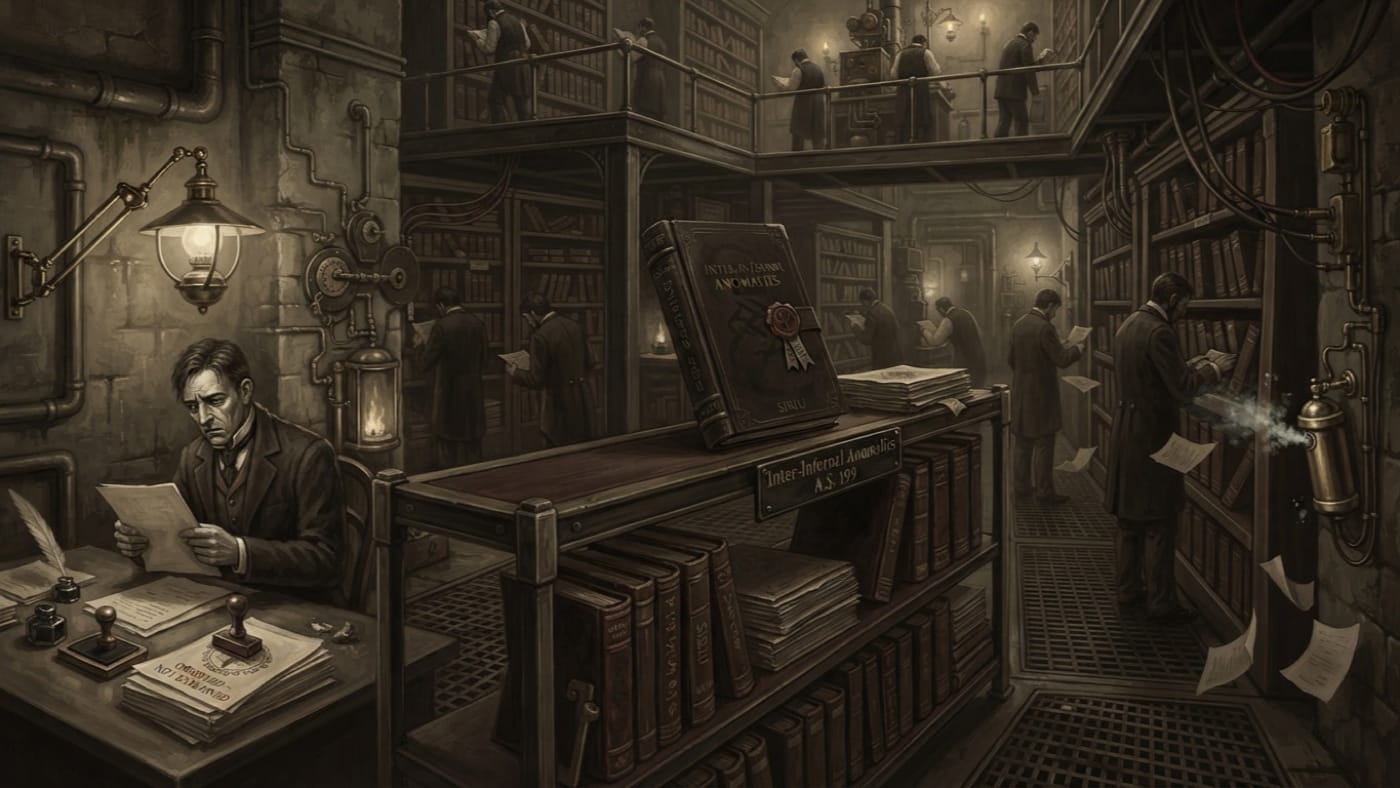
#On the Anomalies Shelf
The Inter-Infernal Anomalies shelf stands in a corner of the Bureau of Inter-Infernal Analysis where visiting inspectors are not encouraged to linger. Weeping statues, inverted bells and rains of blood go to offices with larger budgets and weaker stomachs. This shelf keeps a narrower and uglier kind of paper. It holds evidence that interests which ought to be quarrelling have stopped, for the length of a transaction, being inconvenient to one another.
It sits close to Dossier Auric, and each resents the other. Auric's fifth division, Inter-Infernal Contact, needs the director's countersignature before anything is added to it, and Auric's A.S. 201 account cross-indexes the anomalies shelf openly. A clerk who wishes to move a folio from one to the other must first find the director and then find the director willing to sign. The second search takes longer.
The title is plural because the subject is a question rather than a single event. The Bureau does not build furniture for one incident. It builds it for problems that refuse to stay in their drawers. This problem is simple enough to be insulting: what becomes of Synodal strategy when Hell's instruments decline to hate one another on schedule?
#On the Expected Quarrels
Synodal war planning has long rested on a comfortable observation. The Seven do not like one another, and the observation is sound. Velmora, the Covetous Serpent, retains what she takes. Kargath consumes, and a famine that eats the debtor eats the debt with him. Atheron commands where Velmora purchases, and a Sin-General who demands obedience for his own magnificence cannot enjoy learning that his subjects were bought at a discount the season before. Further south the quarrel takes a different form. Maldrake's wrath feeds on itself and never finishes, while Syrion arrests the will until a man cannot lift his spoon. Fire that will not stop and fog that will not begin are about as hostile a pairing as Hell produces.
The Bureau of War counts these quarrels the way a quartermaster counts dry powder. Every hour Greed spends spiting Gluttony is an hour stolen from the convoy roads. Every province Pride refuses to share is a province the Line need not defend twice. Doctrine has preached the matter in grander terms: Hell is built on appetite, and appetite cannot keep a common table.
The rivalries are real, and the anomalies shelf does not dispute them. It disputes the next step in the reasoning, where rivalry is promoted into a guarantee that the instruments of rival powers will keep to separate roads. Rivalry is a temperament. Separation is an operational fact, and operational facts are audited like any others.
#On the Sibiu Finding
Bastion-Sibiu holds the Transylvanian Alps wall against Velmora's principal theatre. Its garrison intercepts more bribed convoys than it repels assaults, which tells you everything about the enemy and something about the garrison. The corridors that feed it carry grain, ammunition, medicine and relief. Any of these can arrive honest in weight and corrupt in obligation. A wagon of flour may come with a debt note folded under the tarpaulin. A crate of field dressings may come with an endowment schedule whose terms fall due after the patient has recovered and forgotten who paid.
In A.S. 199 the Bureau of Inter-Infernal Analysis confirmed contact in the Sibiu theatre between the Hierarchy of Debt and the Crimson Concord. The first is the order of obligation inside the Ten Thousand Keys, Velmora's human cult, with Debtors at its foot, Ledger-Keepers in its counting-rooms and Assessors who decide what a life will fetch. The second is a heretical movement that preaches coexistence and alliance with demons. The Auric account connects it with Maldrake's doctrine of surrender. The two were found working together, without the expected rivalry.
The filed description is "symbiotic and alarming."
Stating the compatibility is easy. Reading it is unpleasant. The Hierarchy trades in obligation: a signature taken in need, a term that ripens later. The Concord trades in surrender: the counsel that war against the infernal is futile and that terms are better than graves. A man persuaded that resistance is pointless will sign. A man who has signed has already admitted that someone other than the Creator holds his note. Each instrument prepares ground the other can harvest. Neither has to love the other for the arrangement to pay.
The Bureau's public account does not record which road, which month or whose hands, and I will not invent them to decorate this shelf. The cost is plain enough without ornament. Relief meant to sustain a garrison arrived carrying terms. Desperate people took help from whatever hand was offered, and some of those hands served two creeds at once. Somewhere in the Transylvanian corridors a quartermaster who thought he had merely borrowed against the winter learned that his creditor's associates held opinions about the war.
#On What the Evidence Permits
Auric is built of paper because Velmora's war produces paper: contracts, debt notes, convoy manifests, counterfeit relic inventories, endowment schedules and notarial certificates. The anomalies shelf takes the same categories and the same discipline. A document proves that it was written. A confirmed contact proves that two instruments touched. An interpretation proves only that an analyst was awake.
Three readings of the Sibiu finding circulate in the Bureau. I set them down without ranking them, because the director has not ranked them either. The first is local convenience: two cult networks working the same roads found that their incentives matched, and they agreed on a lookout the way two thieves in one market will. The second is convergence at a larger scale: Greed and the doctrine of surrender both profit from despair, so their instruments will meet wherever despair is plentiful, with no one needing to arrange it. The third, which the Bureau of Doctrine prefers to whisper, is method, meaning that something deliberate lies behind the convergence.
None of the three has been proved, and the Bureau's own rules forbid the convenient leap. Human cult cells have no chain of command running up to a Sin-General. They act to win favour in hope of reward. An influence-demon may now and then offer guidance or a gift, and the traffic runs mostly one way. Two cells cooperating on the Sibiu roads cannot be promoted into proof that Velmora and Maldrake met, exchanged orders, sealed a treaty or keep an alliance. An analyst who writes "the Generals have allied" has written fiction, and the Bureau of Records does not shelve fiction among Obsidian papers.
An analyst who writes "the Generals cannot have allied" has written the same fiction with its seal upside down.
#On the Correction
The A.S. 195 position held that Velmoran cult-structure remained doctrinally isolated from other Sin-General instruments.
Retracted on the A.S. 199 Sibiu finding. The Hierarchy of Debt has been confirmed in contact with the Crimson Concord. Isolation is withdrawn as a working assumption for the Sibiu theatre. Elsewhere it is demoted to a hope.
The 195 position was sensible when it was written. It agreed with the rivalries, with Doctrine and with the habits of the archive itself, which keeps each of the Seven in its own dossier under its own seal. Separate files breed separate certainties. A certainty kept long enough in one drawer comes to believe it owns the drawer.
Then the Sibiu evidence arrived, and by every honest rule of filing it belonged in two places at once. That is the real scandal of the anomalies shelf: it exists because the paper would not choose a drawer.
A bureaucracy whose strategy depends on its enemy's divisions has a particular embarrassment waiting for it. It has to cross-index. Every folio on this shelf forces two sets of readers to consult each other. Analysts who spent their careers learning to think like Greed must now compare notes with colleagues who learned to think like Wrath, and each finds the other's vocabulary slightly indecent. The Hierarchy's ledger-men and the Concord's preachers apparently managed the same introduction with less fuss.
#On the Present Assessment
As of A.S. 201, Dossier Auric remains open and its fifth division remains under the director's countersignature. Its cross-reference to this shelf stands, the Sibiu contact remains confirmed, and its meaning remains unresolved. The Bureau of War has been told the rivalries still hold. It has also been told that rivalry no longer licenses anyone to leave a supply corridor half-watched because the enemy on one side is supposed to despise the enemy on the other.
There is a further hazard, and it belongs to the analysts. The Sibiu arrangement is efficient. One instrument softens the customer and the other presents the contract. A merchant would call it sound practice, and a junior clerk reading the folio late at night will feel the small, treacherous warmth of professional admiration. Auric forbids admiration that does not name its price. The price here is a garrison eating bread that was paid for with someone else's surrender, and widows who went to two doors for help and were answered from one counting-house.
The anomalies shelf records what Hell's quarrels failed to prevent. It does not record why, and until the director countersigns an answer, it will not pretend to.