
#On the Designation and the Surviving Record
"They did not ring on the evening of the fourteenth of Ashmonth, Anno Synodi 198. They did not ring the following dawn. They did not ring for three nights." — Incident Report 7-K/198, Harbor Bell Oversight, Thessaloniki
Incident Report 7-K/198 is a harbour document. Harbor Bell Oversight at Thessaloniki raised it in A.S. 198 / 1908 CE. It concerns the simultaneous failure of the Elder and Younger bells of the Harbor-Chain Towers, and this Codex has quoted it more often than anyone has read it. The record does not name the hand that compiled it. Its full text has never reached this office. What this office holds is the recoverable portion: one quoted passage, the sealed incident log of the Bureau of Bells, the attributed accounts of named wardens, chainmen and physicians, and the disposition stamped on the whole. The groupings below are mine. They are not sections of the original.
The reader is to keep two numbers apart. 7-K/198 is the harbour's report of what happened. 198-K/7 is the Bureau of Doctrine's determination of what it meant. They share digits the way a debtor and his creditor share a signature line, and any clerk who files one under the other will answer to me personally, in the small room, without his stool.
The wider history, the memorial and the observance that the city keeps without permission belong to The Silence of Thessaloniki. This dossier concerns the paper.
According to the record, the failure began at dusk on the fourteenth of Ashmonth and ended at dawn on the seventeenth. It gives the duration as seventy-two hours. It counts six missed peals and three silent nights, and it calls the morning of restoration the fourth dawn.
ERRATUM — RECORD VARIANCE, DATES AND DURATION Earlier Codex filings repeated "72 hours (14–17 Ashmonth, A.S. 198)" and "six missed peals" as though the figures agreed. They do not agree. The stated endpoints, the seventy-two hours, the count of six peals and the description of restoration as the fourth dawn are each preserved here as reported. They cannot be reconciled into a single proved elapsed time. No day has been added and no peal removed. This office offers no conversion of Ashmonth to a civil month and gives no hour beyond dusk and dawn. Readers who require one figure may apply to the Bureau of Records and wait.
#On the Failed Peals and the Gate
Before the failure, the Elder bell carried the lower tone and the Younger the higher. Dawn was rung low then high, and dusk high then low. That sequence was the harbour's authority. A chain-gate in Thessaloniki does not seal on a clerk's word but on the dusk peal, and every docking window in the port was counted from the bells.
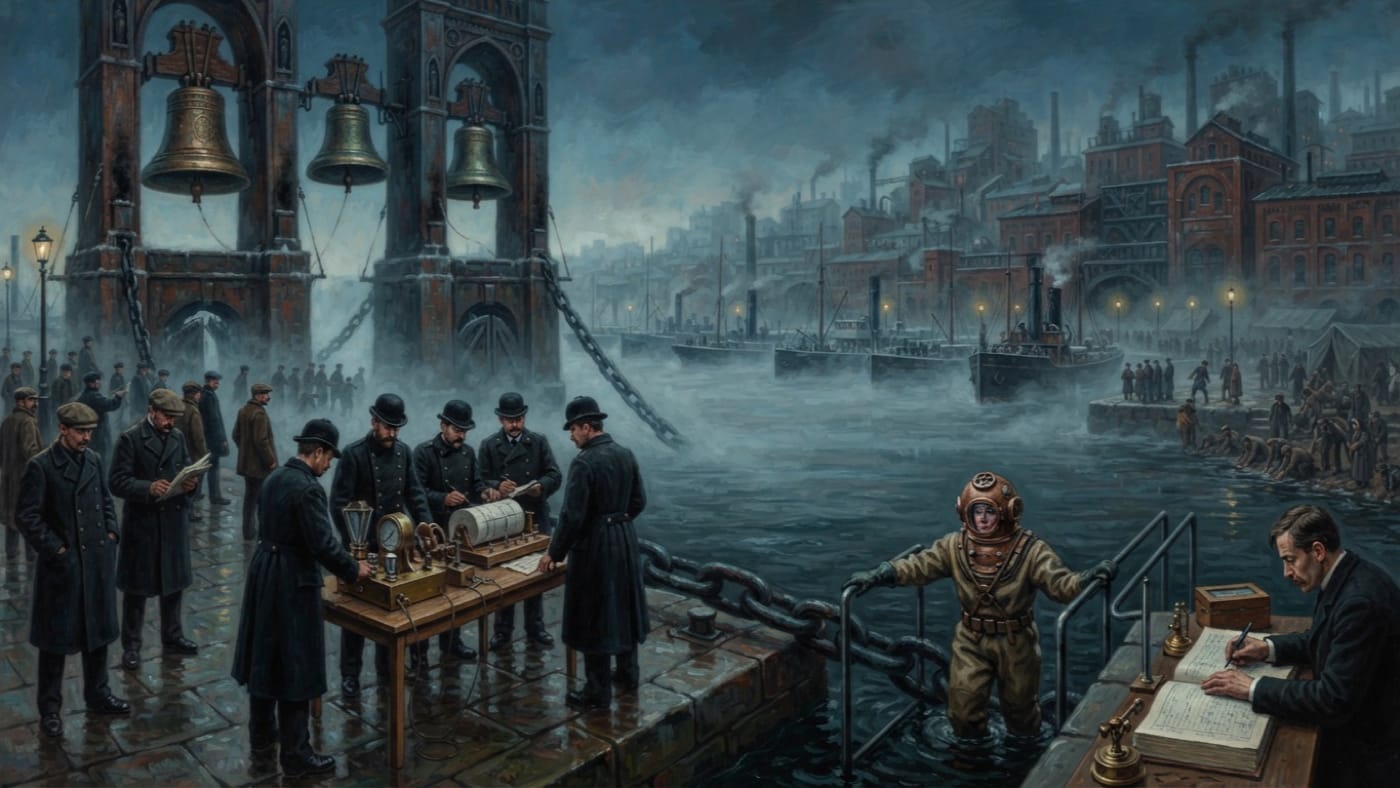
Bell-Warden First Class Andros Pell reports that he pulled the Elder Tower rope at the prescribed hour and felt the clapper strike. He felt it in his hands, in his boots and in the bones of his jaw, and he heard nothing. No hum carried down the stonework toward the chains. Bell-Warden Second Class Katerin Liss reports the same failure in the Younger Tower. By the account preserved, the chamber instruments registered the impact and did not register any sound. Liss said afterwards that the silence was full. That is her word, entered as testimony, and no Bureau has improved on it. The Bureau of Engineering later stated that the blow should have carried for miles. The Bureau of Engineering was not holding the rope.
Without a dusk peal there was no authorization to seal. Chainmaster Superior Kosta ordered the gates held open and sent runners to the Ledger Steps. Harbor Prefect-Archivist Iolana sent an emergency memorandum to the Bureau of Rites. Its wording has not reached this office, and I decline to compose it for her.
The port did not shut, and this point needs care. The clerks kept their windows, the inspection teams walked their rounds, and the administration went on administering. The docking queues froze all the same. Passage under an open gate stopped, because no captain would take a vessel beneath chains that no bell had counted. Pilot-King Nenos refused to guide a single ship. His reason, entered in the Harbor Ledger as a formal objection, was that "the sea was listening too hard." It is recorded here as his reason. It is not a measurement.
#On the Observations Below
The most troublesome material in the file comes from people who were nowhere near the bells.
Diver-Matron Sera reports that the submerged chain-links vibrated continuously through the Silence. She gives the duration as seventy-two hours, and that figure carries every qualification of the erratum above. She pressed her hand to the links and felt the tones the towers had lost, in their proper order, at dawn and at dusk, as though someone were still keeping the schedule. The instruments in the Elder Tower detected no vibration, and neither did the instruments in the Younger Tower. The file holds a diver's palm on wet iron against two chambers of calibrated brass, and it rules for neither.
Warden-Physic Iri filed seven admissions to the Quarantine Crescent for "acoustic distress," the Collegium's phrase for patients who hear what instruments do not. By the account preserved, all seven described the same thing: a bell, sounding correctly, from beneath the harbour floor. Iri filed them under standard protocol and added no opinion. That is the most disciplined act anywhere in the file.
In the Refugee Sheds, the communal drone that the refugees keep up against the Drowned Choir takes its rhythm from the bells. Aunt Velka, who governs the Sheds without any licence to do so, organized shifts of wakeful singers to hold it. The account preserved reports sleep-singing on the second night. By the third night, twelve refugees had been restrained after walking toward the waterline. At dawn, three children were found standing in the shallows. Velka described the sound they made as "the bell-note, but from below."
My clerks have been instructed on these figures, and so is the reader. Seven admissions, twelve restrained and three children are three entries from three sources. No surviving page shows whether any name appears in more than one of them. They are not to be added together into a casualty total. None of these accounts attributes a death to the Silence, and this dossier will not kill anyone for the sake of a rounder sum.
#On the Returned Voices
The record places restoration on the morning of the seventeenth, which it calls the fourth dawn. Pell climbed the Elder Tower, pulled the rope, and the bell rang.
It rang the Younger's high tone. In the Younger Tower, Liss's bell answered with the Elder's low one. By the account preserved, the instruments found each bell sounding the other's registered pitch, and metallurgical examination found the bronze unchanged: the same bells, the same clappers, the same metal. No bell was recast, removed or replaced. The record states the exchange and does not explain it. I have read the passage enough times to recite it at table, and it still does not explain it.
So the sound returned on the seventeenth, and the old order of tones did not. These are two separate entries. Thessaloniki has lived between them ever since, its dawn rung from the wrong mouths and its sealings authorized by a sequence the original consecration never contemplated. The chandlers of the Pitch Markets, asked their view, mostly told the Bureau where to put it.
#On Investigative Authority and Determination
"The Bureau of Doctrine classifies the tone-reversal as a 'test of fidelity administered by mechanisms beyond current doctrinal scope.' The soldiers call it something worse." — Personal notation, V. Drax, margin of Incident Report 7-K/198
The sealed log of the Bureau of Bells assigns the matter as follows:
The Bureau of Rites holds the inquiry, and the Bureau of Bells advises on its own bronze. Every warden in Thessaloniki considers this arrangement either theologically correct or professionally insulting, depending on which tower employs him. Neither Bureau's finding on cause appears in the recoverable record.
The interpretation came later and from elsewhere. Iolana's sealed report reached me in Strasbourg, and I read it twice. The determination that followed, 198-K/7, declares the reversal a test of fidelity administered by mechanisms beyond current doctrinal scope. I drafted it. I chose the phrasing, and I sent it up to the Doctrinal chair with the correct seals and the correct gravity.
Read it with a canonist's eye. The instrument names no examiner, states no criteria and publishes no grade. It assigns no cause. What it supplies is a meaning, and the Ledger has always found a meaning cheaper to file than a cause. The word RESOLVED in the log refers to that filing. It refers to nothing that happened in the bronze.
#On the Continuing Record
What follows is later context. As far as the surviving portion shows, it was not part of 7-K/198.
As of A.S. 201 / 1911 CE, the exchange persists: the Elder sounds the Younger's note and the Younger sounds the Elder's. The harbour of Thessaloniki opens and seals under revised acoustic parameters. That was the recommendation attached to the determination, and it is the only part of it anyone has managed to carry out. The Bureau of Bells has attempted recalibration. Each time, the instruments confirmed the new pitch and the metallurgists confirmed the old metal. The Bureau of Records carries the incident as resolved.
Rites has not answered Sera's report on the chain-links, and Bells has never asked for it. The seven admissions sit in the Crescent's files. Iolana's memorandum stays unquoted because I have not seen it. Whatever the Choir did or did not do during those nights stays where the evidence leaves it, which is below the waterline and outside this dossier.