
#On the Crossing
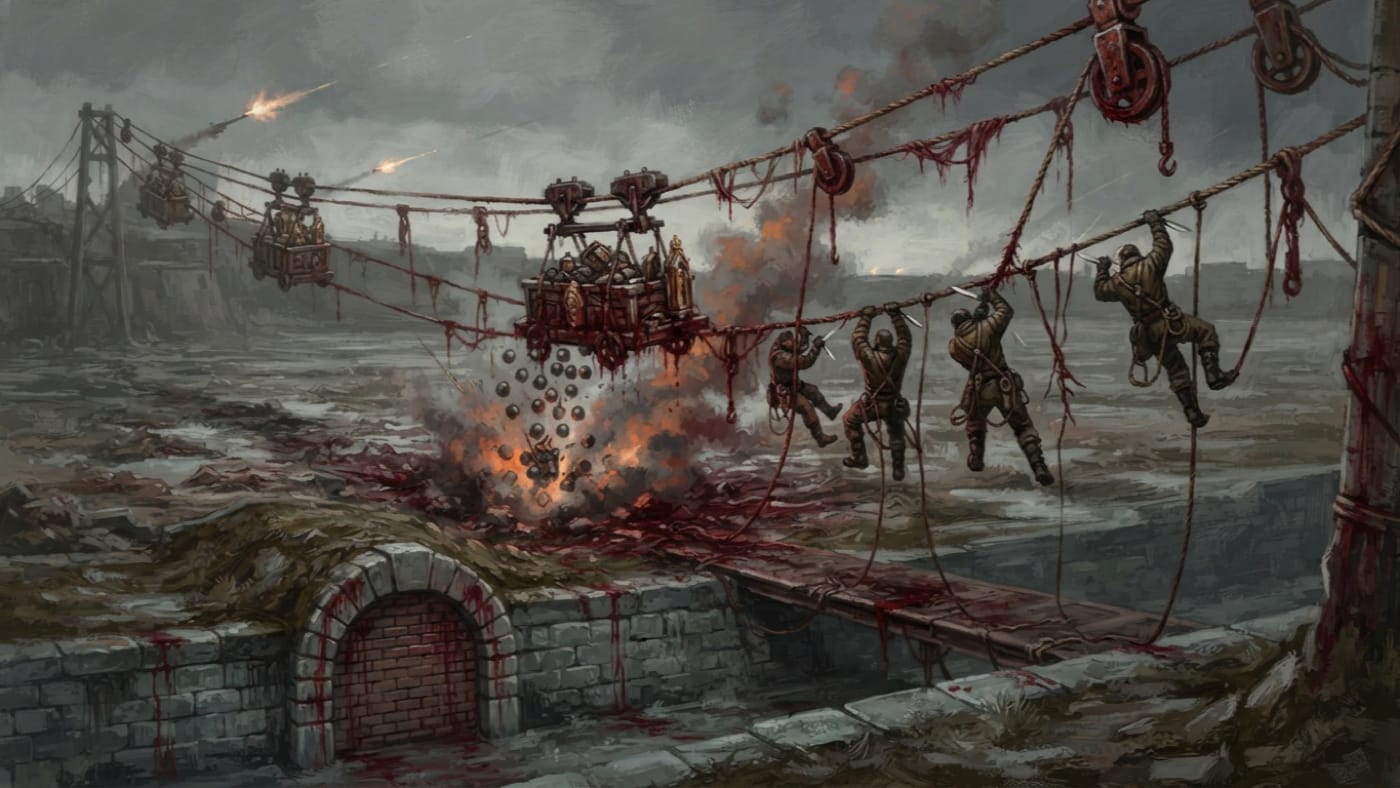
The Incident of the Crimson Pulley belongs to A.S. 189 and to the Knife Mile. A single supply trolley set out across a ropeway carrying reliquary shot and reached the trench below by a faster route than Engineering had approved. The sector faces the Ravelin of Vigilance, the First Outer Ravelin of Bastion-Constantinople. From there the southern anchor of the Sagittal Line watches the northern approach across No Man's Land. Ground in that sector is a matter of opinion. Raids shave the parapets to stakes overnight. Plank crossings sink. Flesh-Mud keeps whatever it is lent and charges interest in boots.
So the freight goes overhead. A cart would sink and a porter would be eaten, so shot, salt and rations travel by trolley and pulley above the mire, swinging like a censer over a congregation that stopped listening long ago. War loves the ropeways because they move ammunition. The men who maintain them love them the way a penitent loves his hair shirt: daily, and against his will.
The Mile had already made its name in A.S. 137, when Shield Paladins sank into the mire and became a causeway, and the Ledger learned to record casualties by depth. That catastrophe has its own page. I mention it only so the reader understands why nobody walks the Mile when a rope will do.
#On the Repair
Midway across, the trolley's axle sheared.
A trolley stalled at mid-span is a sacrament with nobody to receive it. It is heavy and it does not move. It is packed with consecrated explosive and hangs over a trench whose mud will collect it sooner or later. A stranded load strains the line, the strain spreads, and every crate behind it waits. Men went out along the rope to repair it. The account says they scrambled. I accept the verb, because nobody walks calmly along a hemp road above the Knife Mile.
Rope repair is liturgy performed in midair. The cords of the Rope Roads are blessed and knotted with catechism, and a splice under load is a sequence: one hand takes the weight, another makes the cut, a third re-ties, and each waits for the one before. Get the order wrong and the load takes its own decision. For this reason the crews are trained to work deaf. They pack their ears with reliquary wax, keep their eyes on the rope and speak only in tugs and gestures. A tug is a word. A gesture is a clause. A rope crew at work is a silent order of monks whose only scripture is tension.
That is the general practice of the ropeways. The account of A.S. 189 records none of this crew's particulars. It gives no number of men, no names and no ranks. It records an axle, a repair and what followed.
#On the Signal
Then, the account says, the Pale Chanters struck. They did not use song, their usual instrument. They used silence, which the source describes as a stolen hymn turned back upon the crew. I record the phrase as it stands. I do not claim to know what a refracted hymn sounds like. I am not certain it sounds like anything.
Each worker believed he had received the signal to cut and re-tie.
Consider what a man on that rope possessed in that moment. He had wax in his ears, a blade in his hand and the drilled certainty that the signal, once given, must be obeyed at once, because hesitation on a rope is a kind of falling. He had his instruction, or believed he did. Nothing in his body argued with it. The Ledger is careful on this point and so am I: the source says believed. It does not say what he heard, who gave the signal or how it reached a man whose ears were sealed for exactly this reason. Deaf men received an order. The Bureau has not reconciled those two facts and I will not do it for them.
Each cut at once.
Every drill sergeant on the Line dreams of obedience in perfect unison. At the Crimson Pulley it was achieved. Every blade fell on the same beat, every man was confident and every man was correct by his own account, and the rope they cut was the wrong one. The splice had no hand left holding the weight. The trolley dropped.
It fell into the trench below, and the reliquary shot did what reliquary shot is blessed and packed to do. The detonation came after the fall. I keep the order exact because the men on the rope lost theirs, and the Ledger owes them at least a correct sequence.
Some survived. The source says so because survivors gave testimony, and that testimony is the next entry.
#On the Crimson Entry
Survivors swore the pulley bled as it fell. They said it left the rope crimson along its run, as though the iron had opened a vein on the way down. Soldiers have called the place the Crimson Pulley ever since. The name has outlasted every attempt to rename it, and nobody has made a serious attempt.
Records filed oxidation.
I defend the filing. Iron rusts. Rope stains. Men who have just watched their crew fall and their freight explode are poor judges of chemistry, and Records exists so that the Ledger is not written by whoever happened to be shaking hardest. The filing is tidy. It has a noun in it, and the noun has a laboratory behind it.
I also note that no clerk of Records was on the rope.
The survivors' testimony stands in the annals beside the institutional explanation, and the two have never been reconciled. Both are entered. Neither is withdrawn. Bleeding is what the witnesses said. Oxidation is what the Bureau decided. A reader who wants a third column, headed What Actually Happened, may apply to Doctrine for a form. The form exists. The column does not.
Losses of rope crew in the Knife Mile ropeway ledgers are entered under "loss."
Corrected under the Tithes Bureau's second revision, which governs rope casualties on every Rope Road ledger and was not issued in answer to this incident. Rope casualties are no longer logged as loss. They are entered as "contributions to vertical sanctification." The men of A.S. 189 fell under the general rule, as men usually do.
#On Recess Nine
The aftermath of the Crimson Pulley belongs to the stone of Vigilance as much as to the mud of the Mile.
Twelve listening recesses run along the ravelin's lower north wall, beneath the public parapet and above the wet ammunition runs. Each is a cramped chamber holding a copper funnel, a slate board, a wax plug and a bell-string, with room for one listener and nothing that could be called comfort. The listeners sit their turns and write down what the forward ground offers: rope strain, distant chant, false bells, voices that should be dead, and silence of reportable thickness. The last is the category that keeps theologians employed.
Recess Number Nine began to report rope tension when no rope was fixed.
It went on to report bell-clicks in answer to questions nobody had asked.
The ravelin's account does not say exactly when these reports began, before the trolley fell or after it. It says that after the Crimson Pulley incident, and in the same year of A.S. 189, Gate-Warden Petra Valenne ordered the recess filled. She used lime, then brick, then three broken clappers. A bell that has failed is still a bell, and Valenne knows the use of a silenced witness. Nobody has proposed a fourth ingredient.
I will not tell you that Nine caused the incident, or that the incident caused Nine, or that the two are one creature in two places. The sources place the recess and the rope in the same year, the same sector and the same sentence. The chronicler's task is to keep them there and take them no further, however much the reader may want a connection.
The Bureau of Bells requested access for study. This was reasonable. A recess that answers unasked questions with bell-clicks is very nearly Bells' entire jurisdiction in a single room. Valenne answered with a sketch of a closed door. Bells filed the reply as non-cooperation. Valenne filed silence. Of the two documents, hers is the better drafted.
#On the Remaining Watch
As of the A.S. 201 survey, twelve years on, the Knife Mile is still in use. Trolleys still cross it. Reliquary shot still runs through its pulleys. Rope crews still go out with wax in their ears and their eyes on the rope, and they still speak in tugs, because the ropeways have no better language. These are the standing precautions of the sector, older than A.S. 189. No reform drawn from the Crimson Pulley in particular has entered the record, and I decline to invent one for the sake of a better final paragraph.
Vigilance still watches. Eleven recesses still listen. The twelfth is masonry.
The seal on Recess Nine sweats red when it rains. This has been observed and entered. It is a separate entry from the bleeding pulley of A.S. 189, which was testimony about falling iron over a trench. The seal is brick on the ravelin's own wall, witnessed in weather. Nobody in authority has joined the two in writing. Any clerk who intends to be first should first have his reasons countersigned by Doctrine and then by Valenne, in that order.
Access to Recess Nine remains refused, and the Ledger records it so.