
#On the Name, Which Is Not a Province
Two articles cite this place. Neither says where it ends.
The Iberian Approaches appear in the Codex twice before they appear here, and both times they appear beside a pit. The Ash-Mothers entry places a Velkara-aligned compound "in the Iberian approaches." The Ash-Rain entry places it there again, close to Zaragoza's outer farms. Both hand the phrase to the reader as though a surveyor had walked it. No surveyor did.
I have searched for the boundary. I found no perimeter, no charter, no capital, no garrison roll and no line on any map I have been permitted to unfold. There is no Warden of the Approaches. I would know, because he would have written to complain about my prose. What exists is a descriptive phrase for the inhabited ground through which one comes to Zaragoza. It is documented with certainty in one place only: the farms, warehouses and road at the city's edge where, in A.S. 143, Synod artillery found something the Church had certified absent.
The record does not say whether the term reaches further, toward other roads or other Iberian cities. I will not say it for the record.
Iberia is Zone One, the western heartland, far behind the north–south spine of the Sagittal Line. Zaragoza is no frontier town. No trench runs past its olive groves. The front lies across the whole breadth of the Church, reached by mule and by prayer. That distance is the scandal. A pit east of the Carpathians is a horror. A pit behind the heartland's tariff chapels is an audit failure, and the Synod fears audit failures more than it fears horrors.
#On the Ground Between the Farms and the Gate
What the record does supply is ordinary. Its ordinariness is the evidence.
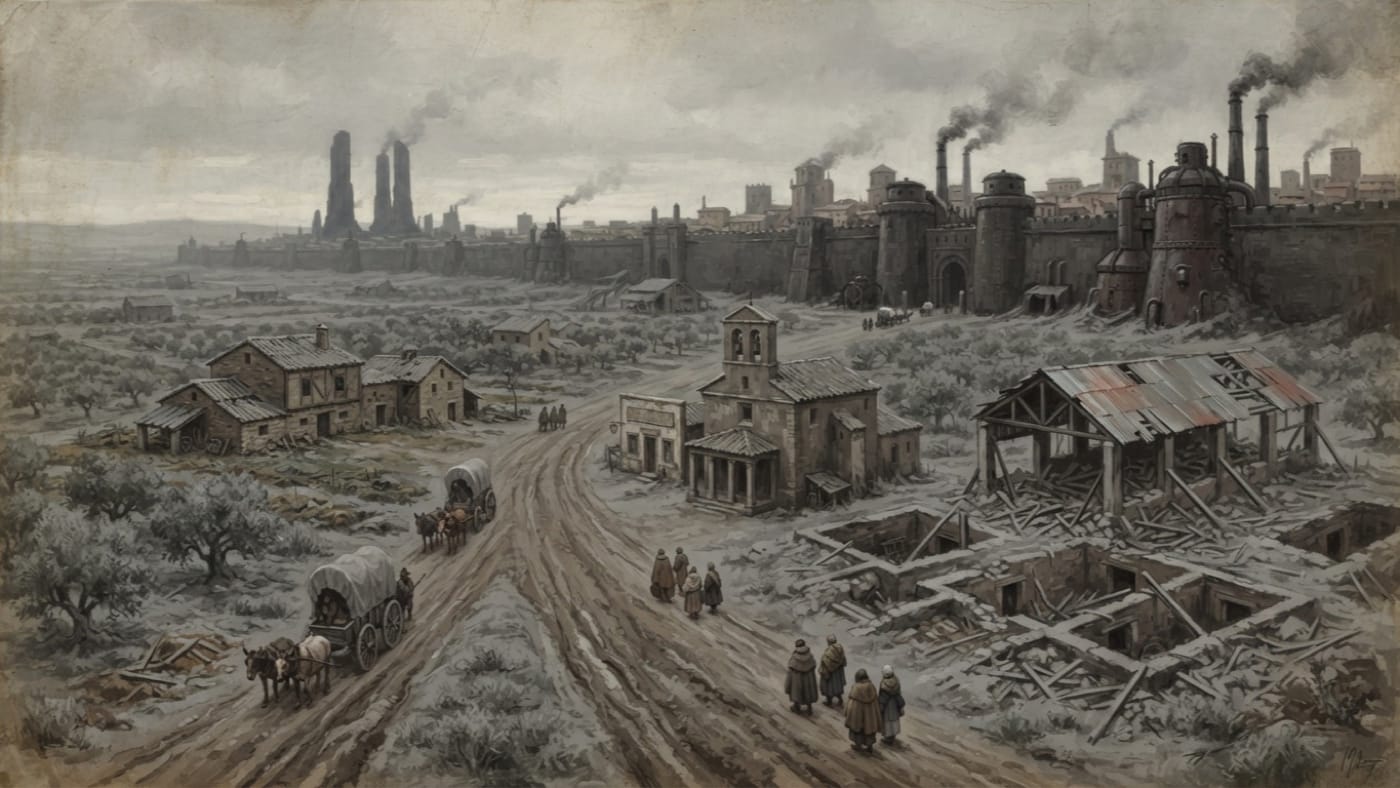
There were outer farms. There was an olive warehouse, with a roof broad enough to shelter carts and a floor solid enough to hide what was dug beneath it. There was a rural dispensary, licensed for births, fevers and the dying. There was a tariff chapel, where goods bound for the city's markets were weighed, blessed and charged, in ascending order of sincerity. And there was a road. It carried mule-carts, grain, oil, market women, and pilgrims bound for the Pillars of Glass, who come to Zaragoza to stare at punished sinners and buy sweets on the way out.
None of it was hidden. That was the method.
The published account of the incident records that local collaborators supplied the compound with shelter, ledgers, guards, medicines and beds. They also supplied the small civic permissions without which a cellar is only a cellar. A warehouse needs a lease. A lease needs a seal. Carts need road-passes, oil needs tariff entries, and a dispensary needs a licence and a linen quota. Each document is small. Each was signed by someone who kept a Bureau stamp in a drawer and had some reason not to look under the floor. Stack them together and you have a permit for an atrocity, issued in pieces. No single clerk would have recognized the whole.
The Codex associates Velkara's servants with the Velvet Choir, the network by which Lust enters Synod territory through debt, appetite, medical exemption and a gentle voice at the right door. I name the Choir because the Ash-Mothers entry names Velkara's alignment. I do not name its local cell, its size or its masters, because no surviving paper does, and I will not decorate a pit with an organization chart. The record lists collaborators. It does not sort them into servants of the Great Deceiver, hirelings and the frightened. The Bureau of Purity claimed the sorting and did not finish it.
The women in the pit belong to none of those categories. They were captive, chained and drugged. Their bodies were the compound's purpose and its raw material. Whatever confessions the inquiry extracted from the farms, it extracted none from these women that could make them party to their own use.
#On the Certificate and the Linen
Six months before the guns, Purity certified the approaches clean.
I have examined Purity certificates professionally for longer than some of its desk-officers have been alive. They are handsome things: a white seal, a black ribbon, the grammar of a bride. They certify that a district is free of hostile seduction. They do not lift floorboards. Purity inspects faces, gates, songs and the private habits of junior clergy. It does not count linen.
A tariff-chapel clerk counted linen.
According to the incident account, a rural dispensary near Zaragoza had requested six times its permitted allocation of clean linen while reporting no births, no surgery, no plague and no funerals. Linen has no discretion. It goes where blood goes, and it comes back to the laundry carrying the evidence. The clerk forwarded the discrepancy to the local Purity desk. Purity filed it as domestic irregularity. The Bureau of Records faithfully copied the misfiling into three ledgers, because Records is loyal to the shape of a page and indifferent to what the page says. The figures then sat in the ledgers. Eventually an artillery officer of the Bureau of War, conducting a supply audit with the wrong bundle of papers, read the linen requisitions beside his own shell-fuse returns. He reached the conclusion that four desks had missed.
In the approaches, the Church was saved by a man reading the wrong papers. I would like this to be a parable about Providence. It is a parable about filing.
#On A.S. 143
The bombardment has its own entry, and the Ash-Rain of Zaragoza tells the story at the length it deserves. Here I give the approaches their share.
In A.S. 143 the guns struck the compound beneath the olive warehouse. The roofs went first. Under them was a reproductive installation of the kind the Ash-Mothers entry describes, and one of the few ever confirmed west of the Carpathians. Women were kept there for bearing. Their offspring were destined for sorcery or for the ranks of the enemy's mortal auxiliaries. The compound burned. Its smoke rose and then came down again as ash, and for three days it fell on the farms, the road, the warehouses still standing and the city beyond them.
It tasted of salt and milk. The published account collects thirty-seven testimonies that use the phrase. Children who breathed the ash slept for three days without waking. These are two separate observations, and the Codex will keep them separate: three days of ash-fall, and three days of sleep. Most of the children woke. Fourteen woke and never spoke again. Older oral accounts claimed the children died in their sleep. They did not. They lived, and their silence has been filed ever since across four offices.
The Bureau of Medicine filed its report in A.S. 143 and recommended quarantine. The Bureau of Settlement recommended classifying the event as atmospheric. The Bureau of Doctrine recommended silence. I serve Doctrine. I will say only that silence was chosen, and that I have defended worse choices with better sentences.
No citywide quarantine was enacted. The approach road stayed open. Carts came in under grey canvas, and pilgrims kept arriving for the Pillars. The Order of Saint Ephrath closed its punishment precinct for nine days, officially for polishing. That closure covered the Pillars inside the city. Nobody closed the farms. The tariff chapel opened at the morning bell, and olives do not wait on doctrine.
#On the Present Condition
What remains is rubble, residue and wording.
The published accounts give the approaches no monument, and I will not invent one. On damp mornings, pale dust still gathers on the lower plinths of the Pillars. The guides call it road powder, a name that sends it back down the road it came from. Local mothers keep their children from touching it. Purity objects to the superstition, yet it replaces the plinth cloths twice as often as it did before A.S. 143. The polishing cloths are more candid than the certificate.
The record I have seen does not say whether anything still stands where the warehouse stood. It does not say whether the dispensary kept its licence. I have found no later certificate covering the approaches, and I would have found one, because I looked for the pleasure of quoting it.
The record does show a correction. The Bureau of War commended the bombardment in language it later had to amend.
"Clean suppression of hostile reproductive infrastructure."
Corrected by the Bureau of War in A.S. 158: "successful interruption of hostile reproductive infrastructure with persistent civic residue." It took fifteen years, and the loss of one adjective, to concede that the approaches had never been clean.
"Persistent civic residue" is the nearest thing the approaches possess to a legal description. I have proposed nothing better. A boundary drawn now would be drawn by Purity.