
#On the Trade in Quiet
"Silence is the most expensive hymn." — Essen proverb
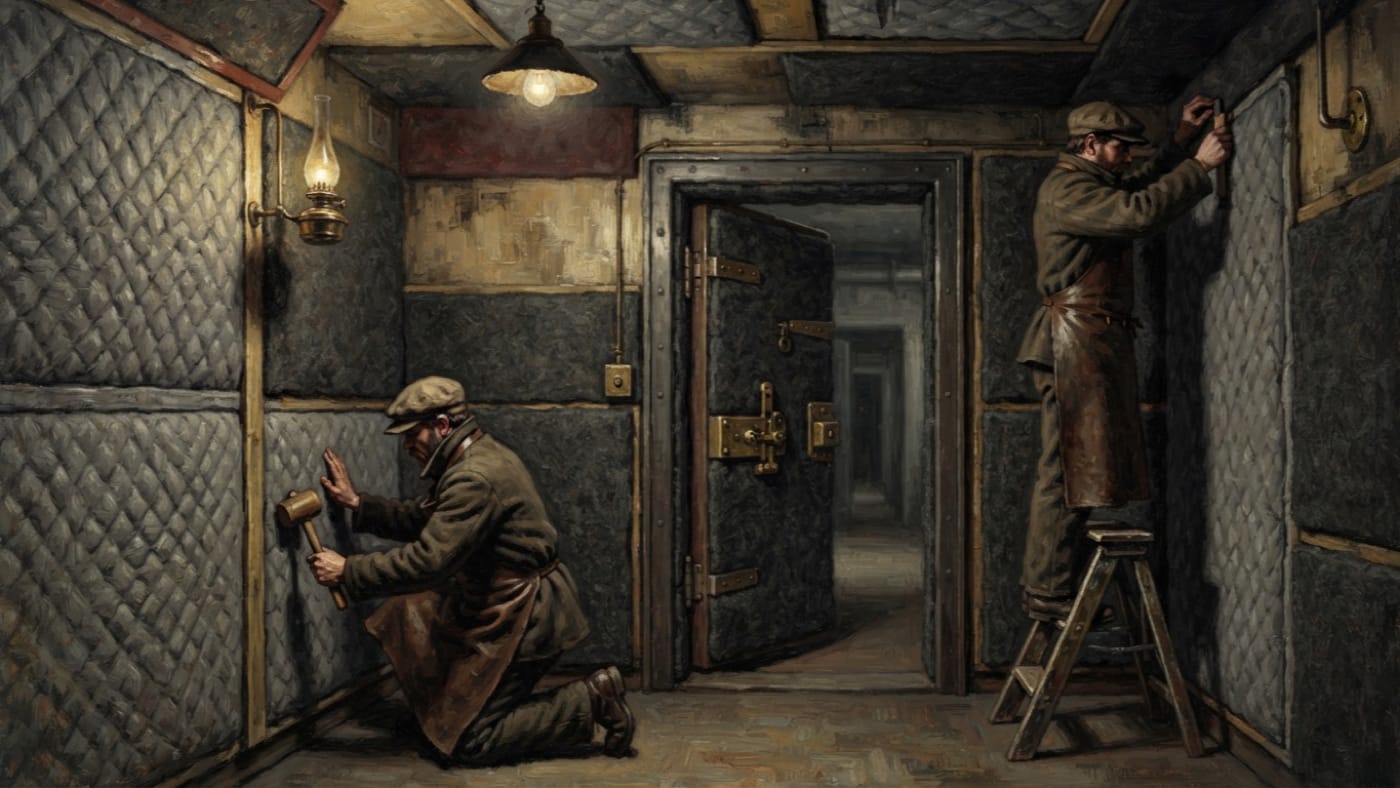
Essen-of-Hymnsteel sings because its steel will not behave otherwise. Shift bells open the day. Calibration choirs sing over the crucibles while the metal pours. Curfew sirens close the night and are called the night hymn. In the hours between, cranes, chains, lock-gates and the Quota Recital fill whatever silence the bells leave. Into this noise the city admits one trade whose product is subtraction. The hushwright is a sound-baffle artisan. A hushwright lines a room with hush-cloth and felted ash, closes the seams with carpentry, and sells the result by the square foot, as the street puts it.
The hushwright is a worker. The Hushwright Guild is an institution. I keep the two apart because the provosts do not. An artisan with a mallet and a roll of cloth fits the room. The Guild holds the contracts, the territory in the Quiet Gradient and in selected chapels, and the friendships among the elite that make a contract enforceable. A worker who felts a door has blackmailed no one by doing so. That worker has, however, made blackmail much more comfortable for whoever rents the room afterwards.
What the trade sells is plain: sleep, hearing kept a few years longer, and a conversation that nobody else is made to hear. Essen counts private silence as wealth, alongside certification, clean air masks and hearing itself. The streets use a shorter word for the people who own it. They call them quiet-rich, and they do not say it kindly.
#On Cloth, Ash, and the Permit
The materials come first. Hush-cloth is sold openly by the Guild and covertly in the duct-markets, and the lock clerks confiscate it when the mark is wrong. Felted ash is listed among Essen's local materials alongside slag-glass and bone-lime cement. The wood is sealed and joined by carpenters, whom the Guild counts among its resources the way a cathedral counts its masons. A finished room in the Quiet Gradient smells of lavender soap and sealed wood. That is to say, it smells of nothing that happened at the foundry.
The skill is in the joints: door edges, sills, flues, and the one floorboard that carries a peal through the joists the way a novice carries gossip up the dormitory stair. I will not guess at the proportions of cloth to ash. The Guild does not publish them, and an artisan who did would be undercut by a cheaper rival before Ninth.
Then comes the law, which has nothing to do with joinery. In Essen silence is property, and it is licensed, taxed and checked by patrol. Silence without permit appears on the same list of forbidden things as unapproved songs and the question "why this stanza." A baffled room is a physical fact and a Quiet Permit is a legal one. The city requires both, and the provost who knocks at a felted door has come about the second. Quiet-room permits are among the short list of Essen documents that are always for sale. Which hand signs which paper, and in what order, I leave to the Bureau of Records, which would charge me for the explanation.
Hearing protection is under the same rule. Ear-plugs are stamped and serialized. Unlicensed hearing protection is contraband, and so is quiet cloth without a Bureau mark. A worker who shows licensed ear-plugs to a clerk is offering a courtesy, and the clerk accepts it as one. It is the only mark of respect in Essen that a person wears inside the skull.
#On the Customers
The trade has three kinds of buyer, and the city ranks them as it ranks everything else.
At the top are the Sealed Elite of the Quiet Gradient, whose dampened homes the Guild treats as its own territory. Next to them are the certified engineers, for whom the city keeps Silent Zones, streets baffled against the din so that the people who calculate the din can think. Then come the selected chapels. I make no comment on a house of prayer that pays to keep out the sound of the city's prayers, except to record that it pays.
Below them are the Certified Artisans, protected but watched, who buy quiet rooms and pay in oath-notes for an extra hour of silence. Such an hour can be the difference between a steady hand at the pour and a missed bar.
At the bottom is the Ash Warrens, where people rent warm floor-space on the duct grates and pay in heat credits. Essen's own description says the poor there go half-deaf early. Their only hush is the one sold after curfew in the duct-tunnels under the Shard Markets: hush-cloth, counterfeit seals, and rooms advertised as quiet that the trade calls "false quiet." Some of those rooms may work. The buyer cannot tell which until someone outside has heard everything.
The Guild counts the Shard Markets as enemies. A monopoly always resents the counterfeiter more than the thief, because the counterfeiter calls the price into question.
Across every tier, the hushroom is rented by the hour for secrets, affairs and heresy. The Gradient that holds the finest residences also holds the rooms where conspiracies meet, and the Gradient is watched. I record the watching. I do not describe how it is done, because the record does not.
#On Silence Rented to Both Sides
The Mirror Choir has no chapel. Among its other venues, it meets in hushrooms rented under false devotional names. The Bureau of Purity has hunted it since A.S. 187. On the conduct of this trade during that hunt, the Codex has already entered the necessary sentence: the Hushwrights rent silence to both sides.
The first side is obvious. A Discord Scribe rehearsing an altered syllable needs a room where the syllable does not carry. A thick door suits that work well.
The second side is the same door. A room that keeps a stanza from the street keeps an informer's name from it just as well. Hunters must meet their sources somewhere, and the foundry floor is a poor confessional. Rented silence carries no oath and takes no side. It goes to whoever pays the hour.
This is the distinction Purity finds tiresome. A room's use does not certify its installer's loyalty. The artisan who felts a chamber for a devout-sounding society cannot hear what that society sings, which is the whole point of the job. Selling the same craft to the respectable and the clandestine proves trade across the conflict. It does not prove that every hushwright belongs to the cell that rented the room.
Its own recorded methods do not help the Guild. It works by contract, by blackmail and by clandestine installation. These are institutional facts and do not indict every journeyman with ash on the sleeves. But an institution that installs rooms in secret and keeps leverage over the people inside them has built a register of confidences that nobody at the Furnace Basilica has sealed. Who commissions a clandestine installation, the record does not say. It says only that the Guild performs them. A sentence like that ought to keep Purity awake. For want of a felted room, it probably does.
No hushwright design has been proven to shelter heresy meetings. That word proven is the only thing standing between the trade and the provosts.
The Tri-Bureau Compact gives the trade three masters to fear. Arch-Notary Veyl of Records controls the certification stamps, and every Quiet Permit is a stamp that can be revoked. Master-Calibrator Sister Rauth of the Bureau of Orison and Song decides which stanzas are approved, and a room where no stanza can be heard is a room where an unapproved one can be practised. Furnace-Marshal Kord of the Bureau of Engines and Furnaces controls fuel and overtime. By furnace arithmetic, an hour sold to a sleeping worker is an hour lost to the pour.
The street knows two Guild figures by habit alone. Lenz the Feltmaster is never heard above a whisper. The one called Sister Lamp speaks with the eyes. In Essen, a person who makes no sound has either a licence or an alibi.
#On Silence Beyond the Craft
Essen uses the name Silent Zone for two different things, and careless clerks confuse them in the ledgers.
The first is the engineers' Silent Zone: streets baffled by human work and reserved by permit. It is quieter than the rest of the city. It is not silent.
The second comes after a Resonance Bloom. The signs are known. Tools hum on the benches, teeth ache, rivets shear, bell-cannon throats crack, and people bleed from the ears. When it is over, a district may fall into a silence in which sound dies for days. No hushwright made that silence. No hushwright has produced its equal in cloth and ash. If one ever did, I know what Orison would call the design, and I know which fire would receive the drawings.
The approved countermeasures are counter-psalms, shutting the Seven Locks, lining the streets with felted ash, and, according to superstition, bone shards nailed into doorframes. The street-lining is the only item on that list that uses the hushwright's materials. It is listed. It has not been shown to cure anything. Felt can dull what a person hears. Nobody has demonstrated that it changes what the foundations say.
Compact Report 447-E attributed all recent Resonance Bloom events to Mirror Choir sabotage.
Carried forward from this Codex's Mirror Choir record: the report was withdrawn under sealed Bureau of Rites review, because Bloom activity predates the Mirror Choir's earliest documented operations by approximately forty years. The three events of A.S. 199–201 remain disputed. A district silenced by a Bloom is therefore not evidence of a Choir installation, and certainly not of a Guild one.
The craft has one more silence to answer for. In a panic, the Seven Locks can be muted, baffled at the freight gates until the alarm bells can no longer be heard. The city calls the result a hush. Lockhands call it the minute in which nobody hears the warning. The same art that lets a skilled worker sleep can keep a whole district from hearing its own alarm.
All of this is now under procurement pressure. Engines wants higher output for the Sagittal Line. Orison will not speed up the tempo without liturgical stability. Records profits either way. More output means more noise, and more noise raises the price of every felted square foot. The hushwright's market grows with the din, and so does the trade's exposure, because every room sold is one more room a provost may one day have to open.