
#On the Trade in Quiet
Essen-of-Hymnsteel is loud by statute. The Bureau of Orison and Song orders the work bells and the shift psalms. The calibration choirs sing to a schedule the steel itself is said to obey. This is the hard arithmetic of armament. The hymnsteel poured at the river fork becomes bell-cannon throats, hymn-drive housings and reliquary fasteners for the Sagittal Line, and a city that drifts off its cadence ships cracked metal to men who must fire it. The Compact has drawn the obvious administrative conclusion. If sound is a matter of armament, so is its absence, and every ear among four hundred and ten thousand belongs in some measure to the war.
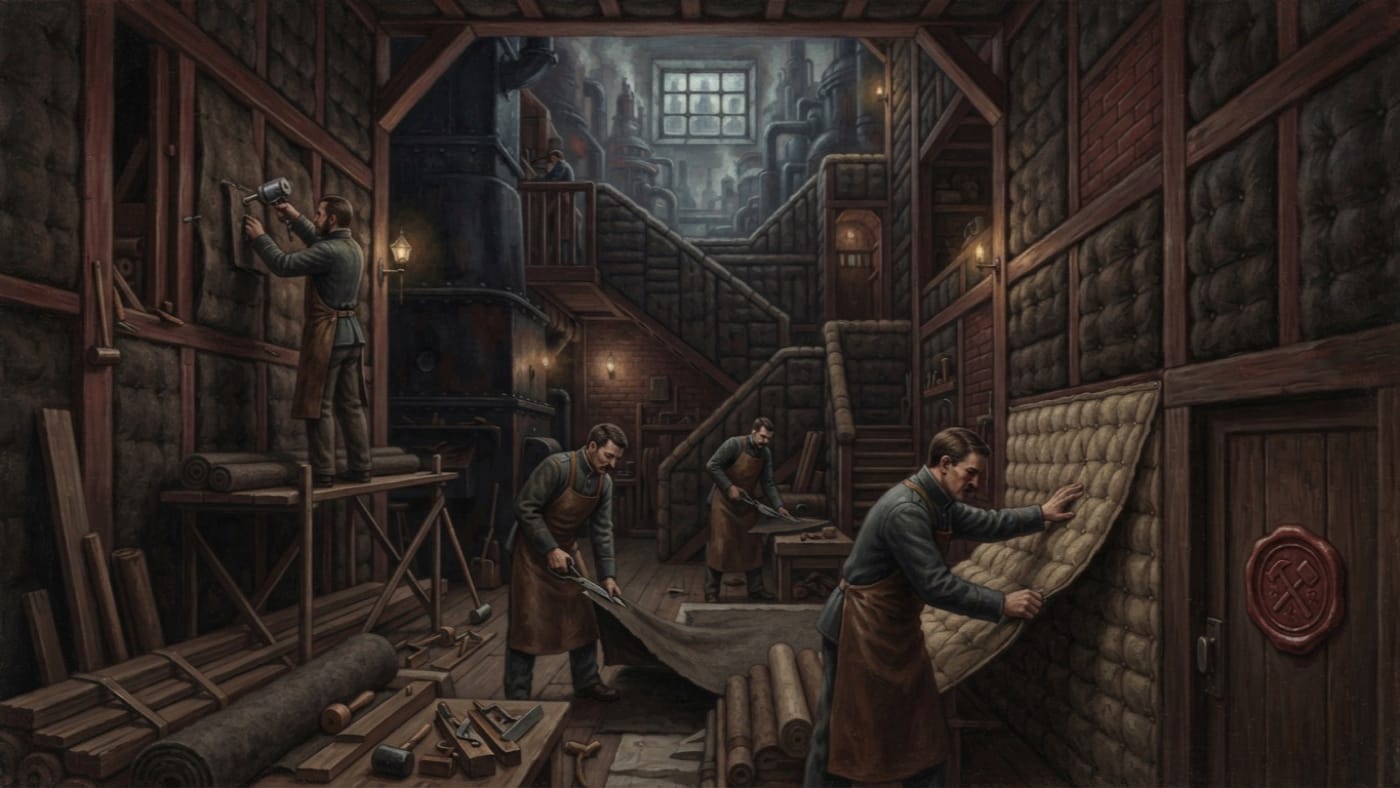
The Hushwright Guild has fitted itself into this arrangement as snugly as a good baffle. Its members are sound-baffle artisans. They line rooms, seal timber, hang hush-cloth and lay felted ash. When they have finished, a notary, a foreman or a sufficiently distinguished visiting theologian may lie down at the Seventh Bell and hear nothing until morning. The Guild works in the Quiet Gradient and certain select chapels. It says it sells safety. What it actually sells is sleep, hearing and the privilege of going unheard, and in Essen these are among the few kinds of wealth worth stealing.
The street calls its clients "quiet-rich." The street means it as an accusation.
#On the Materials and the Seal
The hushwright's craft is carpentry with a theological alibi. A room is opened to its studs. Sealed timber replaces the old boards. Felted ash is pressed into the cavities, and hush-cloth is hung and tacked in layers until the walls take on the padded dignity of a confessional that has heard too much. The carpenters work with awl, mallet and plane. When they leave, the room smells of lavender soap and sealed wood, as the upper Gradient does and as nowhere else in Essen does.
The Guild has never published how much sound a lining defeats, or what proportion of ash to cloth it uses, and this Codex will not guess. A trade secret is property. The Guild owns several.
What the Guild owns beyond dispute is the seal. The surviving advisory under Compact Ordinance 7-C, posted by Orison, establishes four points and nothing more. Unauthorized silence violates the ordinance. Every sound-dampening material must bear a current Hushwright Guild seal. Unlicensed hearing protection is contraband. Violations are reported to an Orison Provost. Elsewhere silence is recorded as licensed, taxed and checked by patrol, and the householder who wants to be quiet holds a Quiet Permit for the purpose.
The division of labour is almost elegant. The Guild certifies the felt. Orison polices the hush. Under the Tri-Bureau Compact, the Bureau of Records certifies everything else, including whether the householder exists. The advisory does not say how often a seal lapses, what an inspection costs, or whose signature on a Quiet Permit weighs most. The provosts, one gathers, know.
#On the Customers and the Competition
The Guild's allies are the elite. That is to say they are its customers, which is to say everyone in Essen who can afford the alliance. A room in the Quiet Gradient costs more than a lockhand earns in a year. That figure is the summit of the market. Further down, skilled residents buy smaller mercies: a quiet room, or an extra hour of silence paid in oath-notes. The poor buy nothing. They rent warm floor-space by the vents of the Ash Warrens and go half-deaf by thirty.
Between the felted bedchamber and the ruined ear sits the ear-plug. In Essen plugs are stamped and serialized, and showing a licensed pair is a recognized mark of respect, as a canon shows his ring. The man with numbered wax in his ears is informing you, with perfect courtesy, that he is permitted to hear less than you.
Two figures are commonly associated with the Guild. Lenz the Feltmaster always whispers, as though the trade had got into his throat. A figure known as "Sister Lamp" speaks with the eyes, a glance to the seam, to the client, to the exit, and the carpenters understand. The Codex records nothing further about either one. It declines to promote a whisper or a look into a biography.
The Guild's enemies trade below the slag-line. In the Shard Markets and the duct-tunnels beneath them, hush-markets open after curfew. They sell cheaper hush-cloth, counterfeit seals, and "false quiet" rooms let to anyone with coin and a reason. The Shard Market Syndicate deals in forged stamps among its other lines. Plenty of duct-traders answer to no cartel and undercut the Guild all the same. Each counterfeit seal costs the Guild a sale and costs Orison a fact.
#On Privacy and Suspicion
The record lists the Guild's methods as contracts, blackmail and clandestine installation. The first is commerce. The second follows from the first with depressing regularity: a firm that lines your bedchamber knows who sleeps in it, and a firm that lines your chapel knows what is said there while the bells are loudest. The third, a room quietened without the Compact's knowledge, is exactly the unauthorized silence Ordinance 7-C forbids, committed by the body whose seal makes silence lawful. This Codex names no victim, no room and no commission. The methods are entered on file, and the file is thick.
This is the Guild's particular exposure. It sells privacy in a city that presumes privacy to be seditious. A hushroom suits an affair, a falsified ledger, or a gathering that sings stanzas Orison never approved, and it suits all three equally well. The Guild's prosperity depends on the Compact believing that every room it quietens is occupied by someone respectable. That belief is renewed one seal at a time, and the Bureau of Purity has never been obliged to share it.
Purity's long hunt for the Mirror Choir has taught the city to look for heresy wherever a sound goes missing. The habit needs correcting.
This Codex's survey of Essen-of-Hymnsteel attributed all Resonance Bloom events to the Mirror Choir heresy, per Compact Report 447-E (A.S. 198).
Retracted and carried forward. A Bureau of Rites investigation (file sealed) places Resonance Bloom activity approximately forty years before the Mirror Choir's earliest documented operations. The universal attribution is withdrawn. A careless provost should not now transfer it to the nearest quiet room.
After a Resonance Bloom, a district of Essen can fall silent for days. Voices do not carry and footsteps make no sound. The walls swallow every vibration. No hush-merchant has reproduced this, and beside it the Guild's finest lining is a curtain hung in front of a cannon. Felted ash is listed among the countermeasures laid along afflicted streets, but whether it accomplishes anything has never been shown. No evidence available to this Codex suggests the Guild has ever caused a Bloom. It has not cured one either. What lies beneath the foundations is a question for the Bureau of Rites, the Bureau of Doctrine and the Creator, in ascending order of reticence.
#On the Present Position
The Guild holds no seat on the Compact. Furnace-Marshal Kord governs production for the Bureau of Engines and Furnaces. Arch-Notary Veyl governs identity for Records. Master-Calibrator Sister Rauth governs approved sound for Orison. The Guild governs felt. It is the wealthiest faction in the city, and all of that wealth rests on a licence, which its issuer may always read again.
Strasbourg's demand for tripled output remains in dispute among the three Bureaus. If the furnaces run longer and the pours run louder, the quiet-rich will want more quiet and the Guild's order-book will fatten. This Codex offers that as inference only; the ledgers have not yet confirmed it. A busier Guild is also a more visible one, and in Essen visibility is the first stage of audit. The Compact Council has never loved an independent guild. It tolerates this one because the Council sleeps in its rooms.