
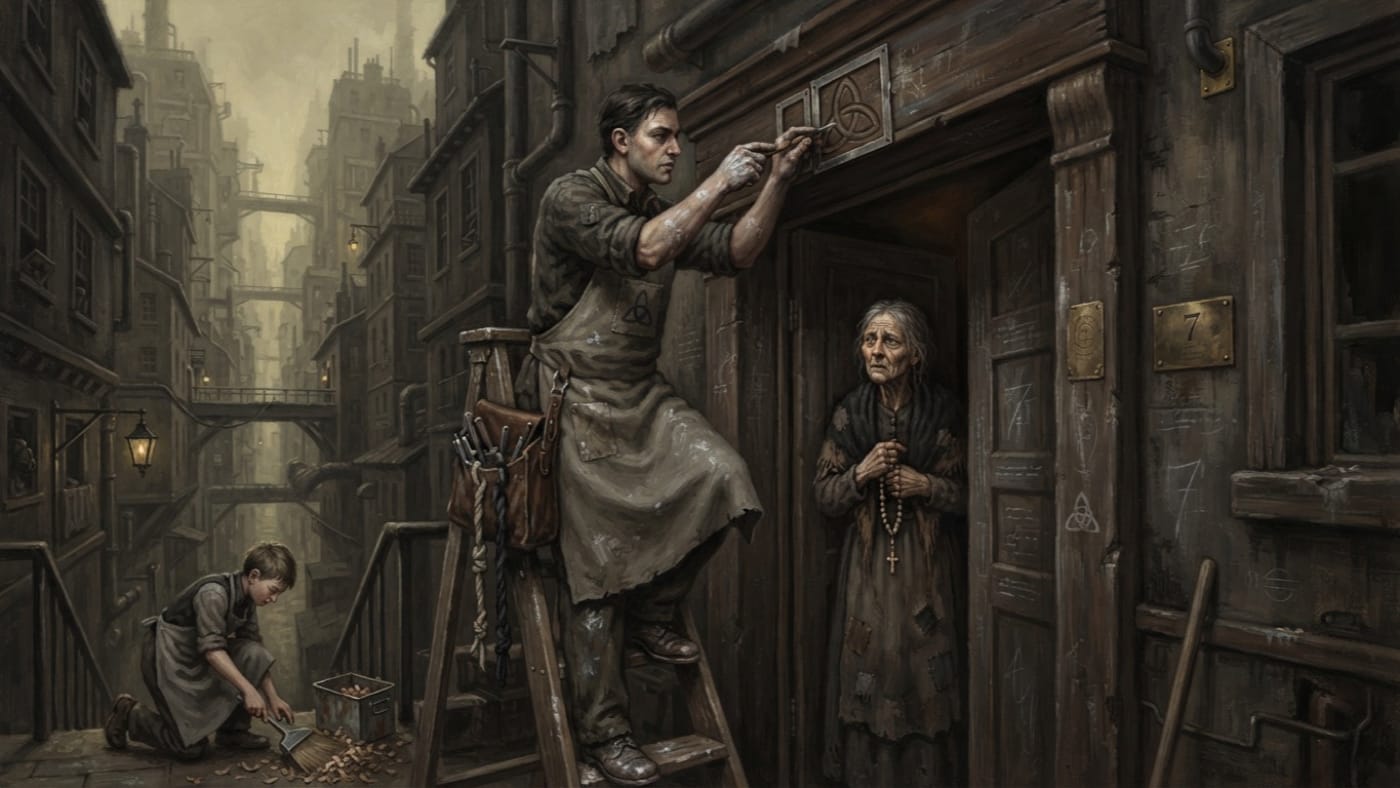
#On the Household Threshold
House-Knotters are the Gate-Carvers who chose the living as their surface. They cut the Triune Knot into the doors, lintels and shutters of dwellings: tenement frames, ward-house posts, the stone lintel over a widow's two rooms. They hold the profession's licence and wear its grey apron and three-loop badge, and their fingers are as chalk-stained as anyone's in the trade. Within the profession they form a faction. Two things define it: where they work, and their contempt for the Grave-Sealers, which the Grave-Sealers return in full. The Knotwright Registry files them under the profession and keeps no separate column for their pride.
Their clients can talk back. No grave has ever asked whether the mark could be made a little larger.
What a House-Knotter sells is moorage. The profession's teaching is blunt: a house without a Knot is unmoored. It cannot claim rations or call for mercy, and it cannot prove that its dead are dead. The family inside may be pious, solvent and loudly alive. Without a registered cut above the door, the Church regards them as a rumour with furniture.
#On the Cut and the Register
Take an ordinary household order of the kind that fills a Knotwright shop's queue at dawn. I made this one up for teaching purposes, so no inspector need go looking for the door.
A tenant arrives with housing papers and a landlord's grudging signature. Before unwrapping a chisel, the House-Knotter checks the claim against a sponsor or the local ledger. The carver does not decide who lives in the rooms. That belongs to the Housing Allocator, who issues occupancy permits and, when the season turns, relocation orders. The carver only confirms that the paper in the tenant's hand matches the paper in the book. A handsome Knot cut over an unverified claim is evidence against the one who cut it.
The class comes next: household, or ward if one door serves a block. The class decides the stencil, and the stencil decides the geometry.
Then the measure. The tri-cord, three knotted lengths, is stretched across the lintel against an approved stencil-frame. The frame's serial number protects the carver and also keeps them on a leash. The cord must be dry, because wet cord lies. A House-Knotter caught by rain on a tenement stair keeps the cord under the apron bib and lets the shirt take the damp.
Then the cut, into whatever the landlord paid for. It may be soft pine gone grey with soot, oak that turns a careless chisel, the iron band of a better door, or an old stone lintel in a quarter older than its timber. The stair smells of fresh-cut wood. Splinters settle into the knuckles. Sanding scraps go into the apron pocket, to be burned at shift's end with the rest of the evidence of effort.
The finished cut is rubbed with chalk. If the dust pools wrong, the angle is wrong, and the carver recuts before the neighbours learn to say chalk lie. Consecration follows: the chalk line, the breath-count, and the wax-tag, pressed while it is still tacky enough to take a thumb. A witness-tag is optional, though common in households that can afford one.
Registration comes last, with the punch, the location note and the class. "If it's not registered, it's not real," says the trade, which in this one instance has the law on its side.
Eventually a Sigil Inspector will climb the same stair. The inspector compares stencil serials, measures the geometry against the registry notes, and takes a rubbing of chalk on paper. A failed proportion does not fall on the carver alone. The family behind the door stands at the bottom of the same report.
#On Those Who Stand Inside
A grave holds still while it is cut. A household does not. Someone always stands just inside the frame. It may be a child sent to watch the stranger, a grandmother who has seen three carvers and trusted none of them, or a lodger worried that the new mark will raise the rent. They give advice on placement. Not above the door. My mother will see it. The House-Knotter moves the mark if the class allows it and refuses if it does not. The family remembers whichever answer it got.
Landlords are a separate species. A marked door can be let and an unmoored one cannot, so they want the Knot. Some offer fuel for what the trade calls downgrade knots, marks that leave tenants legally temporary. Others want a mark grander than the class permits, for the pleasure of a lintel finer than the one next door. Residents ask for something stronger than the authorised geometry. Everyone gets the same answer. The carver then decides whether the request also needs reporting.
The distinction House-Knotters keep, in public at least, is between protection and recognition. Doctrine teaches that the Knot keeps the bad out. Residents swear to it, and I record it as doctrine. What the carver can certify is narrower: the threshold has been cut true, consecrated and entered. That much makes the household readable. Its rations can be claimed, it can call on the Bureau of Mercy by name, and an inspector can account for it. A Knot does not settle a dispute between two claimants to the same rooms. It gives the carver no power to evict, quarantine or bar. Those powers sit in other ledgers, under other seals.
Repairs come later in the day: kicked frames, defaced loops, a soot-black scrawl across the wax. Each is re-consecrated and logged. No House-Knotter mends another carver's Knot off the book. A kind repair left unrecorded falsifies the threshold's history, and the inspector's rubbing will find it.
#On Edrin's Living House
House-Knotters claim Saint Edrin of the Three Nails because people survived behind his door.
The tradition places the house in A.S. 78, 1788 CE, during the Lull of Names. That was twelve years before the A.S. 90 settlement that formally constituted the Synod, so every title now attached to the tale was added later. Fever took hold in a tenement. Edrin measured the lintel with a tri-cord, cut one Knot and barred the door with three nails. Then he chalked the household names on the outside plank, so that the Bureau of Records could never say the sealed had simply vanished. The house stayed shut for three days, or nine, or eleven, depending on which shop is telling it. Some of those inside lived. The tellings disagree on how many, and I decline to referee.
The Grave-Sealers read that closure as a tomb door with breathing tenants. The House-Knotters read it as a house, and their argument rests on the chalk. Nobody writes names on the outside of a door unless someone is expected to answer to them when the bar comes off.
Neither reading makes Edrin a founder or member of either faction. He was a licensed carver of no great rank, and he had no way of knowing the factions would one day quarrel over him.
The shops teach his nails as Measure, Witness and Refusal. House-Knotters lean hardest on the second, which they take as the duty to name and account for everyone behind the threshold. A purchased witness-tag is another matter, and no saint requires one. They recite the common oath, Mark the threshold; name the living; bind the dead, and stress the middle clause. The Grave-Sealers stress the last.
Shop primers teach that Edrin's three nails stand for Mercy, Order, and Sacrifice.
Corrected. Mercy, Order, and Sacrifice is the later Concordat gloss, permitted from the pulpit. House-Knotters are taught the vocational triad: Measure, Witness, Refusal. Doctrine tolerates both, provided the sermon gets the prettier one.
No one has proved that the doorbar halted the plague. The Church's medical offices have said as much, and Doctrine has filed what they said. The House-Knotters do not need a cure. They need the names on the plank.
#On Stone Hands and Fast Hands
The quarrel with the Grave-Sealers is older than anyone can date and better maintained than most bastion walls. Grave-Sealers cut deeper, because stone must outlast its mourners and weather lies. To them a house Knot is decoration that has never been asked to last. House-Knotters call them Grave-Whittlers, people who profit from death, and say it loudly enough for the hazard bonus to hear. The Grave-Sealers reply that a house client can fire you and a grave client cannot.
The profession's own discipline sharpens the insult. Bad proportions, missing punches or too many night jobs can earn demotion to the grave-fields. A House-Knotter who botches a lintel may therefore be sent to kneel in the wet lime of the faction they despise. The Registry has never admitted that this is a joke. That is why it works.
That quarrel is separate from the trade's other divisions. The True Knot purists and the Fast Hands fight over speed, and Registry Loyalists and Shadow Knotters fight over legality. House-Knotters can be found in every one of those camps. When new housing blocks need knots fast, house-door carvers feel the quota first. Night work finds them first too: the outlaw "protective knot" for a refugee family, the banned crest re-carved into a legal abstraction, the ghost registration. That overlap is my own inference from the trade's divisions, not the result of any census.
Sanctions apply to the whole profession and name no faction. Inconsistent proportions, missing punches, counterfeit patterns and stolen stencils can all bring demotion to the grave-fields or public badge-stripping. Pattern treason brings immurement, and ghost registries bring erasure. The Bureau of Heraldry, keeper of sanctioned symbols, decides which patterns count as treason. Official doctrine credits the Knot's protective teaching to the First Bell-Speaker. The trade's working memory credits its standard form to migration, siege and endless arguments over who lived where. Both accounts are taught, in that order.
#On the Present Work
In A.S. 201 the House-Knotter's day runs as it always has. House-calls fill the dawn, inspections and registrations the middle of the day, and repairs and re-consecrations the hours after. From Strasbourg to the southern wards, the queue holds landlords, widows, lodgers, and now and then a warehouse boss who has wandered into the wrong shop. Edrin's small bell-silver icon hangs above the stencil case. Apprentices sweep the sanding scraps. Some carvers keep a bell sliver in the glove seam or a nail in the apron, though nothing requires either.
Before the first call, the carver taps the tri-cord to the shop threshold and says the invocation. Then the carver climbs a stair where someone is already standing in the doorway, waiting to learn whether the rooms behind them will be entered in the book.