
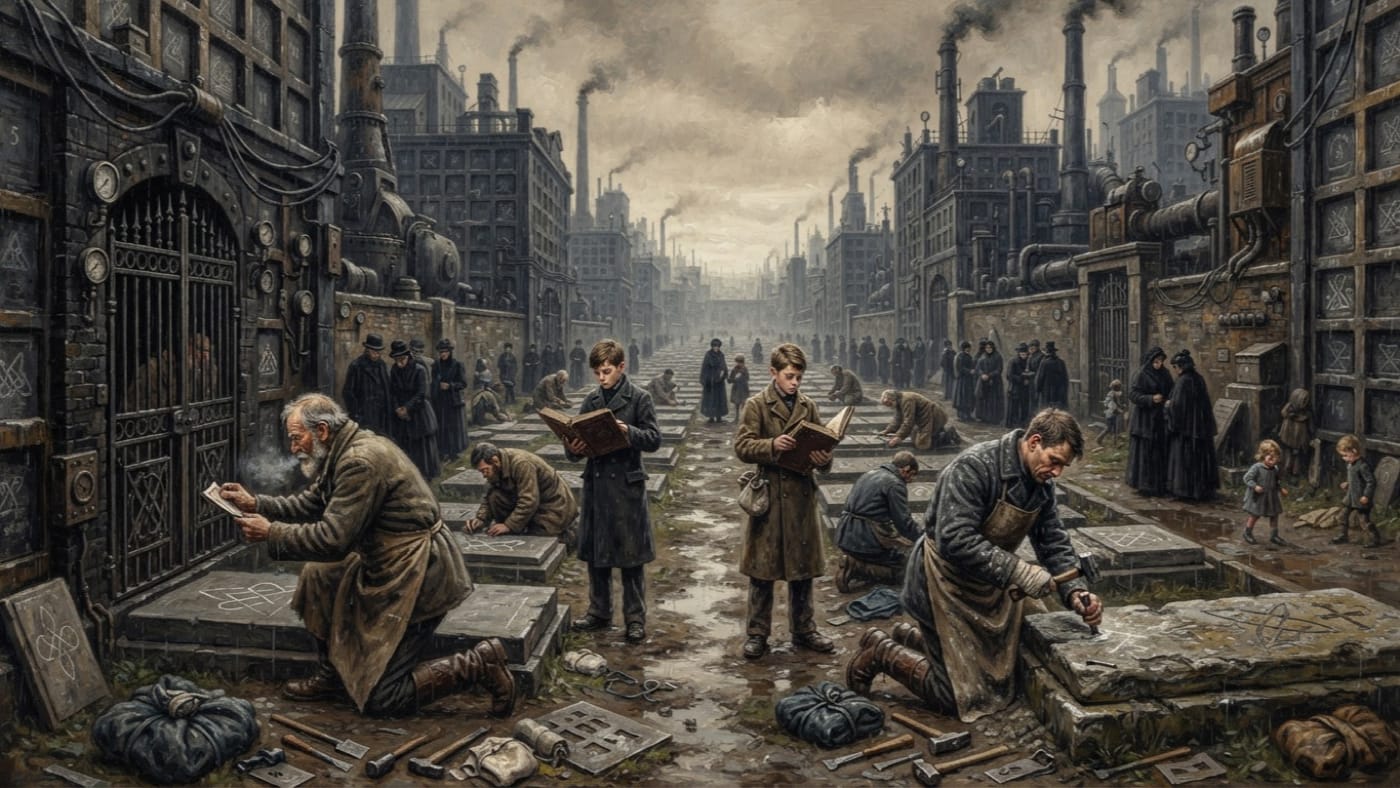
#On the Burial Threshold
Grave-Sealers cut the Knot into stone that will take a century of rain and be read by inspectors for as long as the ledger survives. They are Gate-Carvers who have claimed the trade's coldest surfaces as their own: grave-slabs, ossuary niches, the lids families pay to have closed properly and inspectors pay nothing to open. They belong to the Gate-Carver profession and carry its licence, its grey apron and its three-loop badge. They have no separate charter and no headquarters, and the Knotwright Registry has never troubled to record a faction head. They are a habit of work that hardened into a grudge. Most factions in the Church begin that way, and the more honest ones admit it.
What they make is a grave the Church can read. A slab bearing a sanctioned Triune Knot, properly cut and properly registered, tells the passing inspector that this burial was permitted, measured, consecrated and entered. It tells the mourner that the plot is claimed. It tells everyone else, in language the trade prefers to leave unspoken, that the occupant has been closed in by geometry approved by the Bureau of Heraldry.
It does not say who the occupant is. That belongs to the Ritual Bone-Stamper, who authenticates and arranges the remains, and to the cemetery clerk who brings the burial paper. The Grave-Sealer cuts the threshold around the dead. A marked grave and an authenticated body are separate certificates from separate hands, and much of the grief in the grave-fields comes from people assuming that one implies the other.
#On the Cut and the Register
The work begins with paper. The Sealer checks the grave permit against the sponsor or the local ledger before a chisel is unwrapped, because a beautiful Knot on an unpermitted grave is evidence, and evidence acquires a name. Next comes the class, grave or ossuary niche, each with its own stencil and its own column in the book.
Then the measuring: the tri-cord stretched against an approved stencil-frame. Every Gate-Carver owns a tri-cord. Grave-Sealers guard theirs with a particular anxiety, because a grave-field is seldom dry and a wet cord lies. Old hands keep their cords in oilcloth against their ribs. Some would sooner measure with a shivering apprentice's bootlace than with a damp tri-cord, though they deny the bootlace to inspectors.
They cut deeper in stone than any House-Knotter cuts in a door. The trade says weather is a liar, and a grave must stand in it longer than its mourners live. No manual has ever fixed that depth as a figure, and I decline to supply one. Ask a Stone-Cutter how deep and they will show you a slab from forty winters back, its loops rubbed down to rumour.
When the cut is done, the Sealer rubs it with consecration chalk. If the dust pools wrong, the angle is wrong, and the niche is recut before it receives its chalk line, breath-count and wax tag. A witness-tag is common but not required. Families who can afford one buy it. Families who cannot learn at the next inspection what the absence costs.
Registration comes last: the registry punch, the location, the class, the hand. A Registry Scriber may hold the book while the Stone-Cutter holds the hammer. Neither may register work they did not carve, and no Sealer mends another's Knot without logging the repair. Grave crews keep these two taboos with something close to piety. A Knot repaired off the book has a falsified history. A Sigil Inspector holding a rubbing against the Records entry does not care whose kindness did the falsifying.
#On the Three Nails
Every Gate-Carver claims Saint Edrin of the Three Nails. The Grave-Sealers claim him more narrowly and, in their own estimation, more correctly. His celebrated plague-house threshold, cut and barred during the Lull of Names in A.S. 78, was in their phrase a tomb door with the occupants still breathing. That is their reading. Nothing in the record makes Edrin a grave-sealer, the founder of their faction, or the jailer of a house of corpses. The tradition puts the living behind that bar, and the tradition is all anyone has. It predates the formal Synod by twelve years, and the titles now attached to it were attached afterward.
The grave crews do not need him to have founded anything. They need his three nails. In the older vocational teaching those are Measure, Witness and Refusal, and they suit burial better than almost any other work.
Measure is the dry cord and the chalk rubbing. Witness is the name entered beside the Knot, so that a sealed niche can never become an unexplained one. Refusal is the hardest to say in front of mourners. A grave is closed so that it stays closed. The Sealer's competence is judged by what never comes back out: grieving hands, bone-thieves, and whatever else the trade declines to name in daylight.
The oath fits as well: Mark the threshold; name the living; bind the dead. Grave-Sealers hear the second clause as an instruction to the clerk and the third as an instruction to themselves.
Grave-Sealers recite Mercy, Order and Sacrifice before the first grave seal of the day.
Corrected in this survey. Mercy, Order and Sacrifice is the later Concordat gloss, approved for sermons. Grave crews keep Measure, Witness, Refusal. Doctrine permits both, and prefers whichever sounds better from a pulpit.
Some ossuary carvers of Bastion-Irongate, in the Danube gorge, carry three actual coffin nails in their apron seams. Not all of them do. It is a local devotion, not a test of membership. The carriers do not explain where the nails came from, and I have not asked.
#On House-Knotters and Quotas
Grave-Sealers and House-Knotters hold each other in contempt. The feeling is mutual and well maintained, and it is older than anyone's ability to date it. House-Knotters work wood, at eye height, for clients who can complain. Grave-Sealers work stone, on their knees, for clients who cannot. To a Grave-Sealer, a house Knot is decoration that has never been asked to last. To a House-Knotter, a Grave-Sealer is a Grave-Whittler who profits from death and smells of it. Each side is right about the other's smell.
This quarrel is separate from the trade's other divisions. The True Knot purists and the Fast Hands quota chasers fight over speed, and both kinds work in grave-fields as well as at house-doors. Registry Loyalists and Shadow Knotters fight over legality, and the night has its own grave seals. A Grave-Sealer may stand in any of these camps. The camps agree only that house-work is easier.
The pay recognises the difference with a hazard bonus. The bonus does not cover stone-dust lung, which builds over years until it becomes the cough that wakes the dormitory. Nor does it cover splinter infections gone black, grave-field sickness, ossuary cold that stiffens knuckles until the hammer must be strapped to the hand, or the plain arithmetic of quota. A Sealer spends their hours kneeling in wet lime.
Grave work is also a punishment. Within the trade, demotion to the grave-fields is a recognised sentence for bad proportions, missing punches or too many night jobs. So the most specialised stone hands in the profession work beside carvers sent there to be humbled, and nobody in the shed can tell at a glance which is which. The specialists resent this. The demoted resent everything.
Every Grave-Sealer cites the Ossuary Breach Winter when a House-Knotter mentions hardship. Unsealed niches were blamed for a rising scare, and Knot quotas tripled. The records keep the quota. The crews remember the coughing.
#On the Work That Remains
The everyday horror of the grave-field is administrative first. A slab whose Knot has weathered past a clean rubbing. A niche with a fine cut and no punch in the book. A register entry naming a class the stone does not carry. A repair, plainly newer than the cut around it, that nobody logged. Each one brings a Sigil Inspector, and each inspector brings a question the Sealer answers with the ledger open.
Disturbance is worse. Soil turned where no permit says it should be. A niche lid shifted a finger's width. The trade never jokes about unsealed dead, because someone always swears they saw something. The Church allows that remains can move, but it has never promised that every approved Knot will stop them. The Grave-Sealer's honest answer is the work: recut, re-rub, re-register, and log every stroke, so that whatever follows has a name attached.
The living stand close by. Grave-fields have neighbours: shanty roofs leaning on the boundary wall, children who learn to walk between slabs, mourners who stay beside the Sealer through the whole cut because they cannot afford a witness-tag and will not leave the slab unwatched. They watch the chalk. They listen to the hammer. They ask whether it will hold. A competent Sealer tells them it is cut true and registered, and says nothing more.