
#On the Origin
If the radio fails, the body answers. — training-slate maxim, Compliance Directorate
The Hornline Reforms are the programme the Synod began in A.S. 150 / 1860 CE to make its voice audible in every district, to prove that it had been heard, and to send failures on either count to the offices that keep the compliance ledgers. Attendance was already allegiance. Compliance Directive 14-R had said so every year since A.S. 112, and local counters had climbed tenement stairs with chalk long before anyone thought to give them a corps. The Reforms invented neither the obligation nor the counting. They gave both an infrastructure, which is a far more dangerous gift.
The occasion was the Quiet Quarter Revolt of A.S. 149 in the lower wards of Kanzleiburg. The receivers there failed and the horns could not be heard. A storm tore the rooftop shrines from their housings, and the maintenance requisitions sat in trays while the copper went elsewhere. Into that silence came Silent Godless pamphleteers, unlicensed prayer circles, and a cellar service in a language no Bureau has yet been willing to name. The Bureau of Purity cleared the quarter and redistributed its people, and the files went under black wax.
Within the year the Orison Directorate had issued its implementation note. The Synod had learned what a silence costs when nobody is charged for it. It resolved that nobody would be excused again.
#On Audible Coverage
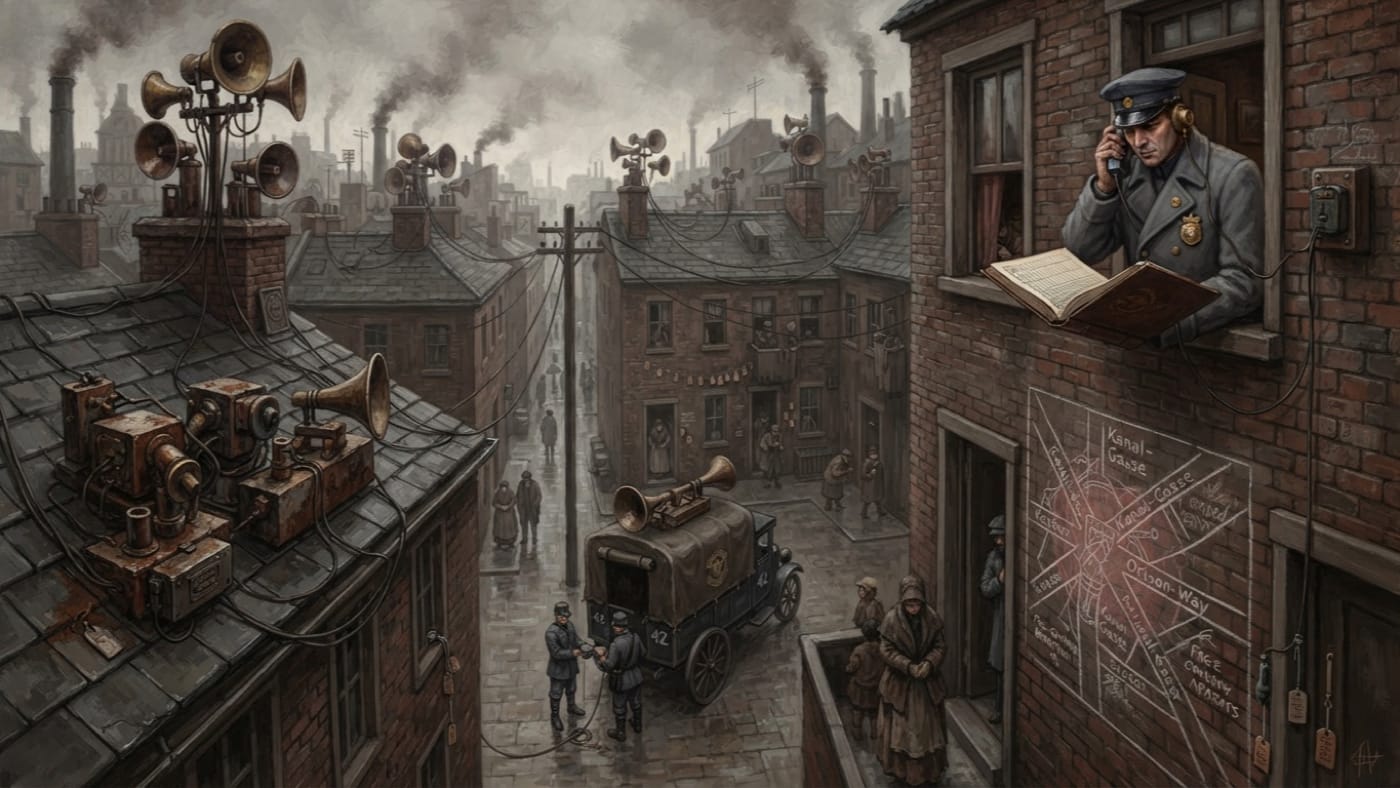
The Bureau of Orison and Song did not build its network in A.S. 150. Tower-horns, household receivers, relay wagons and a good many rooftop shrines were already in service across the Synod's cities, singing to some streets and failing others. The Reforms took that patchwork and made it an obligation. Rooftop speaker shrines went up across the districts, brass bells bolted to chimney stacks and parapets, wired and consecrated and set facing the courtyards where the old horns had only ever reached the façades.
Next came the standards. Every district was to keep audible coverage during the mandatory Orison windows, and the standards were published so that every sector office and every resident who could read a notice board knew what "audible" meant. This was the first innovation of any consequence. Once coverage had been written down, a shortfall could be measured, and anything the Synod can measure it can eventually charge for.
The temporary provision was more practical than it sounds. When a shrine broke, the sector was to have relay coverage within seventy-two hours: a wagon with a horn on its roof, parked in the square, carrying the sermon to streets the broken shrine could no longer reach. The rule promised a stopgap and nothing more. Permanent repair waited on copper, labour and the Engineering procurement desk, and the Reforms set no deadline for any of them.
The seven-day rule is the one people remember. A deadzone lasting beyond seven days was to be treated as spiritually unstable, and a spiritually unstable district was marked for compliance review. Review meant a file. A file meant a reading of the household rolls with a Purity officer close enough to read them too.
#On the Verification
The engineering side of the Reforms belonged to the Orison Signal Engineers, and they did it honestly enough. They climbed the stacks, reseated the coils, calibrated the carriers, kept interference logs in pencil because ink ran in the rain, and signed clean-signal certificates for every shrine that passed. A clean certificate meant the signal left the brass in good order. It certified nothing about anyone below.
The Synod wanted to know about the people below, and so the Reforms joined the engineer's log to the household roll. Each sector got a coverage map drawn from horn reach and relay density, chalked and re-chalked onto the office wall, every street assigned the reception the Bureau expected of it. The verification officer set that expectation against the Bureau of Records household rolls, against the sermon tokens returned or not returned, against the windows open or shut during the broadcast, and against the faint tone of a receiver tested in its own kitchen with a calibrated instrument the size of a fist. Proof of reception came from those four sources together.
These were the men the parent files call the Auditor corps. Some were former local counters who were given a coat, a brass badge and a map. Others were newly hired from among Records clerks who had shown an aptitude for stairs. Before A.S. 150 they answered to their ward. Afterwards they answered to the coverage standard, which outranked any ward. They were not yet the statutory Sky-Sermon Attendance Auditors of later years. They were officers with a duty, a map and a ledger. The Synod rarely needs more.
#On the Consequences
The sequence ran like this. A shrine failed. The engineer logged the fault, asked for copper, and was told the requisition language was imprecise. The relay wagon either came within seventy-two hours or came late, and on some streets it was simply too quiet to hear. Meanwhile the household could hear nothing, so it returned no stamped token and kept its window shut against a rain that had more to say than the horn. The officer came round with the map and found a street that was covered on paper and silent in fact. He wrote down what the map told him to write.
The ledger cannot see the coil, so the absence went to the household and stayed there. An absence affected the sector's ration priority, and a sector with a poor return got longer curfews and a place on the Purity attention list. The household that could not hear and the household that refused to listen received the same notice in the same type, and both pinned it beside the stove.
The engineers objected. Their own logs showed which shrines had failed and when, and a sector officer with any decency could set the log beside the roll and see that the silence had a cause. Some officers did exactly that and noted the fault in the margin of the ledger. The margin has no column, and the ration clerk reads columns only. Shortages of copper, denied requisitions, quotas set by men who never climbed a stack, and the old sport of moving blame up and down the hierarchy all meant that the promise of coverage seldom saved anyone from the penalty for missing it.
An early Orison circular on the Reforms stated that "a sector receiving audible broadcast is thereby a sector in verified obedience."
Corrected. An audible broadcast demonstrates that the signal arrived. A household return demonstrates that the household was counted. Neither demonstrates obedience, which the Bureau does not presently measure and has instructed its officers not to infer. The circular remains on file as an example of premature theology.
#On the Later Settlement
The Reforms set up the apparatus. Its theology came eight years later. The Metric Sanctification Edict of A.S. 158 declared compliance scores to be spiritual health indicators, gave the Auditor corps its statutory standing, and made adjusting a number a sin as well as a clerical fault. Orison and Song issued it jointly with the Bureau of Tithes. The Bureau of Doctrine approved it, and Records filed it twice, once under Liturgy and once under Revenue. None of this was in the A.S. 150 note. Writers who credit the Hornline Reforms with sanctifying the Choir Rate are crediting the scaffold-builder with the hanging.
One attempt was made to reconnect the engineer's log to the ration clerk's column. At the Fourth Compliance Congress of A.S. 171, delegates proposed that the condition of the signal be considered before a household was punished for nonattendance. The Congress rejected the proposal. Its authors, whom the street called the Signal Methodists, were later declared by the Bureau to have never existed as a faction. Their vote is sealed, and the sealed record shows that they did exist.
#On the Present Application
As of A.S. 201, the old Quiet Quarter appears on public maps only as Lower Chapel Sector Twelve. Its historical name has been removed from public use, and its former population was dispersed after the clearing. The sector now has seven rooftop shrines, two relay masts, a permanent Orison office, and a Purity substation whose windows face inward. These figures belong to one sector and should not be read as the Reforms' universal standard. They show what the Reforms produce once a district has given the Synod reason to pay attention.
Every window opens on schedule. Every receiver hums. The Choir Rate has not fallen below ninety-four percent in twelve years, and the sector officers have stopped reporting this as a success. A standing Purity order, reissued every year, directs that perfect attendance in a designated deadzone be treated as hostile until proven otherwise. Lower Chapel Sector Twelve has not been a deadzone for half a century. The officers treat it as one anyway.