
#On the Settlements Behind the Last Lock
The Hintermark settlements are the part of a supply table where people live. Bastion-Constantinople holds the Bosphorus as the southern anchor of the Sagittal Line. It feeds itself, casts its iron, buries its dead and replaces its men from the country at its back. That country is the Hintermark, a Zone 3 industrial-forward belt west of the walls, lying between the Sofia supply corridor and the fortress approaches. The settlements are the places in it where people sleep.
I use the plural on purpose and I will not put a number on it. Records holds furnace stations that became towns, towns that became wards, levy-villages that became widow-villages, and grave-field lanes that have never been anything on paper. A gazetteer would ask me to certify where one ends and the next begins. I have seen the maps. They disagree with one another in three colours of ink, and the households under them disagree with all three.
The trade villages on the Black Sea coast keep their own file. They are raided differently and they smuggle differently, and the Codex will not tack them onto this paragraph to make it tidy.
#On What the Settlements Send East
The settlements send coal, pig iron, rivet stock, foundry labour, levy replacements and coffin timber. The Harbor of Chains and the Foundry Quarter depend on all six, and the last two cost the most. Rivets can be reordered. Sons cannot, though the conscription rolls have never accepted the difference.
Three groups of settlements carry the load. Keska began as Furnace Station K-6 in A.S. 116 and was a town by A.S. 160. It smelts and casts, and in Settlement its name now stands for that Bureau's worst fortnight. Edremit began as Furnace Station E-3 in A.S. 118. It was Edremit Works by A.S. 146 and became a municipal casting ward after the census of A.S. 160. It makes boiler throats, rivet stock, furnace collars and casing rings, and its people cough. Its other peculiarities belong to its own entry, where they may stay.
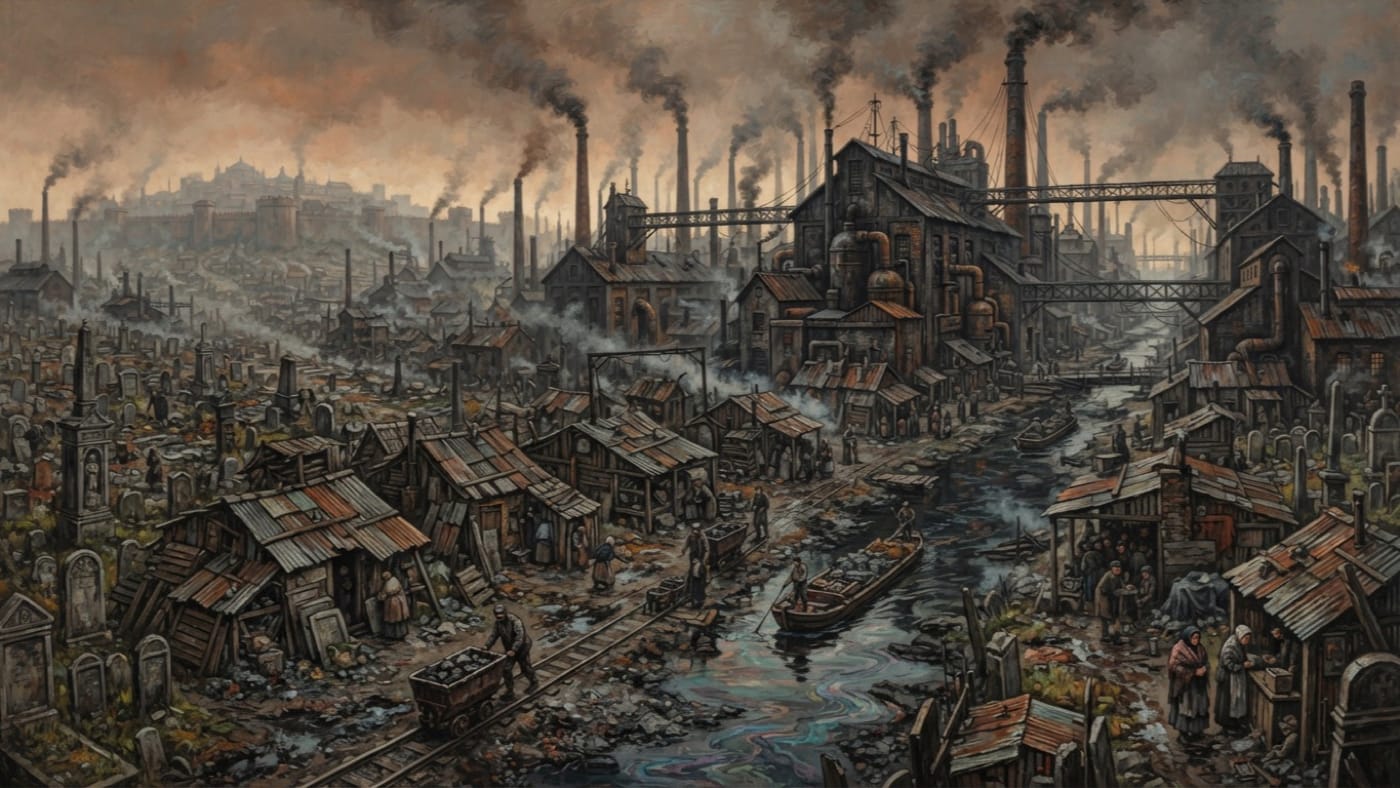
The third group is the Saint Orban's Channel settlements, strung along Keska's Black Run. The stream has been canalised to serve the works. It feeds furnace troughs and quenching, and the only things that float on it are flakes of paint. The towns' output leaves by road and rail. Any clerk who has entered the Black Run as a freight canal should withdraw the entry before a barge-master reads it.
In and around these places live the households that make the output possible. There is the foundry family with one shift token and four mouths to feed. There is the widow with a levy quota and no husband to meet it. There is the carter whose permit is worth more than his mule. The furnaces are only the part of this that a survey can see.
#On the Redrawing
In the Hintermark a classification decides practical things. It settles which ration table feeds a house, which permit office renews a carter's licence, which levy bracket calls up a son and which burial ground takes him when he comes back. A settlement with the wrong classification eats from the wrong table. A settlement with no classification does not, in law, eat at all.
The classifications inherited from A.S. 130 still described rural strips, though the strips had since grown chimneys. The Bureau of Settlement issued Mandate 188-A in A.S. 188 to correct them. It took six months to draft, three months to review and fourteen days to carry out. I recommend that ratio to every student of administrative speed. The mandate covered the Hintermark, Constantinople's eastern terraces and seventeen rear-echelon settlements along the Line. Seventeen is the number the mandate named. It is not a count of the Hintermark. Forty thousand civilians were moved from the eastern terraces to the western approach, and that figure belongs to the terraces. People moved on through the Hintermark afterward as a knock-on effect. Nobody counted them properly, and the Codex will describe that movement no more precisely than that. The full ledger is under the Administrative Redrawing of A.S. 188.
Neighbouring towns were hurt in different ways. Keska lost its Zone for eleven months. It had no tithe bracket, no permit renewals and no lawful assessment, and its births and burials went into a drawer. Edremit kept its Zone but lost its housing and burial classifications. Its Black Apron district was reclassified as an industrial buffer, although people lived there. The residents became an administrative inconvenience living inside a margin.
Yvette Langres reconciled Keska's case in A.S. 189. The town was restored to Zone 3 Industrial-Forward, retroactively, under register KES-3/189-R. By then it had lost a third of its population. Some left. Some took service wherever it was offered. Some are simply absent, and the Codex records absence as absence. How Keska's line came to be left out of the register is still unresolved, and I will not invent an explanation to close the file.
Earlier accounts placed the primary blame for Keska's omission on the Bureau of Records.
Corrected. Records reviewed the tables. Settlement drew them. The failure belongs to Settlement, and the Codex now enters it there.
#On Shelter and Obligation
The settlements have more widows than roofs. Since the redrawing they have had more refugees than either. The best housing is the ossuary apartment, licensed and built from the sanctioned dead. Those who cannot get one go to the grave-fields. There the Grave-Field Shanty Broker leases the wet ground between headstones as caretaker shelter. The arrangement rests on real graves and on death certificates kept ready for inspection.
Each Bureau that touches the ground wants something different from it. The Bureau of Rites holds the consecration. Records holds the interments. The Bureau of Tithes taxes every candle it can find. Settlement Memorandum 14-R, issued in A.S. 178 and revised in A.S. 194, classifies the shacks as structures for maintenance or mourning. A family can live in one for ten years and remain, on paper, a mourner who stayed late.
Caretaker classification confers residency upon households sheltering in Hintermark grave-fields.
Withdrawn. The classification recognises that someone tends a grave. It says nothing about who sleeps beside it.
Authority over a household builds up in layers, like coats of whitewash over damp. The Widow's Syndicate extends ash-credit through seven villages. The Pilgrims' Court holds the road franchises that decide whether a carter's wheels may turn. The Caretaker Saints are brokers, not saints; the title is street speech and no committee canonised anyone. They take low rents in ration chits, shift tokens and grave-washing. These authorities overlap without belonging to one organisation. A household that pays all three is in debt three times over. That does not make it a conspiracy.
#On the Second Book and the Knife
The Black Ledger moved into the gaps the redrawing left. During Keska's eleven months it offered what Settlement could not: counter-stamps that worked for rations and papers for households that had legally ceased to exist. It works in a fixed order. It steals a permission and hands out help. The help is entered as a debt, and the debt is enforced when anyone questions it.
The Theatres make the gift public. The Accountants write it down. Their instrument is the second book, and the Hintermark has given the Codex its plainest example. A fragment recovered in A.S. 199 lists households, their weak points and the ways a Ledgerwright could reach each one. It records which door, which shift and which debt.
RECOVERED SECOND-BOOK FRAGMENT — HINTERMARK, A.S. 199 COLUMNS PRESERVED: HOUSEHOLD / ACCESS / PRESSURE [ONE FURTHER COLUMN WITHHELD BY THE CODEX] [ENTRIES HELD UNDER BUREAU OF SHADOWS CUSTODY]
The fragment records how close the Ledger got to these families. It is not a membership roll. A household entered there is one that somebody meant to use. Whether it agreed to be used is a separate question, and the book does not record the answer.
The Knives arrive when an entry in such a book becomes audible. After the redrawing crisis, six bodies with bound wrists were pulled from Keska's slag channel. Purity classified them as furnace deaths. Furnaces do not tie knots.
The Bureau of Shadows estimates three to five Ledger cells across the settlements. Shadows gives the range with its usual caution, and I reproduce it with mine. A reader who turns it into a count of Knives will be corrected. So will a reader who turns it into a count of the Syndicate's villages, or of everyone who once took a loaf from a stranger in a hungry month.
The Marseille intercept that defines the Knives as a faction stays in Marseille. The Hintermark has evidence of its own. It does not need to borrow a corpse from a harbour docket.
#On the Present Condition
As of A.S. 201 the settlements are still producing. Keska casts under stricter consignment seals and under a Shadows assessment that calls it probable Ledger infrastructure. Edremit casts and coughs. The Saint Orban's Channel settlements quench their iron in water that eats paint. Coffin timber still goes east, and some of it comes back as roofs.
The registers are still disputed. Keska exists only retroactively. The Black Apron has residents and is officially a buffer. The grave-field households are plainly living there and are officially in mourning. How far the Ledger has got in is estimated. Nobody has counted it.
The Codex follows the policy set out in the Knives entry and claims no completed operation. Witnesses should be protected before they become examples. Second books should be seized wherever they turn up. Courier routes should be cut. The households whose hunger is the Ledger's cheapest recruiter should be fed. Settlement has filed no replacement shelter. I have mentioned this to Settlement. Settlement has mentioned my tone.