
#On the Two Names
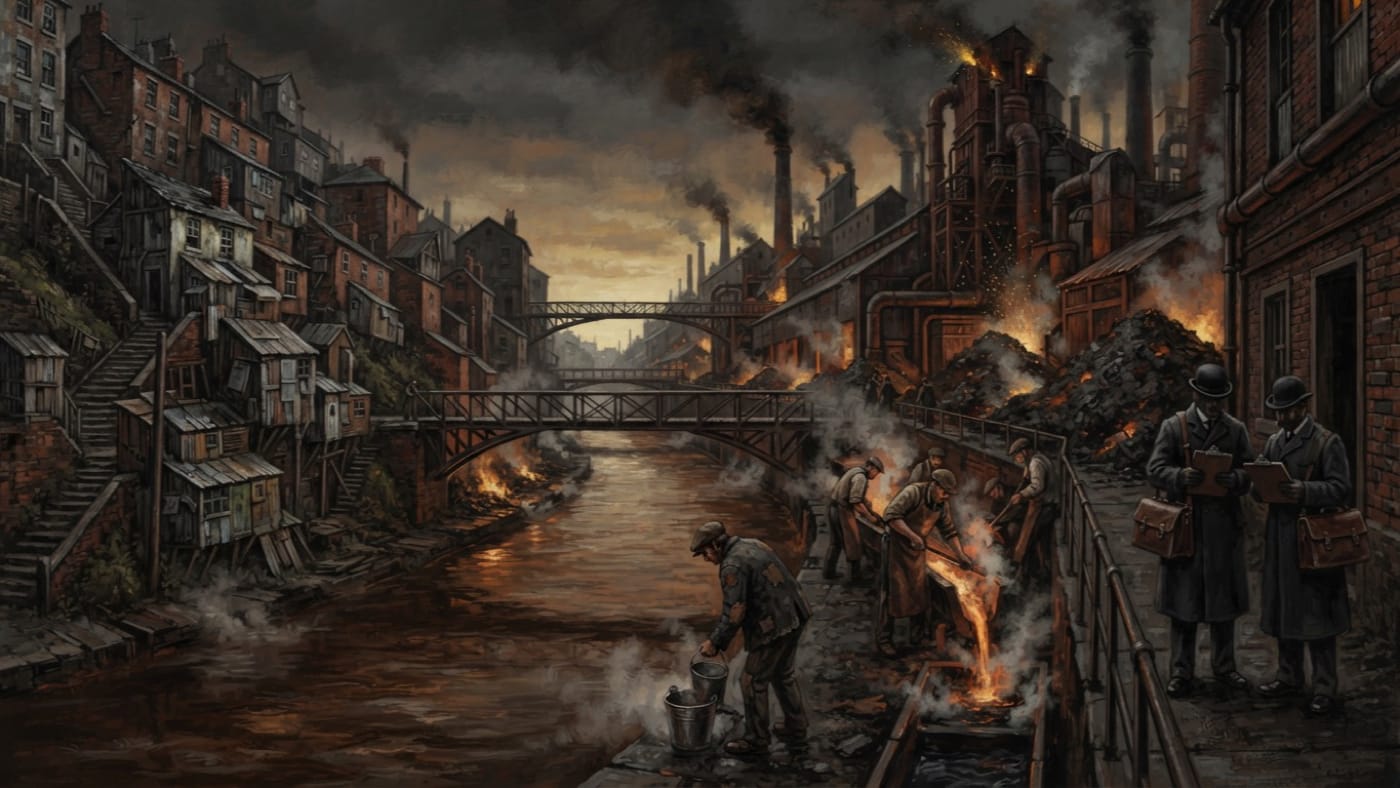
The Saint Orban Channel is a canalised stream at Keska in the eastern Hintermark, west of Bastion-Constantinople. The surveys use that name. So does any Keska resident who has spotted a visiting chaplain within earshot. Once the chaplain climbs back into his cart, the stream becomes the Black Run again, and the town goes back to speaking honestly about it.
The honest name describes the water. It leaves the slag troughs dark and warm, and now and then it strips the paint from a bucket. People who have watched their buckets come up bare do not need a hagiography to tell them what runs past their doors.
Nobody can now say what the stream was called before the furnaces came. Three supply surveys and one devotional renaming wrote over the original name in turn. Each surveyor scraped the vellum a little cleaner for the next, until the saint arrived and sealed the palimpsest. The Codex does not hold the old name. It holds no dates for the surveys or the renaming either, and I decline to manufacture any for the comfort of tidy readers.
#On Furnaces and the Rural Strip
Keska began in A.S. 116 as Furnace Station K-6. Its first furnaces were rude brick stacks built beside the stream. No theology is needed to explain the siting: a furnace wants water for its troughs, and a canal that is already dug offers it without argument. By A.S. 160 the station had become a town. Ash Steps climbs the east bank, where the older houses lean together like exhausted litigants. Foundry Row, the loading yard, the casting sheds, the slag banks and the rail siding all share the same smoke. I will not pretend to have paced out the distance from each of them to the water.
The Black Run works, and its work is local. Keska's output leaves by road and rail. Coal, pig iron, rivet stock, foundry labour and coffin timber move east through the Hintermark toward Constantinople, the Harbor of Chains and the Foundry Quarter. No barge of record carries the town's metal down the Black Run. The stream's service to the southern anchor is the trough, the quench and the ruined bucket.
The saint's name spread to other places. The Saint Orban's Channel settlements lie along the Black Run and are counted among the Hintermark's principal nodes, a grey bead-string of Zone 3 industry behind the fortress.
The Hintermark's classifications were written in A.S. 130 by clerks who thought growth was a matter of arithmetic. Under those tables the country along the Black Run lay in a rural strip. Rural. Beside a stream that eats paint.
#On the Line Removed in A.S. 188
Some decades late, the Bureau of Settlement discovered that its rural strip contained a foundry-town. Tithes had been assessing smoke as pasture. Conscription had been calling sons from households that had moved, merged or been buried. War had been routing consignments to addresses nobody had checked in half a century. Settlement's remedy was Mandate 188-A: four hundred pages, drafted in six months, reviewed by Records in three, and implemented in fourteen days.
The mandate covered the Hintermark, Constantinople's eastern terraces, and seventeen rear-echelon settlements along the Sagittal Line. The forty thousand civilians moved from those terraces to the western approach belong to the larger ledger of the Administrative Redrawing, and they are counted there. They did not travel by the Black Run. I will not march them along its banks to improve a paragraph.
At the stream itself, the operation was simpler and worse. The old rural strip along the Black Run closed when the mandate took effect. A new industrial band was drawn to take in the foundry towns that fed Constantinople. Keska sat between the two. The old register shut, and the new one left Keska out.
Keska offers four explanations for the missing line: a copying error, a boundary error, a packet-sequencing error, or an act of malevolent mercy. I have no fifth to add, and no grounds for choosing among the four. The mechanism stays in its drawer. The responsibility does not. Settlement drew the tables, and Settlement owns the hole.
The wound has limits, and the Codex keeps them. The file shows Keska losing its Zone. It shows nothing of the kind for the whole length of the Black Run, or for the other settlements along its banks. Symmetry is pleasing, but it is not evidence.
#On Counter-Stamps and Reconciliation
For eleven months Keska had no Zone. That meant no tithe bracket, no lawful assessment, no permit renewals and no address amendments, and the draft office stopped calling names. Births, marriages, vacancies and burial lots went into a drawer marked Pending Boundary Clarification. The furnaces kept burning, and the Black Run kept running dark. Nobody had consulted either of them about the mandate.
The Black Ledger noticed before Strasbourg did. By the third month it had opened a cellar office under a cooper's shed on Ash Steps and was issuing ration counter-stamps. False household stamps followed, then hazard chits from an office that did not exist, paid out in cash that did. Assistance came first. Obligation followed behind it, as it always does, carrying the receipt.
Yvette Langres took up the reconciliation packet in A.S. 189, five years before Settlement gave her its chair. She put the population decline, the missing permits, the retroactive tithe exposure, the illicit stamps and the Ledger incursion into a single distribution. Copies went to Settlement, Records, Tithes, War, Doctrine and Purity. Keska was assigned retroactively to Zone 3, Industrial-Forward, and billed a retroactive tithe for the months in which it had legally not existed.
By the time of the reconciliation, the town had lost a third of its people. Some left before the retroactive tithe could bite. Some entered Ledger service. Some left no forwarding address. The Codex will not turn every absence into a grave just because a grave is easier to file.
Committee memoranda and lower pamphlets attributed the Keska failure to transcription irregularities in the Bureau of Records.
Corrected. Records reviewed and filed the boundary tables it received. Settlement drew them. The blame belongs to the Bureau of Settlement, and the Codex now records it there, to the lasting irritation of Settlement and the quiet pleasure of Records.
#On the Present Account
As of A.S. 201, the Black Run still leaves the slag troughs dark and warm. The furnaces beside it work under stricter consignment seals. The weigh-house keeps two Purity observers and a Settlement clerk whose desk faces the door. The cooper's shed on Ash Steps was demolished for structural weakness. Officially. The Bureau of Shadows lists Keska as probable Ledger infrastructure, which means it can see footprints but has not found the room.
The rural strip that once followed the stream now exists only as a closed register. The industrial band that replaced it holds Keska by retroactive correction, with the suffix stitched onto the town's name like a mended cuff. The stream itself has no Zone and needs none. Men assess the water at the troughs, and everyone assesses the men.
Visiting chaplains still call it the Saint Orban Channel. By local courtesy, they remain the only ones who do.