
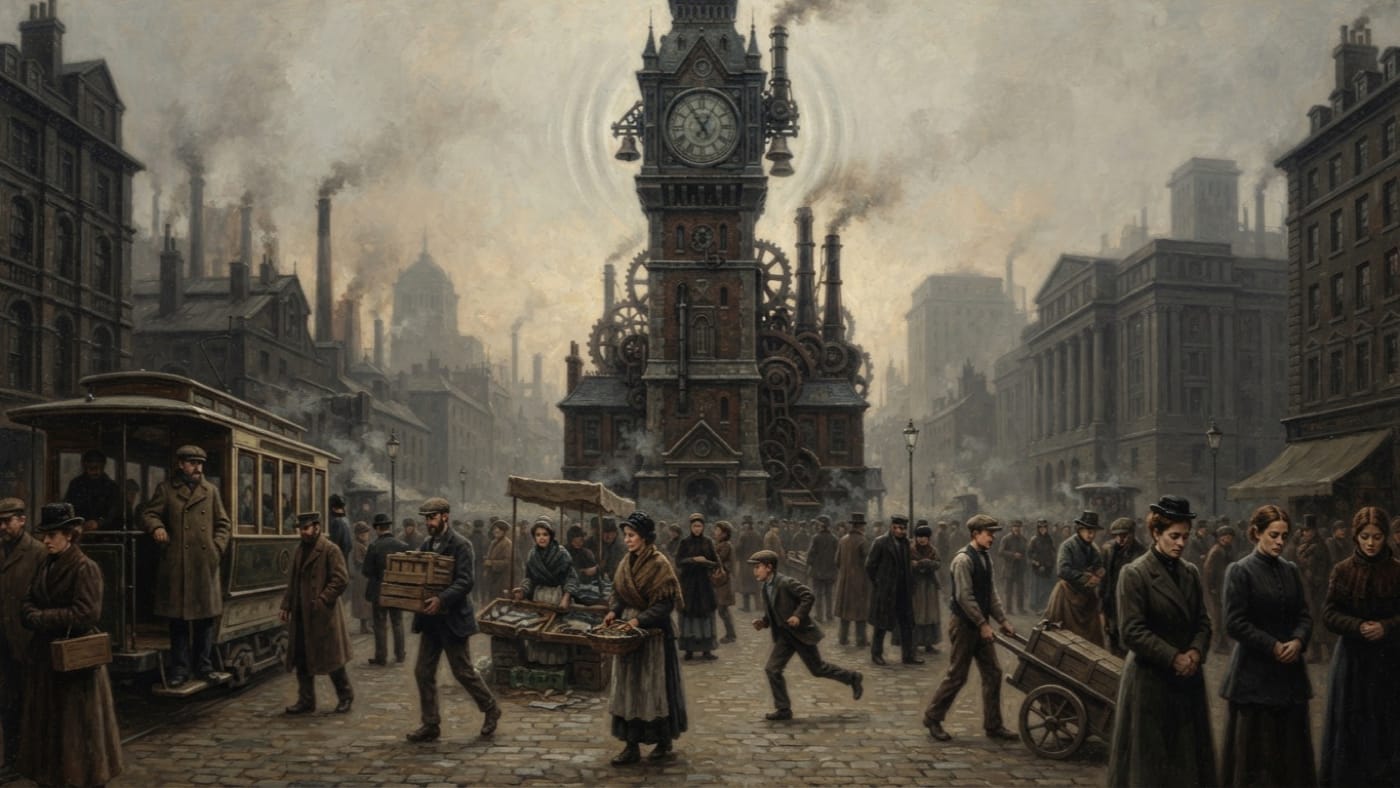
#On the Noon Command
The High Angelus is the noon peal of the Bell Codex. It has three ascending commands, struck at midday, and they order the population to stop, to recite and to resume. That is the whole of its published definition. The Bureau of Bells has never needed more. I have read the Codex in its vault copy, in its feast-day copy under smoked glass and in several provincial addenda that contradict both, and I have found nothing that improves on those three words.
The other great peals frame the day. Ninefold Matins drags it out of bed, the Widow's Toll licenses its grief and Iron Vespers locks its gates. In catastrophe, Silentium removes sound altogether. The High Angelus interrupts. It comes at the hour when a city is most fully occupied with its own business. Ledgers are open, kilns are hot and the bread is half-sold. Then the bronze climbs three steps, and every one of those businesses is suspended by an authority that owns none of them.
A dawn bell tells the body to begin. The noon bell shows that it can make the body stop.
The Bureau of Bells teaches that the unnamed Cantor of the Miracle of Cologne sounded the High Angelus with his final breath. That account is hagiography and is preserved as hagiography. I report it with the care owed to any story whose witnesses cannot be deposed. It tells us that Bells wishes the peal to be old. It does not tell us who composed the peal, when it was first rung or from which tower. The Codex is silent on all three points. The Codex is rarely silent unless someone has arranged it.
#On the Ordered Interval
A clerk of the Bureau of Records is halfway through a baptismal register in Strasbourg when the first command sounds. He lifts the pen clear of the vellum. A blot made during the Angelus is a blot made in the Bureau's hour, and it must be explained in writing to a superior who was also praying when it happened. In the square below, a fishwife sets her knife beside a half-scaled carp. A carter reins in with one wheel on the kerb. A boy carrying a message stops where he stands, which may be in a gutter. The Codex makes no allowance for gutters.
The second command is a step higher, and it orders recitation. Here the peal hands its authority to the mouth. The bell does not speak the words; it requires that they be spoken. The text belongs to liturgy, so the Bureau of Rites claims it. My own Bureau of Doctrine claims the meaning of the text. Parish practice has gone its own way under both claims, as parish practice does. I will not set a text down here. Any wording I printed would be quoted back to me with outrage by a parish that recites another.
The Bureau of Bells prizes the arrangement for one reason. A city reciting together makes a sound no tower could produce, and the tower produces it all the same. The bronze gives the order and the city's voice carries it out. The Bureau of Bells has done the governing before anyone opens a mouth.
The third command is the highest, and it orders resumption. Citizens rarely notice this clause. Every administrator should hang it above his desk. The clerk does not take up his pen when he has finished praying. He takes it up when the bell tells him to. The fishwife's knife waits for bronze. At a quarter to noon, work belonged to the person doing it. Afterward it is handed back as a loan from the authority that took it.
#On Those Who Keep the Hour
Bells decides when authorised bells ring, how they ring and in what tones. Ordained Bell-masters exercise that authority in the provinces, and their writ often eclipses that of local clergy. A parish priest may want the noon peal moved for a funeral, a feast or his own digestion. He petitions the Bell-master, the Bell-master consults the Codex, and the Codex was not written for parish priests.
The Bellwardens stand below the Bell-masters and keep the instruments, while the Bell-masters keep the law. Before noon, a Bellwarden inspects the chain of his toll-key, which is fixed to his own body. He strikes a tuning fork and holds it near the sector bell, checks the chalk pitch marks, oils whatever squeals, and reads the day's peal chart against the calibration log. His forearms are rope-scarred. There is brass dust between his teeth. His hearing fails slowly, until he is the last person in the tower to notice a wrong note. If the noon peal sounds flat, he answers for it. If it sounds at the wrong hour, the Bell-master answers. Records receives both answers and files them in separate rooms.
No parish rings the High Angelus on its own initiative. It rings because its Bell Peal License and the chart put the peal in its tower. Those licenses specify stroke count, hour, tonal range, purpose, decay and jurisdiction. Each copy of the Codex also carries its authorised local addenda and seasonal corrections. A provincial tower therefore rings the same peal as Strasbourg, according to a page that Strasbourg has not seen this year.
The ratified Codex sets a standard tolerance of seven seconds unless it is dispensed. That tolerance governs when the peal begins against the schedule. It says nothing about the spacing between the commands or about how long a mouth may take over its recitation. A Bell-master who cites it for either is mistaken or is angling for promotion. The two conditions are frequently found in the same man.
The Bureau of Bells governs the provinces "from Strasbourg's Bell Codex of 231."
Corrected. The Office of Bells was constituted in A.S. 52, and the present Bell Codex was ratified in A.S. 115. There is no recension of 231. This was easy to establish, since the year 231 has not yet occurred. The Codex itself rests in the Bell Tower of Strasbourg Cathedral, where it is guarded by men who do not read it.
#On Borrowed Authority
A bell rung outside the schedule is speech outside jurisdiction. The miners of Liège learned this when they sounded their work-shifts without Synodal approval and were scourged for it. Their offence concerned shift-bells, which are licensed by the same authority that licenses noon. The Liège case had nothing to do with the High Angelus. I include it because every Bell-master cites it when a parish asks why its noon peal needs paperwork.
Cologne taught the harder lesson. On the Night of Borrowed Curfew in A.S. 134, the enemy did not need illegal bells in rebel hands. They needed one command in a lawful shape. The command they borrowed was curfew. Doors were locked and lamps put out, on behalf of whoever had learned the grammar. The High Angelus was not involved, and I want the record to say so plainly, because careless retellings have begun to blur the two.
I name the noon peal here for another reason. It is the most rehearsed command in the Synod. Citizens obey curfew at night, when most of them would rather be home anyway. They obey the High Angelus in the middle of the working day, every day, from childhood. It is the most thoroughly practised obedience in the Synod, and an enemy would value it accordingly. The Bureau of Bells knows this and does not say it in public.
Counter-Toll Operators exist to drown hostile signals under authorised patterns. Their trade depends on two things: the city knows the true peal, and the tower knows it more exactly than the city. Each noon in the square rehearses the first condition. The second depends on Bellwardens who are going deaf.
#On Its Present Observance
In A.S. 201 the Codex standard is eighty-six years old, and the Office of Bells has kept the hour for a hundred and forty-nine. The noon peal has outlived every Bell-master who swore to it. It will outlive me, a prospect I find more offensive than the peal deserves.
From the window of my chambers I watch the square at noon. The first command sounds and the square goes still from the centre outward. The traders in the middle hear the bronze first. The porters at the edges see them stop and stop in turn. During the second command I watch mouths. During the third I watch hands, because they show more. One man takes up his tools a breath before the bell has finished. A woman waits a breath after it, so that someone will see her waiting. Most people move exactly with the bronze and never think of it, and those are the people the Codex was written for.
Doctrine is interested in the early hand and the late one. The early hand belongs to a man who thinks his own work has a claim on him. The late hand belongs to a woman performing piety for an audience, which is acceptable in moderation and suspect in excess. Neither has broken a law I could cite. Both have been noted.