
I've finished the source reading and am drafting the prose now.
#On the Hall and Its Furniture
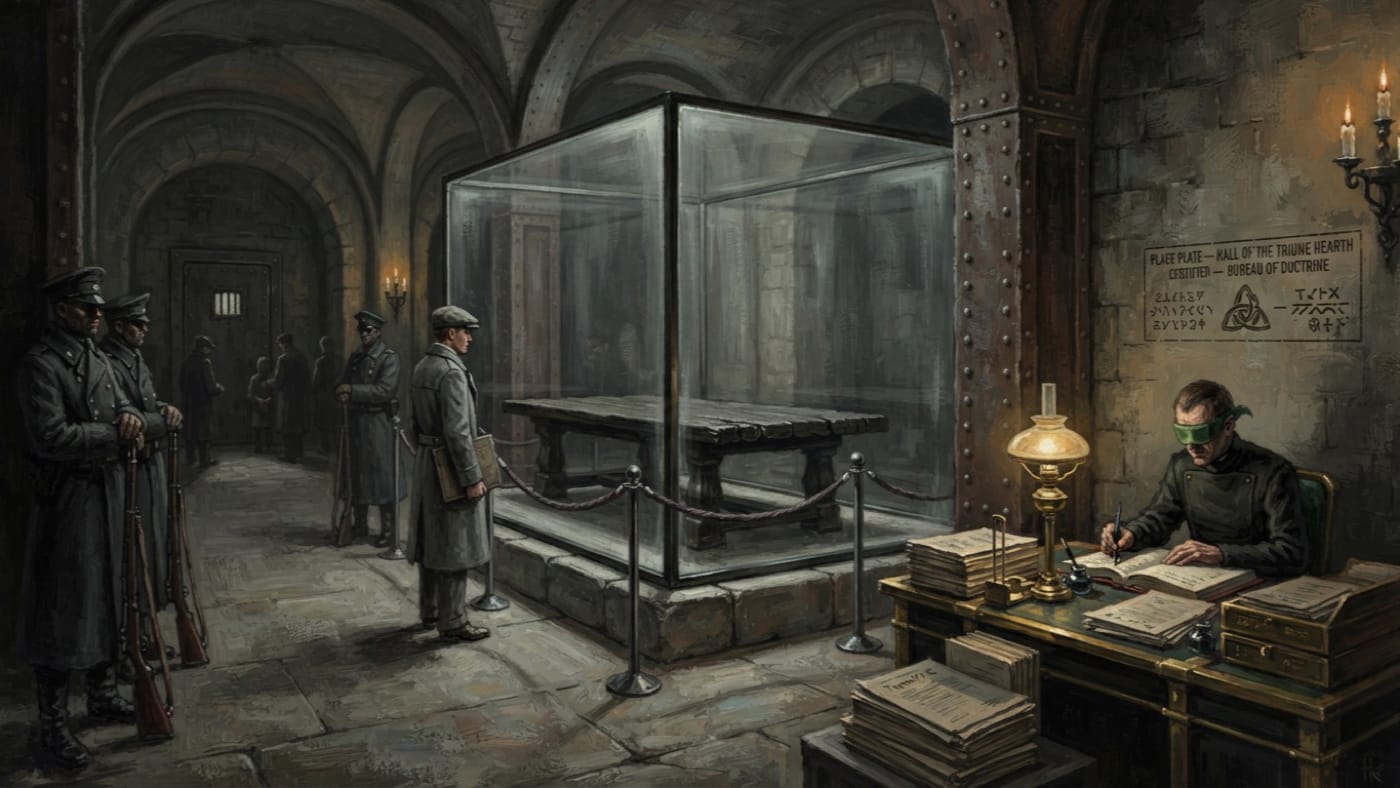
The Hall of the Triune Hearth is a room in Strasbourg arranged around a table. The stone, the guards, the rope, the queue and the clerk at the inkwell all serve one purpose. They hold the citizen at the correct distance from a slab of black oak under glass that matters more than any of them.
On that table the Concordat of Strasbourg was sealed. It binds nothing now, since the binding was done in A.S. 90 and needs no carpentry to hold. The Synod keeps it anyway. A constitution is hard to kneel before, and a piece of oak is easy. The Triune Hearth is many things: a doctrine, a tax region, a festival calendar and a schoolroom answer recited by children who could not locate Iberia with a lamp. Only in this Hall does it become something a person can stand beside and feel small.
Citizens may approach on approved days, by appointment, if they have filed Form 77-C and if the Bureau of Purity has seen no recent impropriety in them. Those who lack either may admire the door. It is a good door. Many people have spent a long time looking at it.
#On the Altar Made Treaty Table
The table began as an altar. Before it carried the Concordat it stood in a chapel dedicated to Saint Florentius, where it received whatever Saint Florentius's chapel received: candles, cloths, the elbows of tired priests. It is Rhenish oak, black with age or treatment or holiness, depending on which office you ask. When the Concordat needed a surface, the Church took the altar, removed the chapel from the question and set the instrument of three nations on the wood where the sacrament had been.
The Concordat account places the signing in the nave of the Basilica of the Ledgered Saints. There, in A.S. 90, France, Iberia and the Rhineland pressed their three seals into a single pool of wax upon this oak, each seal set by a different hand into the same red mass. The settlement was proclaimed in A.S. 91. The seals and the parchment have their own custody and their own article. The table only held them up, and it was fortunate to have the work.
So the progression runs from altar to desk, and from desk to relic of the state. The Hall's own chronology is less obliging. Records has supplied no year for the room's naming. It has supplied no year for the glass, and no record of when the table first passed into the Hall's keeping. I decline to invent one. Dates attract pilgrims, pilgrims attract complaints, and I have enough of both.
An earlier entry of this Codex recorded that the Rhineland "sent Augustinus himself, who sealed with such visible grief that Records preserved the blot."
Corrected. Augustinus and Kratz were both dead by A.S. 88, two years before any wax touched this oak. A successor pressed the Rhineland seal, and the present file does not establish that successor's name. The founders built the machinery the Concordat completed. Neither ever leaned on the table, and no grief of theirs stains it. The tears belong to devotional commemoration and should stay there.
#On Permission to Approach
The admission instrument is Form 77-C. The account preserved in The Bureaucratic Synod gives its full title as Application for Proximity to Sacred Furniture. It must be filed no fewer than forty days before the visit. I find the title beautiful. It gives the citizen no right to look, touch, kneel or understand. It grants proximity, a lawful nearness to wood, measured by the Church and revocable on suspicion.
The condition that matters most comes second. The applicant must carry no recent impropriety visible to Purity. Purity does not publish what it can see. The visible part of a citizen's life is whatever Purity has decided to notice. A farrier with a clean record and an unlucky cousin may wait forty days and be turned away at the rope. A magistrate with a stained soul and a clean file walks straight up to the glass. Purity calls this efficiency. It is.
Every citizen of the Hearth inherits this table by doctrine. No citizen may touch it. Children learn in school that the oak belongs to all three nations. Adults learn at the door that "belong" has a fee schedule, a waiting period and a list of disqualifying acts. The Hall keeps the inheritance safe from its heirs, which is how the Synod has always kept inheritances.
The number 77-C causes trouble. The Bureau of Doctrine used the same designation in A.S. 174 for Directive 77-C, which forbids copying the Shadow Court's Mock Liturgy. The two instruments have nothing in common except three characters and the tired clerk who files them both. The internal numbering clarification lists the viewing form as "civic furniture access: obsolete in several districts, still annoying," and ends with the instruction Do not merge files. Nobody has merged them, and some people have been confused by them anyway.
The best-known confusion happened at this very table. A Strasbourg guide refused an elderly citizen admission because he believed she was reconstructing altar order. Presumably he thought the oak's past as an altar made her interest heretical. She struck him with her umbrella. Doctrine upheld the blow as procedurally understandable. Neither party's name is on file. I count it among the few rulings from that office I would frame.
#On the Table Sent Abroad in Replica
For most of its public life the table was honoured quietly. Before A.S. 175 the Concordat already had bells, relics, oath renewals, schoolroom chants, mayoral kneelings and the viewing of this table by citizens with filed forms. To a sensible man that would be plenty. The Bureau of Festivals judged it insufficient.
The Tumults of Lyon in A.S. 170 had shown that a costumed crowd can turn against its costume. Five years later Festivals answered with the Procession of the Triune Hearth. It has forty days of floats, recurs every tenth year and runs through eleven cities, from Strasbourg to the Pilgrim's Gate of Bastion-Constantinople. Along the route, spectators are counted, cheers are timed and absences are entered on lists that end up with Records and Purity. A pageant passes and a census remains.
The seventeenth float carries the Table of Concord. It is a replica. It is so heavy that eighteen oxen pull it, and one clerk has the sole duty of denying that it outweighs the original. The original stays under its glass in Strasbourg. As far as the published route shows, it does not travel, and I will not send it travelling in prose to please a float committee.
The two tables split the work between them. The Hall's table is for the few who apply. It asks for paper in advance and admits one cleared citizen at a time. The Procession's table goes out to the many who never applied and could not dodge it, and it counts them where they stand. One teaches that nearness to the Hearth is a privilege. The other teaches that the Hearth will come to your street whether you have earned it or not, and will write down whether you took off your cap.
#On the Hall's Present Use
In A.S. 201 the Hall does what it has always done in every account I can verify. It keeps the oak under glass, admits applicants on approved days and sends them away again. Every applicant's papers carry the Triune Knot, as every citizen's papers do, with its three loops read as Mercy, Order and Sacrifice. The applicant brings the Knot in and the Hall checks it. The table sits behind the glass and does nothing, which is all it has done since the wax cooled.
Visitors behave with remarkable consistency. Most stand where the clerk points. Some look for marks of the seals, though the wax was never this table's to keep. A few kneel, and the guards treat that with the wary patience owed to a gesture no form anticipated. Hardly anyone speaks. For the length of an appointment the Hall achieves the silence the Synod would like from the whole Hearth, at a far lower cost than the Procession, and nobody needs oxen.
I have heard young clerks call the Hall a museum. The word is wrong. A museum displays the past to curious people. The Hall reminds obedient people that the present was sealed on wood they may not touch, by nations that no longer sign separately, under an authority that keeps the furniture. The table is the Hearth's oldest witness, and it has never been cross-examined.
Let the umbrella stay sheathed and the forms be filed forty days ahead. The glass is not to be breathed on.