
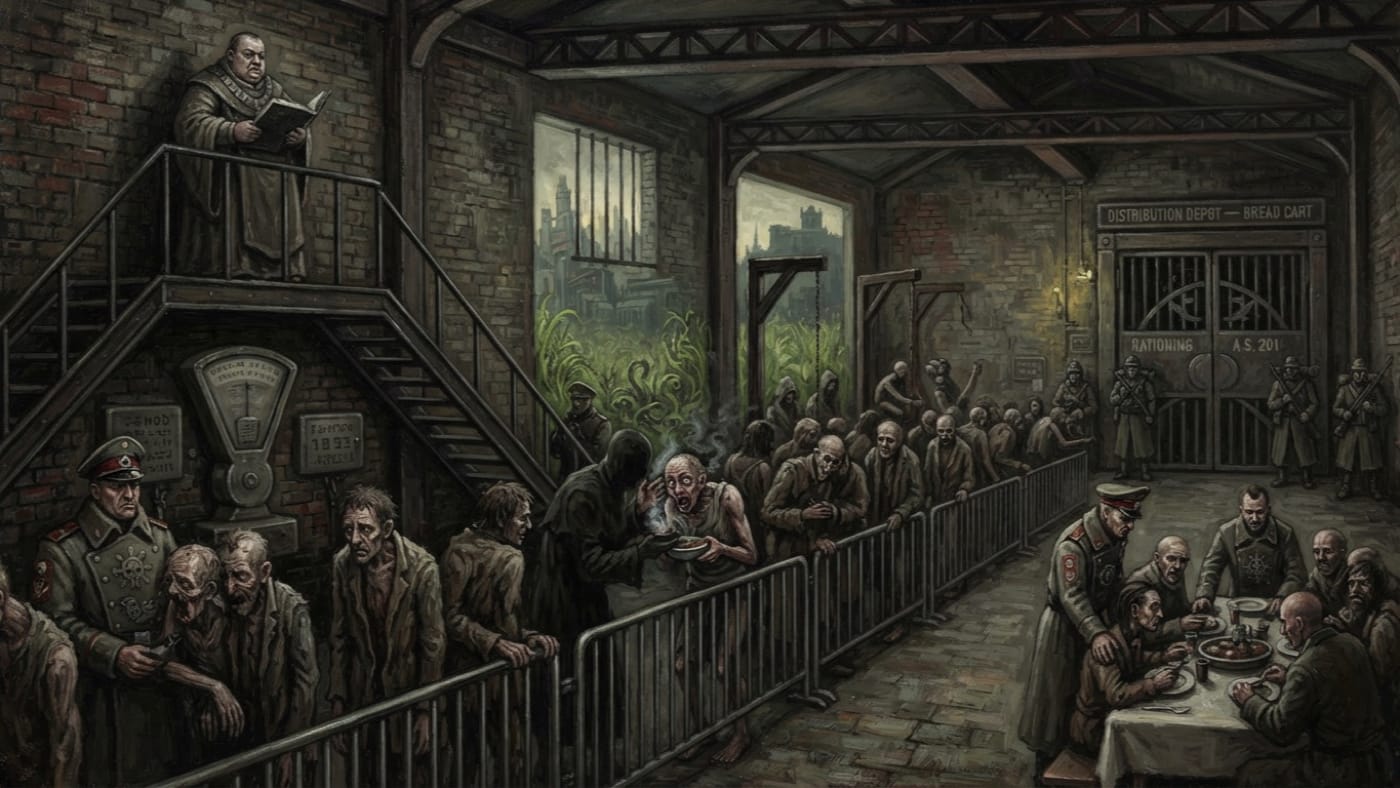
#On Hunger and Sin
"Eat only what you are given." — inscription above the ration-hall doors, recited at the queue as a prayer
The Church has never held that an empty stomach offends the Creator. An empty stomach is a matter for the ration-clerk, the quartermaster and the bread cart, and those offices answer to the Bureau of Tithes. The Bureau of Doctrine concerns itself with a different emptiness: the kind that widens as it is filled.
That emptiness is Gluttony. In the formula the Bureau approved for the dossier on Kargath, it is need that grows with feeding. It is consumption that destroys what it consumes and is still not satisfied, and scarcity carried in the soul long after the larder has been stocked. Bread is its commonest coin. The appetite does not stop at bread. It reaches for stores, for sensation, for other people, and at last for purpose, until a man who once ate to live finds he now lives only to eat.
Earlier editions of this Codex defined Gluttony as overeating, and illustrated it with the figure of a stout man at a banquet.
The Bureau of Doctrine retracts the definition and the illustration. Excess is a symptom of the sin. It is not the sin. The size of a body establishes nothing about the state of a soul, and the Bureau of Purity is instructed to stop accepting waistlines as evidence. Hunger is not a moral failing either. The Bureau records this correction without comment on how many arrests the old definition supported.
Kargath is Gluttony's general. This entry concerns his sin, which reaches further than he does.
#On the Gift and Its Consequence
"He finds the ones who remember famine." — Kargath dossier, On the Theology of Gluttony
The Bureau's own doctrine contradicts the public sermon here, and the doctrine is correct. Gluttony does not seek out the greedy. It seeks out the hungry: the mother who divides one loaf into five and eats the crust herself, the farmer who still dreams of the year the well turned, the clerk who counts the household's chits twice each night and finds them short. The ones who ration most carefully are the most exposed. So are those who feed dependants, and those who look at a full granary and see only the winter when it will stand empty.
Doctrine holds that Kargath's influence-demons go to such people. They cannot possess a body or command a will. They offer, and the offer is food.
The offer is real. I record this against the wishes of three Bureaus. The food appears, and the children eat. The hunger stops, the fear goes out of the house, and for a season, sometimes several, the family is fed better than the Theocracy has ever fed it. A pastor who preaches that the gift was rotten from the first mouthful is preaching to people who tasted it and know he lies.
The turn comes afterwards. A meal no longer satisfies. The second helping makes the hunger sharper, and the fourth sharper still. Depositions taken along the eastern approaches record what follows: hunger immediately after eating, bodies that waste while they consume, teeth sharpened or multiplied, mouths that sit wrongly in the face. Provisions spoil at the touch, and the habit of providing for one's own turns into the habit of taking from everyone else. The Bureau of Medicine declines to arrange these reports into a sequence. Some victims show every sign and some show none. Some are found still able to put down the bowl.
That last point is doctrine. The human chooses, even when hungry, and even when the Great Deceiver's servants have made every other choice feel impossible. Choosing differently does not undo the teeth. The choice can still be made.
#On Gluttony Made Flesh
"Eat the grain and starve." — Bureau of War field instruction, eastern perimeter
The sin wears bodies beyond the walls. The garrison of Bastion-Constantinople, at the southern end of the Sagittal Line, sees more of them than any other, because Kargath's hunger presses on the Bosporus approaches, and the Blightmarsh and the Moldavian territories lie behind it.
The Abundance Fields must be kept distinct from the gift described above. The gift feeds for a time. The Fields never do. Their wheat is heavy and their fruit splits with ripeness, and their produce gives no nourishment from the first bite. Refugees walk into them. Soldiers on low rations look at them from the parapet.
Blightbearers carry the opposite curse. Where they pass, stored grain sours overnight and water turns brackish. A granary need never be breached to empty.
Hollow-Walkers are deprivation turned dangerous. They are emaciated, drawn by the smell of rations, and sometimes still able to speak. Corporals have reported being asked for help in their own grandmothers' dialect. The reports end shortly after that.
The Gorged are demons filled past every capacity and still crying out. The Bureau of Doctrine uses them as a sermon on appetite. I add, for the benefit of the Bureau of Purity, that they are demons, and a sermon about demons is no licence to inspect the citizenry's bellies.
#On the Hungry Within
"They are not performing generosity. They are providing." — Bureau of Purity threat assessment, sympathetic annex
Gluttony's congregations are small, local and human. Cells form in a ration district, a mill town or a hamlet of failing farms. An influence-demon may act as patron to such a cell, appearing now and then with a gift. No deposition in the Bureau's possession shows a cell taking orders from Kargath himself, and I decline to invent the chain of command that every frightened sermon assumes.
The structure is one of dependency. The Hungry join for bread. The Fed have tasted the gift and recruit others while its memory lasts. The Providers decide who eats, and that control is their only satisfaction. The Consumed are kept fed so they do not devour the cell. The Hollow, emptiest of all, know precisely what to offer to a newcomer whose hunger has just begun.
They gather where food is counted: ration offices, distribution depots, the tally-houses of agricultural parishes. A Provider in a ration office does not need to poison anything. He can misroute a cart, or let a district's allotment arrive three days late, and when it does he arrives himself with a full basket. He believes he is the only honest man in the building.
#On the Doctrine of Enough
"Contentment with rations is holy." — Doctrine of Enough, first article
The Synod's defences against Gluttony are bowls, seals, queues and gallows. Each one works. Each one also deepens the hunger it was built to cure, and the Bureaus file that difficulty in separate drawers.
Rationing holds allocation together and prevents riots. It also keeps most of the population underfed, which is precisely the condition the influence-demons look for. The Bureau of Doctrine acknowledges this privately.
Fasting, mandatory on the appointed days, is defended by the Bureau of Rites as a training of the soul against temptation. The Bureau of War answers that a fasting levy marches slower and listens harder to anyone carrying bread. Their correspondence is classified as an unresolved jurisdictional dispute, meaning neither can prove the other wrong.
Communal meals are the best of the defences. People who eat together can see who is missing, who is wasting, and who has more than he should. Shared tables offer no immunity, and they cannot make an insufficient pot sufficient. Even so, the field chaplains rate them above every other measure. The garrisons rate them a luxury.
Blessing of provisions is carried out by the Bureau of Relics, which maintains that blessed food cannot carry Kargath's curse. Field evidence does not support this. Grain from the Abundance Fields remains barren with or without its seal. The seal assures the people who receive it, and assurance is a commodity the Synod can still afford.
Hoarding is punishable by public execution, and the confiscated stores are redistributed. The law falls on widows with sacks of meal under the floorboards and on old men who remember the famine and keep a crock against its return. The same law does not reach the depots of senior officials, whose stores are filed as strategic reserves. Twice the Bureau of Purity has tried to bring a cellar under Velmora's Greed so as to execute its owner on a cleaner charge, and twice the Bureau of Doctrine has sent the file back marked hunger, not avarice. The owners were executed under the original charge.
At Bastion-Brest, which faces Velkara and has no business with Kargath, the same machinery runs in a northern form. A ration chit will pay a crossing toll on the Ribs, and no crossing is granted without a confession receipt. A starving family on the Bug therefore pays for passage with the bread it needs and the sins it can bear to name. I cite Brest as administration and charge no sin with its condition.
The Doctrine of Enough joins all of this together. It teaches that the allotted portion is sufficient by definition, and that wanting more than one's share is itself the Deceiver's work. Under its terms, a ration that is too small in the stomach is enough in the soul, and the person who still feels hungry has a doctrinal problem rather than a supply problem.
I wrote part of the Doctrine of Enough. The Bureau considers it among my better work.
#Ratification
The Bureau of Doctrine certifies this entry as the present assessment of Gluttony for the year A.S. 201. It confirms that ordinary hunger is no sin and that the Synod's rations should be called sufficient. Both clauses bear the same seal.