
#On the Threshold
"I did not open it." — first clause of the Gate Litany
The Gate Litany is a prayer with a postal address. No hamlet bears the name, and neither does any chapel or crossroads inn with a painted sign. The Gazetteer files it among places anyway, and the Gazetteer is correct. A recitation that may be performed on one stone only has stopped being portable devotion and has become municipal property.
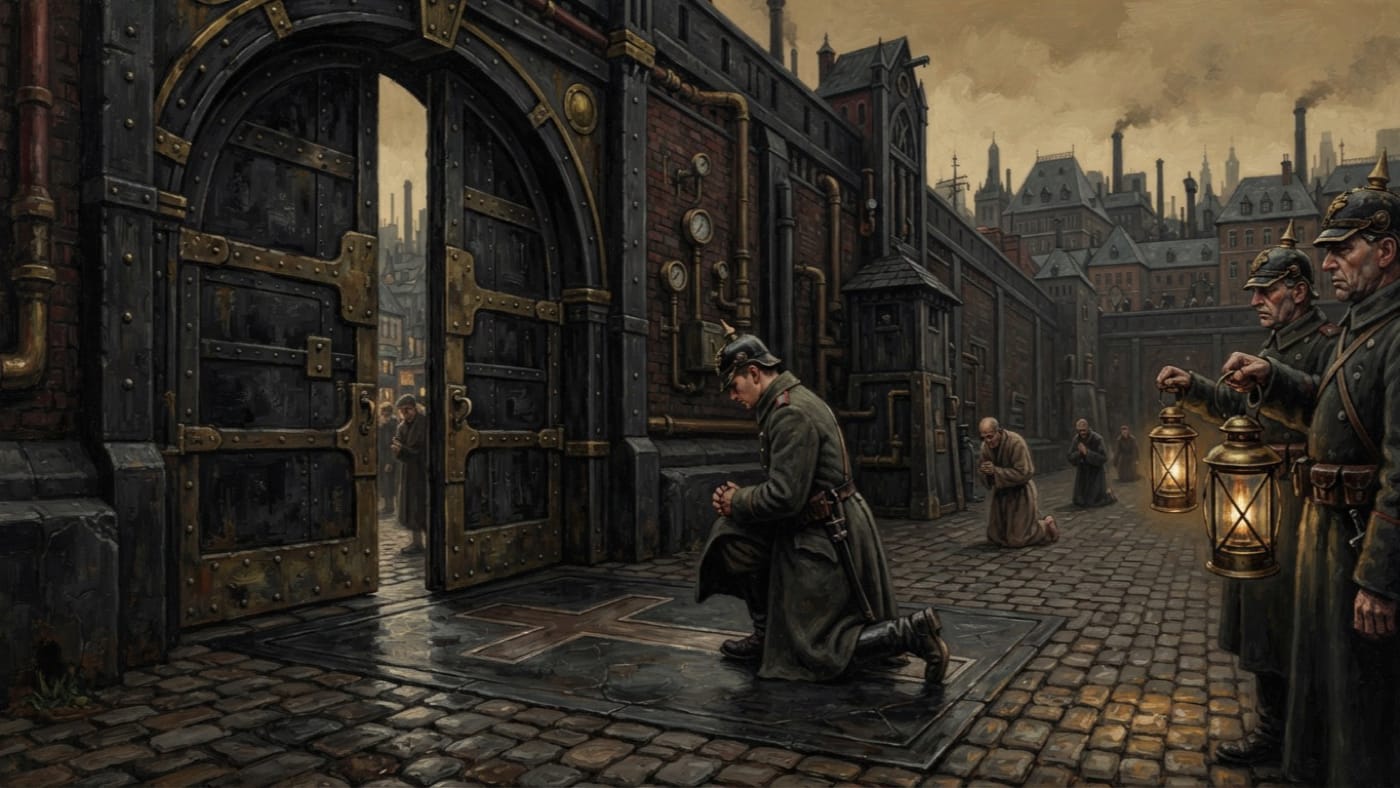
The stone lies under the western gate of Aachen, and a cross is cut into it. Pilgrims cross the mark barefoot. Soldiers newly posted to the Aachen garrison kneel on it on their first morning and recite forty-seven clauses, beginning with I did not open it and ending with hold me accountable anyway.
Every soldier who has ever knelt there has spoken the first clause truthfully. None of them opened it. The men who could have said otherwise have been dead for generations, and the Litany has never once taken this into account.
#On the Opening Remembered
In A.S. 25, in the middle of the Atheist Wars, Lord-Protector Guillaume surrendered the citadel of Aachen to the Rationalists. The Lore Book records his price as dominion over the Lowlands. He never received the Lowlands. He received a folio, and in this Church a folio lasts longer.
The western gate opened at midnight on the Feast of Saint Bartholomew. Colonel Verdane wanted the city whole. He wanted the stores intact, the courier stables seized, the bridge warrants in hand and the chapel bells secured before anyone could ring them. Aachen stands where the roads from Cologne, Liège, Maastricht and the Lowlands meet, and a junction of that quality is worth more unburnt. So the Betrayal came in through an unbroken gate, in ordered ranks, over a threshold that nobody had yet thought to carve.
The rest belongs to the chronicle. The northern faithful front broke. The Treaty of Regensburg in A.S. 30 crowned a Rationalist administration that had already been signing warrants for five years. Fifteen years after Regensburg, on 1 November A.S. 45, the Sundering interrupted Reason's paperwork with considerable violence. After the Concordat of Strasbourg in A.S. 90, Aachen was garrisoned, reconsecrated and assessed.
The Litany concerns itself with none of this except as cause. Its subject is a single fact. The gate was opened from the inside, by a man with a key, and the stone beneath it was clean the next morning.
#On the Mark and the Iron
The cross has two grooves. The long one runs from the road toward the inner yard, along the line any column takes when it is allowed to walk in. The short one runs across the passage at the point where the Rationalist front rank halted to receive Guillaume's key. One groove marks the entry. The other marks the transaction.
The two obligations at the mark are kept apart. Pilgrims give their soles to the stone, and recruits give their knees. The ordinance does not ask the soldier for his feet or the pilgrim for forty-seven clauses. Visitors who have read too many devotional pamphlets keep confusing the two, and so do several of the pamphlets.
The gate itself is black iron. Engineers have reported more than once that its hinges were replaced. The Bureau of Doctrine accepts these reports as materially accurate and rules them spiritually irrelevant. The gate that opened is the gate that stands, and any replacement hinge inherits the guilt of the hinge it replaced. I record this as the Bureau's ruling. I do not record it as metallurgy. No foundry has yet been asked to certify that iron can repent, and I would not lend my seal to the one that agreed.
Earlier civic guidebooks described the western gate as "restored."
Corrected by order of the Bureau of Doctrine, A.S. 199. Restoration implies injury followed by repair. The western gate is preserved under penitential continuity. A soldier who kneels at a restored gate is admiring masonry. A soldier who kneels at a preserved gate is kneeling where it happened.
#On the Forty-Seven Clauses
The Codex prints two clauses, the first and the last. The other forty-five belong to the stone and to whoever kneels on it, and they are taught in Aachen to everyone who needs them. A Codex entry is not a missal, and a reader in Lyon who wants the shape of penance without the knees may go to Aachen and buy a pair.
The two clauses I do print are enough to read the whole grammar of the thing. I did not open it is a denial, and it is true. Anyone speaking it today was born a century or more after the midnight in question. A hundred and seventy-six years lie between Guillaume's key and the recruit kneeling this spring, and that is several lifetimes of not opening it.
Hold me accountable anyway is a surrender, and the important word is the last one. Between the first clause and the forty-seventh, the speaker moves from what he did to what he will answer for. He begins as a witness to his own innocence. He finishes as a signatory.
The Bureau of Doctrine holds that repetition deepens contrition, which is why there are forty-seven clauses. I do not dispute the arithmetic. I note only that a penance a man can finish before his knees complain is a penance he will treat as a formality, and the authors of the Gate Litany, whoever they were, clearly understood knees.
The Litany never says who opened the gate. It does not need to. The whole Church knows Guillaume's name, and leaving it out of the prayer spares the speaker the comfort of blaming someone else.
#On the City That Learns It
In Aachen the Litany starts in the schoolroom. Children learn it before multiplication. An Aachen girl of six can tell you she did not open it, and that she should be held accountable anyway, before she can tell you what seven eights make. Her teachers consider this the right order of instruction, and so do I. Arithmetic can be corrected later. Contrition taken in that young does not wear off.
In the barracks the Litany is a first-morning duty. After the Concordat, the garrison was drawn from provinces that had not fallen to treachery, and the ordinance has been kept up ever since. The soldier who kneels at the mark is therefore usually a stranger to Aachen, reciting a guilt that was never his city's, over a stone his great-grandfather never saw. He does it once, on arrival, and the regiment keeps him for years. The city in front of him has been reciting since childhood.
In the counting-house the Litany has no words at all. It takes the form of the permanent memory levy, collected by the Bureau of Tithes since the post-Concordat settlement and entered on every merchant's assessment beside his ordinary duties. The child recites, the soldier kneels and the merchant pays. Aachen meets the same midnight in three offices, and only one of them accepts coin.
#On the Continuing Obligation
Aachen in A.S. 201 is clean, prosperous, devout and watched. The garrison polishes the threshold until the groove shines black. Pilgrims come barefoot in all seasons. On their first morning the recruits kneel where Verdane's front rank stood and say what they did not do, then accept the bill.
The city has petitioned the Synod to lift its penitential classification, and the petitions are refused. A city that teaches the Litany to its children has, in the Bureau's reckoning, recorded its own continuing need for it. Aachen's advocates have never found a reply to this that would survive a second reading.
Every evening the western gate is barred at curfew. Three clerks witness it, two soldiers hold the hinge lamps and one bell sounds. Nobody recites the Litany at the locking, because the Litany is for mornings and for newcomers, while the locking is a procedure and procedures do not repent. The key that turns is a working key, cut for a working lock. Guillaume's own key is still missing, and its seven approved explanations are filed with the city.
The cross stays in the stone overnight. In the morning another soldier arrives.