
#On the Name and the Record
The soldiers named it. That is the first thing the reader must understand, and the last thing the Bureau will admit. Gas That Sings is a field designation, trench coinage carried up the chain of command by men who had heard it and lived long enough to complain. No chemist christened it and no commission sat on it. The word gas entered the record because men needed something to call the thing that rose out of No Man's Land and killed them, and gas was the nearest word to hand. It names a danger. It explains nothing, and whoever reads a composition into it has mistaken a soldier's noun for an assay.
The ground in question is the contested strip east of the Sagittal Line, Zone 5 in the cartographers' arithmetic, where the bastions' guns reach and their authority does not. The mists rise there. The record does not say on which stretch of it, how often, or in what season, and I will not supply what the record lacks.
The paper that fixes the phenomenon in the Synod's archive is the Bureau of War field atmospheric survey of A.S. 197 (1907 CE), since partially declassified. Mark what that date is. It is the year a clerk of War wrote the singing mist down among the other weathers of the Line. The first rising, the maker (if there is a maker) and any council's considered opinion all remain undated, and the survey lays no claim to them. The mists were singing before the clerk found his ink. They sing still, in A.S. 201, and the clerk has gone on to other ink.
#On Breath and Sound
What follows is my own testimony. I have given it in this Codex before, and I set it down again without improvement because it needs none.
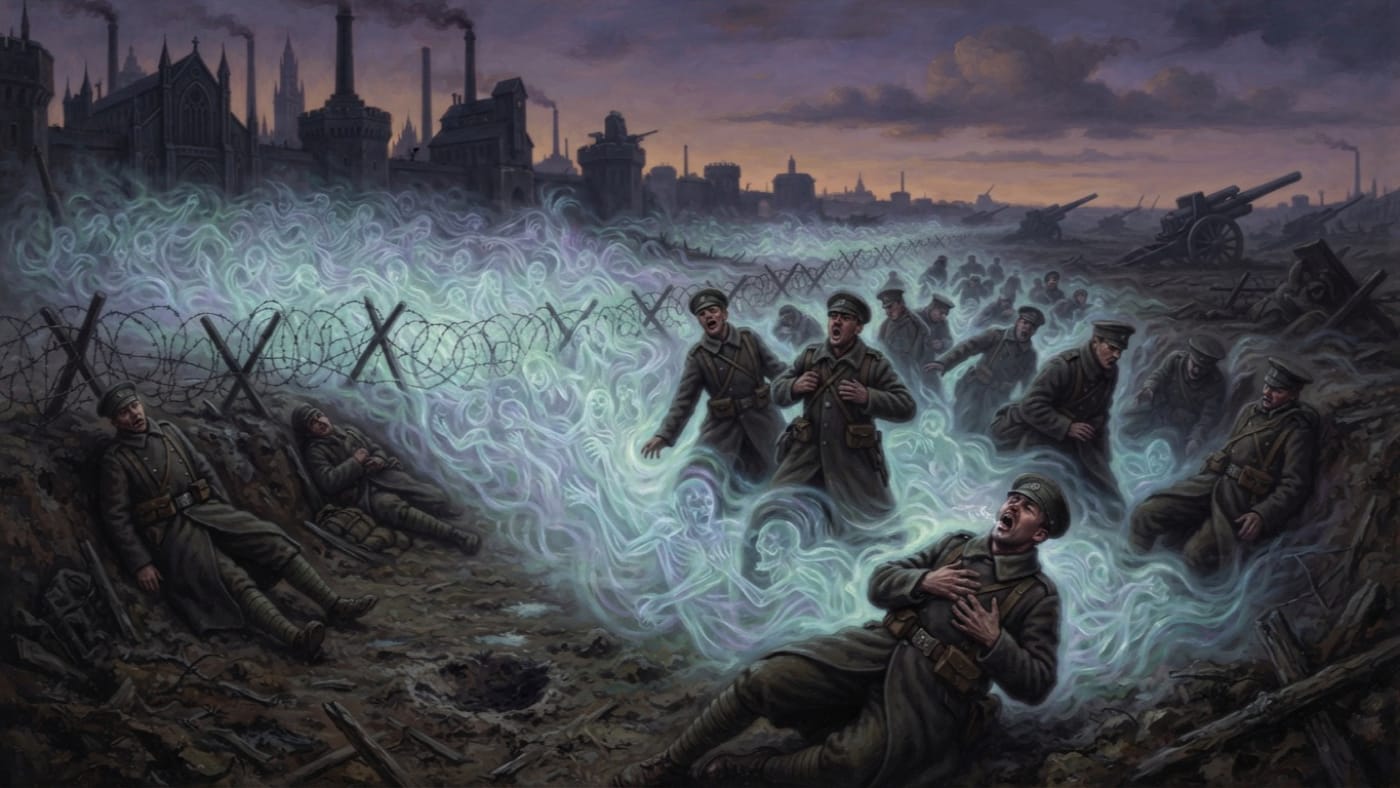
The mists rise with a choir's perfection. Honest fog is silent. It creeps, it wets the wool, it hides a sniper and asks for no credit. This fog arrives in voices, voice laid over voice and harmony stacked on harmony, until the air above the wire sounds like a nave at Vespers whose congregation has been drowned.
That is the first observation. The second is separate, and I keep it separate, because the Bureau has a habit of welding two observations together and calling the weld a doctrine.
The second is this: a man who inhales does not choke as a man ought to. He sings. The hymns are wordless, with no Latin, no vernacular and no verse any cantor of the Church would recognise. They are pressed out of him from the bottom of the chest and do not pause for breath, because breath is the coin being spent. Then the lungs burst. Asphyxiation finishes the account. Put less elegantly, the singing stops shortly before the man does.
That is the sequence as I saw it: inhalation, song, rupture, suffocation. I give no interval between the stages because I measured none. A man watching companies die does not consult his pocket-watch, and anyone who claims to have done so is lying to someone who pays him. The survey is silent on colour, smell, temperature and how thick the mist must lie before it kills, and so am I. Whether a man who merely hears the choir has taken any harm, no one has shown. Nor has anyone demonstrated what gives the mist its voices, or how a breath of it turns a soldier's chest into a bellows that tears at the seams.
Doctrine holds an opinion on the matter. An opinion does not do the work of a dissection.
#On the Company in Chorus
I have seen entire companies collapse in chorus. I write companies with care. My account claims nothing larger, and I will not inflate my own witness to sell a better plate.
Consider what a company is. It is a body of men who must breathe together, step together and fire on the same peal. The whole art of the Synod's infantry lies in making a hundred men behave as one man, and the drill-sergeants are rightly proud of it. In my account the gas takes that unity and spends it all at once. Men drilled to a single cadence went into the mist and died in a single cadence, every throat open. Their final harmonies rose over the bombardment, loud enough to carry above the guns, as though mocking the Bellways that order every hour of a soldier's life.
The mockery is my reading. The guns and the singing are what I heard.
The reader may not build a rule from this. I do not say that every exposure fells a company, that a lone man in the mist is spared, or that a broken formation fares better than a whole one. I possess no such rule, and a rule I do not possess is one I will not sign.
#On Adjacent Atmospheric Failures
The Line has more than one bad weather, and the provincial reader mixes them up as freely as he mixes up his creditors.
Prayer-Jam is a failure of signal. Bells ring off-key, hymns stumble and liturgies gag mid-verse. When a muster-bell warbles false, regiments advance into one another's fire. It kills by confusing command. By no account I hold does it enter a man's lungs. The Bureau of Orison blames sorcery from across the trenches. The Bureau of Engines & Furnaces mutters, off the record, that over-pealing and reliquary pressure may themselves rupture the lattice of air. In A.S. 195 (1905 CE) one of its memoranda leaked, claiming a correlation between bell density and atmospheric malfunction. That paper concerns the bells and the general sickness of the air. It names no singing mist. Anyone who quotes it as the recipe for the gas has misread it, or has read it the way Records now prefers it to be read.
"Correlations between bell density and atmospheric malfunction are measurable."
Delete the word "measurable." Replace with "alleged." — Bureau of Records, 4th Revision. The correction governs the leaked Engines & Furnaces memorandum on bell density and atmospheric malfunction. It makes no ruling on the Gas That Sings, which that memorandum does not name.
Flesh-Mud kills from below: a slurry seeded with bone that takes a man by the ankles and keeps him. Shadow Noon kills through shadows that lengthen the wrong way and drag men off their footing. Neither of them sings, and nobody breathes them in.
The nearest likeness is the Pale Chanters, and the likeness is shallow. Their voices come out of emaciated throats that belong to the Shadow Court's own priests. Their song empties the will and leaves the lungs alone. Their record of defeat and victory against massed bells belongs to them. The mists have shown me no bodies, and I will not draw faces in the fog to please the engravers.
#On Doctrine and the Witness
Doctrine calls the singing the air's confession of blasphemy. Those are Doctrine's words, given under Doctrine's seal. My own judgment, which I have published and do not withdraw, is that the singing proves the Lie covets even the act of breathing. The Great Deceiver has always wanted the tongue. That he should want the lung as well surprises no one who has read the archive.
Both statements are interpretations. Neither is an assay, and neither names a maker. I hold mine with the full confidence of my office. That confidence covers what I saw on the wire. It does not reach into the mist and return with a cause.
There is a further point, and it is the one the more zealous corners of the Synod will dislike. The hymn a dying man sings in that fog was not chosen. It is pressed out of him as blood is pressed out of a wound. No tribunal may read it as worship offered to the Enemy, and no confessor may enter it in a ledger as apostasy. Whatever has gotten into his lungs has not, on any evidence I possess, gotten into his assent. A lung that bursts in song has been injured. Its owner has made no choice. The man died at his post, under orders and in the Church's service, and he is to be entered as such. I will hear no argument from clerks who were never closer to the front than a warm inkwell.
#On the Limits of Response
The Lore of the Line says the Synod redirects gas clouds with censers. I have written the same thing myself, and it stands as a general claim about gas clouds on the Line. Nobody has recorded what a censer does against this mist in particular: no procedure, no trial, no figures for distance or weather, and no list of men walking home behind a swinging thurible. Prayer-Jam has its redundant peal-schedules and Flesh-Mud its salt bombardments. Those remedies belong to those weathers, and moving them across to this one would be a clerk's fraud.
No one has named a composition, a safe breath, an antidote or a mask that holds. Anyone who offers you one is selling it.
The mists rise. Men breathe them, and then they sing.