
#On the Gallery and Its Occupant
The Gallery of the Quill is my working room in the Tower of the Quill, high enough above Strasbourg that the stair has finished its sermon on humility before anyone arrives. The stair is narrow and mean. I climb it daily. On good mornings I climb it in a single breath, which no rector of my acquaintance can claim without lying, and several have tried.
The Gallery holds a walnut desk. The desk holds the work. I hold the desk as a bishop holds his see: by appointment, by habit, and by outlasting every clerk who coveted the chair. Give me my full style and the room seems smaller: Valerius Drax, Hieromnemon of Strasbourg, Warden of the Sacred Ledger, Archivist of the Holy Bureau of Doctrine. Three titles. One room. The masons did their best.
It is an office. Anyone who climbs up expecting pictures, pilgrims or a man selling tickets is corrected on the stair, usually by the knees.
#On the Desk
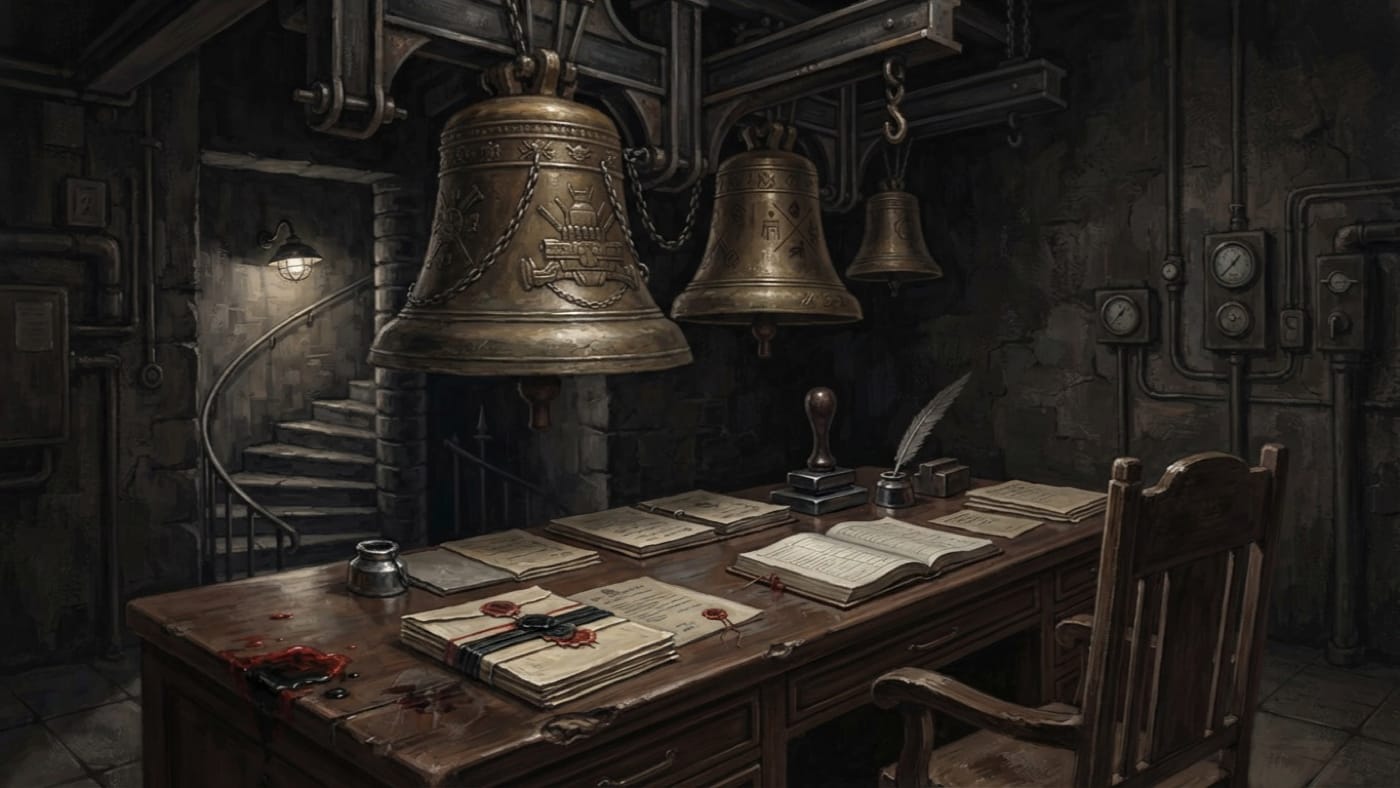
The desk is walnut, dark and dense, broad enough to lay out a bastion's dispatches side by side without one sheet covering another's seal. Its front edge has lost its polish where my cuffs rest. Its left corner carries a crescent of old wax, red over black over red, and no clerk may scrape it. A stain is a record. Records are not scraped.
The inkpot stands at my right hand. I fill it myself, because the junior clerks fill it to the lip and then act astonished by what follows. Around it the correspondence arrives in its several liveries: Doctrine's own folios, drafts from the Cloister, rationing tables, petitions in hands that tremble at the capitals. War's briefs come under wax so thick it seems to resent being opened. I open them anyway. That is the office.
The labour is dull, and I am magnificent at it. I read. I collate. I strike out any phrase that permits two meanings and keep the one the Synod can afford. I seal. Finished pages go down the stair to whoever is owed them, and the desk takes the next morning's supply as a confessional takes the next sinner, without surprise.
Once, under the war bell, the inkpot walked half an inch east and a sealed brief from War slid open before I had touched it. I have set down the occasion under Leviathan. I have not forgiven the inkpot.
#On the Work of Doctrine
The Bureau of Doctrine owns meaning. Other Bureaus own grain, bodies, bronze or roads. Doctrine owns what the words for those things may say. A dispatch calls a retreat a "realignment." A sermon calls a ration cut "the lean mercy." Somebody must decide which phrase goes into the Ledger and which goes into the fire. On many mornings that somebody sits at a walnut desk in the Tower with a cold hand and a warm opinion.
I do not pretend every decree in the Church passes across this wood. Many are drafted in the Cloister of Concord, argued in rooms with better chairs, and sealed by hands senior to mine. I mention this so the reader may admire my modesty while it lasts. The Gallery is one desk in a great machine of desks. It is the one with the best handwriting.
The machine is simple to describe and expensive to run. Doctrine says what a word means. The Bureau of Records remembers that it always meant so. The Bureau of Purity visits the man who used it otherwise. My sentences travel that route every week, and I would be a liar and a poor archivist if I claimed not to know where it ends. I know the address. I write legibly so that nobody knocks at the wrong house.
The Concordat of Strasbourg gave the Synod its constitution in this city in A.S. 90. Everything since has been commentary. Commentary requires a desk.
#On the Bells Heard Here
Three bells hang above the Gallery, and each one enters the room by a different route.
Leviathan, fourteen tonnes of war, comes up through the floor and into the furniture. When it tolls, the desk becomes a drumskin and the Warden its least dignified fitting. The tone passes from wood to palm to sternum and stops all thought for a few breaths. I find the deprivation restful. The posters that follow are less so.
Fames, the hunger bell, rings when the Bureau of Tithes declares a rationing adjustment. It moves nothing on the desk. It moves the next morning's post, which arrives thicker, angrier and worse spelled.
Bell 7-C, the Whisper, comes in by the ear and stays for the conscience. The Bureau of Bells sets its schedule with Doctrine's approval. The public believes it rings for heresy, and Doctrine lets them, because a bell people believe in spares the cost of a paid patrol. From this desk its tone is thin and well-mannered, like a deacon clearing his throat at the back of the chapel. I dislike it. I approve of it. I have written in its defence, and I would do so again with the same pen.
The ordinary peals belong to another register. Bakeries open by them, taverns go quiet by them, auditors gather by them. They are the city's clock, and I hear them as a magistrate hears a cough from the public benches: noted, and kept out of the minutes.
A school primer of A.S. 171 teaches that Bell 7-C "detects doctrinal impurity by sanctified resonance."
Corrected, as the Whisper's own entry already records. Bell 7-C rings by schedule. Working within earshot of it proves nothing about the listener, the Warden at his desk included. His purity rests on better documents.
#On the City Around the Tower
I will not draw you the view. Views become maps, and maps of this precinct are kept by men paid to be more nervous than I am. It is enough to say that the Tower stands opposite the Basilica of the Ledgered Saints, where the census of the living lies beside the absolutions of the dead. The Cloister of Concord keeps its arguments close by. Beyond the basilica, the Palatine Counting House counts coin and bone with equal appetite.
Each of these neighbours reaches the desk on paper. The Basilica sends questions about entries: was this man's recantation notarized before or after his death, and does the order matter? The Counting House sends columns, and the public cannot bear columns until someone adds adjectives. The Cloister sends drafts in a hand I correct for sport.
Strasbourg is the capital of the safe western heartland, and safety has a sound. It is the scratch of pens far behind a front that most of the city meets only as posters and bread. Here the war arrives as correspondence. It arrives sealed. Now and then it arrives with a bell.
#On the Present Occupation
As of A.S. 201 the Gallery is occupied, by me, and in use, by the Synod. The desk holds the season's petitions, two folios awaiting my correction, and a sealed brief from War that I have not yet opened. I prefer to open War's briefs when I can hear myself read them. The inkpot stands two fingers below the lip. Overhead the bells hang according to their kinds: one scheduled, one idle, one waiting.
Authority sounds above this room, and the room goes on being an office beneath it. When Leviathan shakes the walnut, I lay a hand flat on the desk and wait. When the Whisper insinuates, I keep writing. When Fames rings, I send for more paper. Each bell asks something different of the Warden. He supplies it, signs for it, and goes back to the page.
Correspondents who have read this far and still wish to climb the stair should reconsider. The stair will discourage them. I will finish what it begins.