
#On the Stone in the Ring
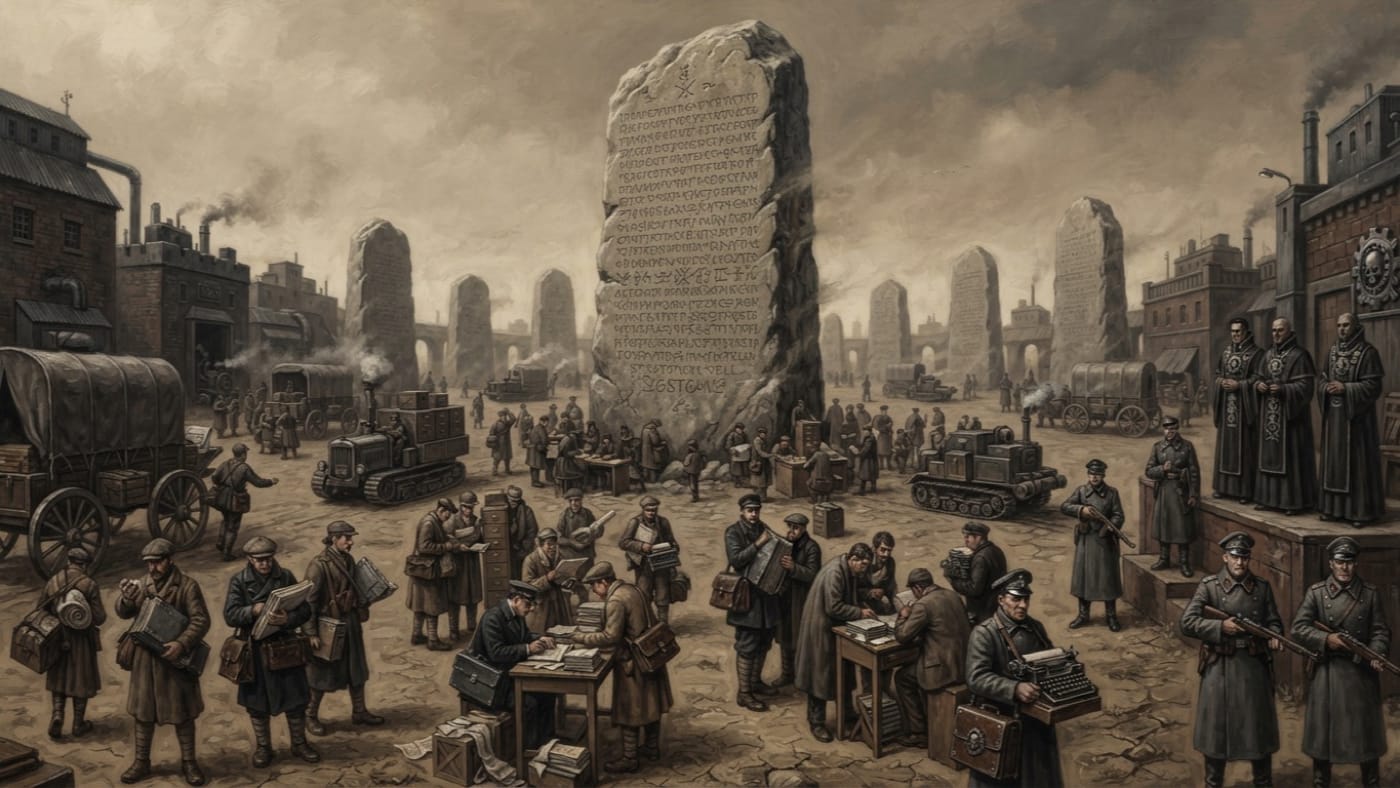
The Fourth Stone is one of seven. Visitors forget this, because a monolith with a grudge seems to deserve a chapter of its own, and the Steppe Gate encourages the mistake by numbering its terrors. It stands in the Treaty Ring of the Steppe Gate of Windscript Treaty-Stones, wind-polished limestone among wind-polished limestone, its carved clauses read aloud by a steppe wind that no one living has known to stop. Caravans, refugee columns and supply trains pass beneath it carrying salt, grain and war matériel. The Caravan Court of Nine Weights sits in its shadow, or in its neighbours' shadow, depending on the hour.
There are seven stones and nine weights, a sum that troubles provincial clerks. The weights belong to the bench, where High Arbiter Senn Vark pronounces which clause binds a dispute. The stones belong to no one. They decide whether he has pronounced it cleanly.
The Codex holds two things concerning the Fourth Stone in particular: one recorded case and one hostile phrase. Its clauses have never been transcribed into any register open to this office. Its height, girth and place in the ring are not recorded either. Guides in the Scribe Bazaar point it out to visitors with great confidence. They do not always point at the same stone.
#On the Raising and the Script
The seven were raised together in A.S. 76 (1786 CE), at the narrow cutbank gap where the caravan wars of the eastern approaches had always been settled with knives. The wind found the carvings and the stones began to whisper. The fighting stopped, which is more than most councils can say of their constitutions. In A.S. 78 the Bureau of Records registered the arrangement as the Windscript Treaty-Stone Border Compact, Administrative Node Seven. Registration made the ring legible to Strasbourg. It founded nothing the wind had not already founded.
A.S. 76 dates the raising of the group. It does not date the quarrying of the Fourth Stone, the cutting of its letters, or any older layer the masons may have found under them. Those dates are missing, and I will not supply them. At the Steppe Gate a forged year is only perjury on a longer fuse.
The clauses are cut in an archaic script older than Doctrine. In A.S. 178, a hundred and two years after the ring was raised, the Triune Alphabet was imposed by edict, and scholars noticed that certain strokes on the stones resemble its approved forms. The Bureau of Doctrine holds this to be proleptic validation: the Creator permitted the stones to anticipate correct orthography. As a servant of Doctrine I repeat the finding with professional warmth. The stones have not commented, and I have no wish to make them.
#On the Innkeeper's Petition
The Fourth Stone enters the record through a complaint about sour beer, which is how most serious jurisprudence begins.
In A.S. 171 the keeper of the Split Tongue, one of the Oath Inns of the northern gullies, swore a deposition against a junior clause-reader named Senn Vark. His grievance was that Vark would not order sour beer unless the server repeated the request, the room scribe marked the hour, and another patron gave assent. The innkeeper called this an insult to hospitality and a drag on trade. The court found no offence in it. The complaint was dismissed.
Later, the same innkeeper brought a toll dispute before the court. The record does not say how much later, and I will not invent the year. His petition contained the phrase informal understanding. He lost.
Vark's dossier says the Fourth Stone hates that phrase. I accept the description as a fair account of legal hostility. Whether limestone has an inner life capable of hatred is a question for theologians with more leisure than I have and less sense. The record establishes something narrower, and it is enough. A man who had mocked witnessed speech came before the stones with a claim resting on an understanding nobody had witnessed, sealed or entered, and he said so in his own petition. He had accused himself. The court only had to agree.
The record also leaves a good deal out. No clause number survives in the account, and no toll amount. No further penalty is attested: no closed throat, no bleeding ink, no correction appearing in the margin of his papers. The innkeeper lost a dispute and kept his voice. By the standards of the Gate that is a mild outcome, and it still made the phrase notorious.
Nor does the case prove that the Fourth Stone voids every unwritten bargain, or that the two words are fatal whenever they are spoken. Precedent at the Gate spreads by fear faster than by reasoning. One loss, properly circulated, teaches a whole bazaar to stop saying something. The scribes stopped saying it.
#On the Price of Admissible Speech
If informal speech is dangerous, formal speech has to be bought, and the Steppe Gate has organised its market accordingly.
A caravan master who comes to the ring with a toll grievance does not bring an understanding. He brings a translator-scribe to put his claim into certified language and a licensed phoneme guide to keep his vowels from the spirits' attention. He brings witness seals from Seal-House Row, a pronunciation certificate, a passage writ and, if he is prudent, a Vark compilation bought openly in the Scribe Bazaar. Every item carries a fee, and every fee has a house that collects it. Seal-Mistress Ylena Korr's Seal-House Consortium certifies the wax. Captain Rho Balesh's patrols hold the roads a petitioner must travel to arrive at all. Neither commands the Fourth Stone, and neither can waive it. They have no need to. It is enough to stand between the petitioner and the stone with an open hand.
Vark's books set the deepest hook. To cite his precedent is to accept his reading, so a man who argues from a Vark compilation has conceded the court's authority before he opens his mouth. The innkeeper's loss has become a lesson every precedent peddler can sell, through commerce if not through statute: write down nothing you have not had witnessed, and pay someone to tell you which is which.
The refugee waiting at the Ditch Gate cannot afford any of this. He arrives carrying promises: a cousin's word, a carter's nod, an escort agreed over a cup in the gullies. Before the stones such promises are fragile goods. The official line holds that the treaty protects the weak. The street says it protects the literate. Both sayings are posted in the Bazaar, and only one of them is sold in copies.
#On Pronunciation and Silence
The Fourth Stone's quarrel is with careless wording. Its neighbour taught the Gate what careless vowels cost. In A.S. 94, Licensed Arbiter J. Sarn mispronounced a binding term on the Third Treaty-Stone during a salt-convoy arbitration, and about a thousand throats closed in a single night. The Red Pronunciation belongs to the Third Stone alone. I mention it here because the seven stones share a wind, a court and a population of frightened clerks. The clause-spirits that punish mispronounced terms answer to the ring as a whole, with tightened throats, ink from the ears, paper edges that cut skin and corrections that appear on documents unbidden. No spirit peculiar to the Fourth Stone is recorded. None is needed to frighten anyone.
Bureau of Doctrine casualty return, Red Pronunciation, Third Treaty-Stone: "approximately one hundred."
Corrected A.S. 95: approximately one thousand. The first figure was entered before the bodies could be counted politely. The correction concerns the Third Stone and implies nothing about the Fourth.
The Null Tongue Brotherhood offers another answer, which is to say nothing. Its adherents cross the ring in gesture-cant, and when they petition at all they petition by proxy. Their reasoning is that if the Fourth Stone punishes careless words, a man with no words cannot offend it. Street slang calls this the null-walk and calls it effective. It is also illegal. No ruling of the Caravan Court has settled whether silence lies outside the stones' jurisdiction or inside it without a record. I do not recommend the experiment. The Brotherhood buys Vark's sealed pamphlet on silence in bulk, which suggests they do not trust it entirely either.
#On Present Jurisdiction
Since A.S. 194 the Burnless Archive has been producing Living Addenda: clauses in wet ink, with no known author, carrying witness forms that satisfy procedure. Under Ruling 201-Blue/17, Vark holds that an instrument which satisfies the form binds, whatever hand wrote it. The court does not outrank the Treaty, and it cannot suspend what it has no power to overrule.
That leaves the bench exposed. Human arbiters read the stones. They did not write them, and now something else is writing alongside them. No source I can certify establishes any Addendum amending the Fourth Stone. I record the absence plainly because the Gate is full of men who would sell you the opposite.
The ordinal is the cheapest part of the relic. The Fourth Stone is not a fourth treaty or a fourth court. Sharing a number with the Archive's Fourth Vault establishes nothing. Pilgrims count, and the stones do not. What the record supports is one member of the ring, raised in A.S. 76, before which a toll petition failed on two careless words. Who or what writes the Archive's wet clauses, and whether the stones will ever object, remains unknown.