
#On the Seat and the Canal
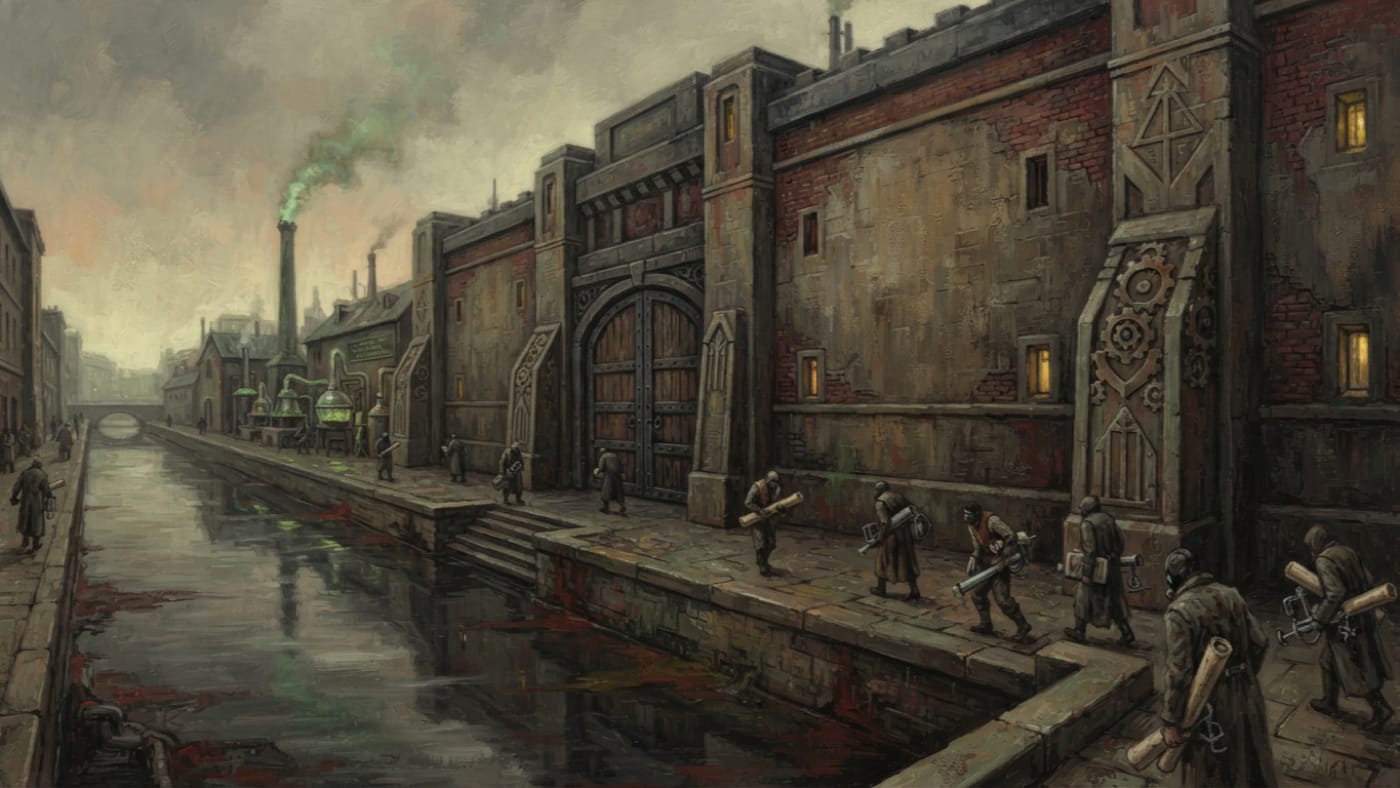
The Bureau of Engineering works from the Foundry Archive, a low stone complex on the eastern canal of Strasbourg. Pilgrims who come looking for it usually walk straight past. It has no spire to steer by and no bell to answer, and no gilt saint stands over its lintel to invite comparison with the saints of better-funded Bureaus. The building lies along the water like a sealed folio set down on a bench: square, heavy, and plainly not meant for the casual reader.
Inside, the canal announces itself in the damp of the stairwells and the cold that comes up through the flags. Everything else smells of lamp oil, graphite, wet stone, and paper handled by men who wash their hands after the calculation and never before it.
Engineering measures, surveys, specifies, builds, and files. The first four happen on the Sagittal Line, in marsh and basalt and wire. The fifth happens here, or begins here. The Bureau has never told me which of its originals rest on this canal and which sit in the draughtsman's offices of the bastions, and I will not guess on its behalf.
The reader should not confuse this house with the cathedral vaults of the Bureau of Records, or with the Burnless Archive, which is a different file, a different fire and a different embarrassment. Records keeps what the Synod remembers. Engineering keeps what the Synod stands on.
#On the Building's Tolerances
The Bureau's own account states that the Foundry Archive is reinforced to tolerances exceeding those of Strasbourg Cathedral. That one sentence is the entire public record. It comes without wall thicknesses or load tables. It lists no iron and no mortar, names no architect and gives no year when the first course was laid. Engineering supplied the conclusion and kept the arithmetic, as it does with every audience it suspects of wanting an argument.
The Bureau of Doctrine considers the comparison an insult. When a seat of the Synod stands more securely than the Synod's own cathedral, a question of precedence follows, and Doctrine does not like questions it did not draft. Doctrine has twice tried to relocate Engineering, and Engineering has twice declined to vacate. The account preserves the count and nothing else. It gives no dates, no proposed premises and no record of proceedings, and it does not name the officers who carried the order down to the canal and carried it back again.
I have tried to picture the second refusal. What I see is a numbered clause.
Doctrine's position has a liturgical logic: the house of the Creator ought to be the strongest house in the capital. Engineering's position is a measurement. Both have shared the city for as long as the Archive has stood, and the Archive has stood through both attempts.
#On What Engineering Files
Every Bureau produces paper. Engineering produces paper that has to bear weight. It files structural assessments, tolerance grades, survey data, load classifications, technical catalogues and field reports, all in numbered clauses that answer questions with more numbered clauses. Survey teams write the field reports, and so do the Litany-Engineers at the wire, whose maintenance logs set gauge readings beside the psalms and oil stains next to both.
One example shows what such a record contains, and how little.
In A.S. 178, Bureau of Engineering Team Gamma-9 surveyed beneath Gate Nine on the Queue Road at Bastion-Irongate, where the Apparatus lies. Their plumb-line hung taut and pulled sideways. The chain was cut. The engineer who cut it was transferred within the week. The Bureau's record says it in roughly that many words: a reading, a deviation, an action and a personnel note. It does not say what the line was pulling toward, because Engineering records direction and leaves the question of destination to other Bureaus. Where the original report now rests is a matter for the Bureau that wrote it.
The catalogues are just as plain and more patient. Engineering's catalogue of masonry instruments runs to fourteen illustrated volumes. Anyone holding a Category Three reading permit and the patience of a martyred saint may consult it. I hold both, and I have consulted it. It contains every chisel the Bureau knows, which also tells the reader exactly which chisels it does not know.
That rule governs field reports. No one has shown me a broader rule covering the building, its rooms or the rest of its papers, and I will not invent one to make the reader comfortable. Within its proper scope the rule is severe enough. A field report becomes secret the moment it is filed. It reaches another Bureau only when a second seal sits beside the first, and the second seal belongs to someone who did not hold the plumb-line.
#On the Neighbouring Laboratories
The Bureau of Alchemical Standards occupies Strasbourg's lower east laboratories, next to the Archive. Its charter abstract describes the arrangement as adjacency "by regrettable necessity," the most candid phrase either Bureau has ever put on official paper. The two are neighbours and nothing more. Neither is the other's tenant or landlord, and neither shares the other's keys.
The mandates are different, and the difference is a constant source of friction. Engineering measures structure. Standards examines what structure becomes once relic, ash, heat, bone, salt and less mentionable substances are introduced into it. Engineering can pour a bastion curtain. Standards was constituted partly because certain mortars began singing after midnight and nobody in the Archive would put a word to it. Standards is a recognised ancillary function under the Twelve Portfolios of the Synod. Engineering's account calls itself a primary organ. Both statements have been sealed, and the laboratories sit at the lower end of the street.
Their work overlaps wherever sacred material carries load: in ash-lime mortars, relic-calcium aggregates, chrismole fuel from the Furnaces of Brast, and the walls of Chamber 7. An A.S. 171 Engineering appendix called that chamber's strength a product of "standard" aggregate bonding. Standards found no prior aggregate that matched it, and the word "standard" was withdrawn. Engineering still objects to Standards' replacement term, hymn-responsive. It has not filed a measurement to contradict it.
Early Concordat manuals describe Alchemical Standards as a technical service subordinate to Engineering.
Corrected. Engineering measures structure. Alchemical Standards measures what structure becomes when foreign matter, sacred or otherwise, is introduced into it. Each Bureau holds its own mandate. This retraction concerns jurisdiction alone, and it settles nothing about whose stone is whose.
#On Custody and Interpretation
Engineering measures. Doctrine decides what a measurement may mean in public. The Holy Bureaus have rarely set out the division of labour so cleanly or enforced it so quietly.
The pattern is on record. In A.S. 155, Doctrine suppressed Engineering's plan for a seventh line of fortifications along Constantinople's southern marches. In A.S. 178, Engineering confirmed gold veins running beneath the foundations of Bastion-Sibiu, and Doctrine classified the survey at once. In A.S. 187, Engineering surveyed the sealed vaults beneath the Crownwright Diehouses, and the findings were suppressed. In none of these cases did Engineering withdraw a number. It filed each one under whatever classification it was given and went back to the next job.
The counter-seal rule gives Doctrine a reason to be in the room. Engineering's rule gives Engineering a reason to keep its papers. The two rules have coexisted for decades, much as two cats coexist on one hearth.
The holder of the office of Archon-Engineer is classified under Bureau of Shadows File 11-K. The Codex records the designation and stops there.
#On the Present Condition
In its A.S. 201 account, the Bureau of Engineering continues to hold the Foundry Archive as its seat, and the building's reinforcement still exceeds the Cathedral's tolerances. Doctrine's two relocation attempts are on record. A third is not.
The same account reports that Engineering's filing rate has risen by thirty-one percent over the last three years. That figure describes the Bureau. It says nothing about the building. It gives no shelf capacity, no new storerooms, no staff numbers and no bill from the masons. What it does show is a Bureau measuring faster and on more fronts, and sending more of its paper into the restricted file under the original seal, where Doctrine's counter-seal must reach it.
The canal still runs past the eastern wall, the lamps stay lit over the survey tables, and on the workshop benches, where no catechism will ever print it, the Bureau's unofficial motto is cut into the wood: the number is the number.