
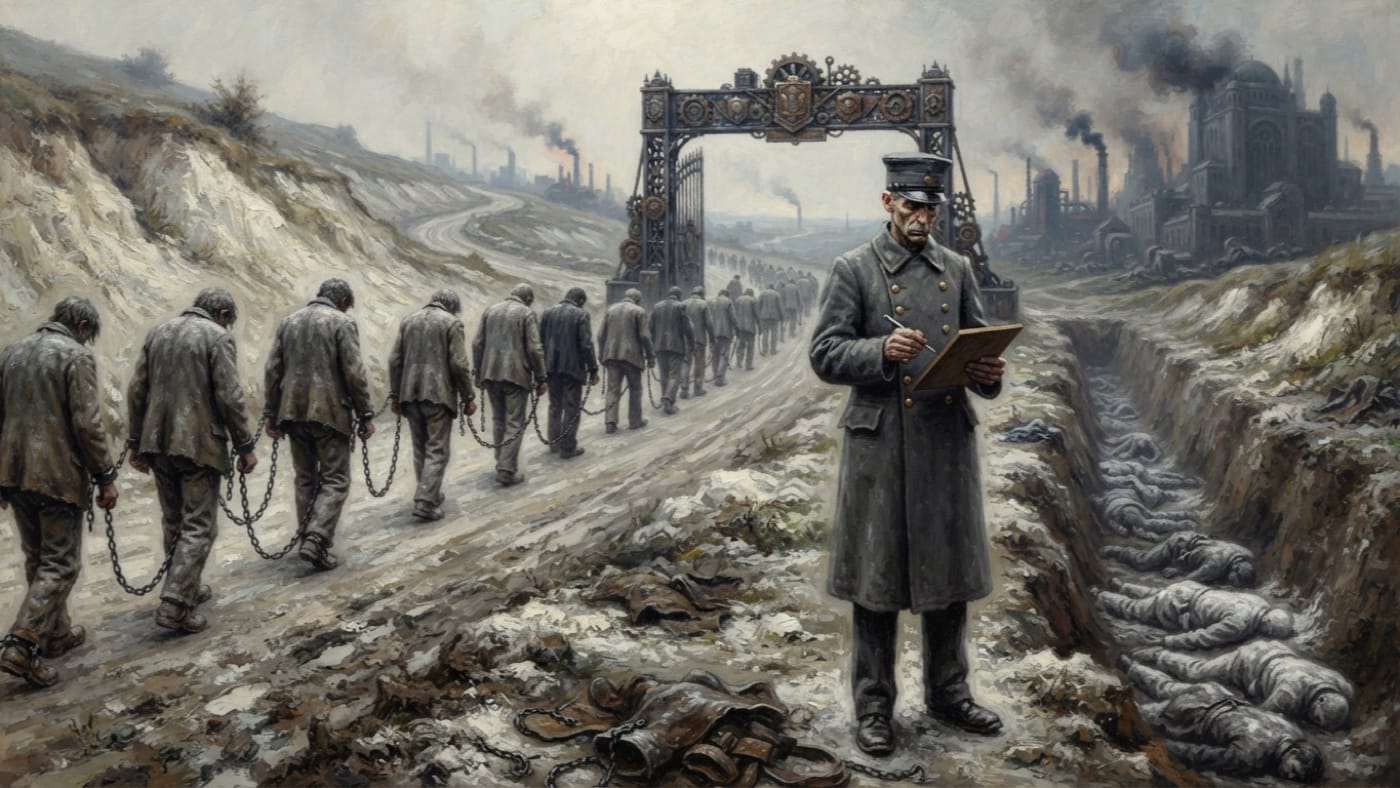
#On the Instrument
"Cessation of Ambulatory Penitence." — title line, Form 17-C
Form 17-C is the only document the Bureau of Pilgrimage requires when a chained penitent stops walking and does not start again. It is a single sheet. It rides in the satchel of every Pilgrim-Chain Handler on every licensed route, beside the wax for the tally slate, and it is printed before the march begins. When the press releases it, the death it records has not yet happened. The explanation for that death has already been set in type, inked, dried, bundled into quires and carted to the departure yard. The pilgrim comes later, and only to complete it.
Nobody recorded who wrote it. Nobody recorded the year it was first issued, or the year of any revision. I have looked. The form enters the Codex the same way it enters the road: already in use, already sufficient, and owed to nobody.
I examine it from a stack on my own desk. These sheets reached me in a supply crate addressed to the Bureau of Doctrine, misdirected by a Records clerk whose hand could not tell Doctrine from Ditches. I have kept them. Clean stock is the honest version of the instrument. Every completed copy has a body attached to it.
#On the Printed Completion
Three entries are printed and two are left blank. You can read the arithmetic of the instrument from across the room.
The cause is spiritual completion. Mark the tense: finished and closed, the way a psalter is closed when the office has been sung. The phrase does not describe a heart that stopped on the third day under an August sun, or a knee that would not unlock after the bridge, or a fall under the drag of the chain. It gives the Bureau's opinion of the result, and the Bureau printed that opinion before the column formed. When its public notices speak of "penitents whose journey was completed by divine acceleration," they are reading this line aloud.
The disposition is roadside consecration. That means the ditch, which the Bureau prefers to call a "roadside reclamation point." I will come to the ditch.
The notification status is next of kin informed per standing directive. In my entry on the Handlers I wrote that this means nobody is informed, because the kin put the pilgrim on the chain in the first place. I wrote that sentence with a theologian's confidence and a theologian's carelessness. It holds for the tithe-offered, whose families did surrender them. The condemned were surrendered by a court. The voluntary devout surrendered themselves. The printed line makes no distinction among the three, and it informs no one in any of them. The directive stands. I have never seen it move.
The Handler writes only the date and the tag number. The tag number is struck into the pilgrim's wrist cuff and ruled into one line of the tally slate. Of everything the cuff carries, the form wants the number. It does not ask how the pilgrim died. It puts a single question to whoever signs it: did the death occur "within scheduled parameters"?
#On the Two Signatures
As far as the procedure is written down, it has four movements. The pilgrim goes into the ditch. The Handler signs. The nearest shrine-priest countersigns. The form is attached to the column's tally slate and filed with it at delivery. If the reader has heard of anything more (witnesses, copies, appeals, a register of graves), the reader heard it in a tavern.
The Handler's signature certifies custody. In effect it says: this tag was on my chain, the chain is my charge, and the charge has been processed. It carries no sacramental force because the Handler has none to lend. The profession is barred from hearing confession, granting absolution and performing any sacramental act. A Handler who kneels at the lip of the ditch to murmur over the body has gone beyond the licence. I have seen it done quickly, with one eye on the road behind.
The shrine-priest's countersignature puts the Church's hand on the paper. The rule says nearest and nothing more. Nothing on the sheet asks the priest to have seen the body.
The Route-Stamper counts heads against the slate at every checkpoint and cares only that the numbers agree. The Stamper does not sign the cessation form and is not asked to. The form rides with the slate to the destination shrine, where the two are filed together: the count and its excuses in one bundle. Then the column is entered as delivered.
#On Scheduled Parameters
The form asks whether a death fell within scheduled parameters and never defines them. Neither does my stack. The parameters live elsewhere: in the mercy quota, in the bell-window, and in the settled habits of a route.
The quota grew out of the Road-Mercy Scandal of A.S. 136, when Handlers on the Munich–Sibiu corridor were caught selling water and rest off the ledger. The Bureau's answer was to allot every cup, every pause and every strip of bandage by formula, and to check the allotment at each checkpoint. The formula was last revised in A.S. 141. The Bellway Harmonisation of A.S. 148 then put every column on the Bureau of Bells' clock. A column that misses the window to the next shrine-post leaves a gap in the bell sequence, and a gap brings an inquiry.
The Handler walks between those two instruments with a gourd of counted water and a column of uncounted thirst. When the quota runs short, the water goes to those who can still walk, because those who can still walk keep the bell. The trade has a maxim, "Don't feed the ditch," and a practice of unrecorded water, the silent mercies, poured to keep the dead from spiking into an audit. By the trade's own standard, an excellent column is one in which deaths occur only where they are allowed.
That is as close to a definition of scheduled parameters as I can offer. I will not describe how the question is answered on the page. The Bureau has never explained it to me, and I decline to explain it on the Bureau's behalf.
"...the Bureau of Pilgrimage's delivery statistics collapsed so thoroughly..." — On the Pilgrim-Chain Handlers, account of the unchained Jubilees of A.S. 94 through A.S. 108.
The Bureau of Pilgrimage was established in A.S. 123, twenty-nine years after the first unchained procession and fifteen years after the last. The name was applied retrospectively to whichever offices kept those counts. The chains came in A.S. 109. The Handlers were licensed in A.S. 112 by an office the record does not name. The statistics collapsed all the same, whoever held them.
#On Roadside Consecration
The ditch runs at the edge of the Pilgrim Road. The body goes in still white with the lime it was marched through. The chain is opened with a key of sufficient rank, the gap is closed, and the column moves on inside its bell-window. The Handler signs on the slate board, standing, because kneeling takes time.
The blessing comes later. After the column has passed, a shrine-priest rides the route on a donkey, with censer and bell, and consecrates the ditches in bulk at a trot, because the next column is a day behind. The Bureau of Rites has confirmed that this consecration is genuine. I record the confirmation. The Codex is not where the sanctity ledgers of Rites are audited, and I have enemies enough at the Bureau of Bells.
The record does not say the countersigning priest and the rider on the donkey are the same person. The form is signed beside the ditch, and the blessing follows down the road on its own schedule.
On the sheet, roadside consecration takes up one printed line, ruled and level. On the road it is a trench in clay or chalk. By midday it has flies. By the time the donkey's bell has faded, the next column's dust has settled into it. The filed disposition is accurate. The ditch was consecrated. Both statements will be found in order.
#On the Filed Count
I walked behind Column 7-North in A.S. 188, under Maren Kessler, Handler 3rd Class. There were four hundred and twelve at departure and three hundred and seventy-nine at the first checkpoint, and at every checkpoint after that. The delivery rate was filed at one hundred per cent.
The difference between the first two numbers is thirty-three, and it is a difference between counts. I was on that road, and I do not know how many of the thirty-three lie in ditches, how many sheets of 17-C rode to the end on Kessler's slate, or what reconciliation turns three hundred and seventy-nine of four hundred and twelve into a perfect delivery. I did not ask. Nobody asks a perfect column for its paperwork.
The sheets on my desk are blank at the date and blank at the tag. By the standard of the office that printed them, everything else on them is already true.