
#On the River Professionals
This survey, compiled in A.S. 201, covers one institution in one town: the Fishermen's Guild of Sandomierz as it now stands on the Vistula, with its recovery record and its Martius wick work. It does not cover fishermen in general. Fishermen in general are found throughout the Dominion, like damp and debt, and the Bureau of Records has no shelf long enough for them.
The guild exists to fish, on every day of the year including the solemn ones. Its members set nets, haul barges off shoals, mend rope, argue over catch prices, owe money and collect it. They know the current: where the river slackens under the alders, where ice backs up in a thaw, and where a sack or a body will lodge if it is going to lodge anywhere. Parish prints in Kraków prefer to show them as holy simpletons. The printers have never stood on the wharf at five in the morning, where a holy simpleton would lose his boat by noon.
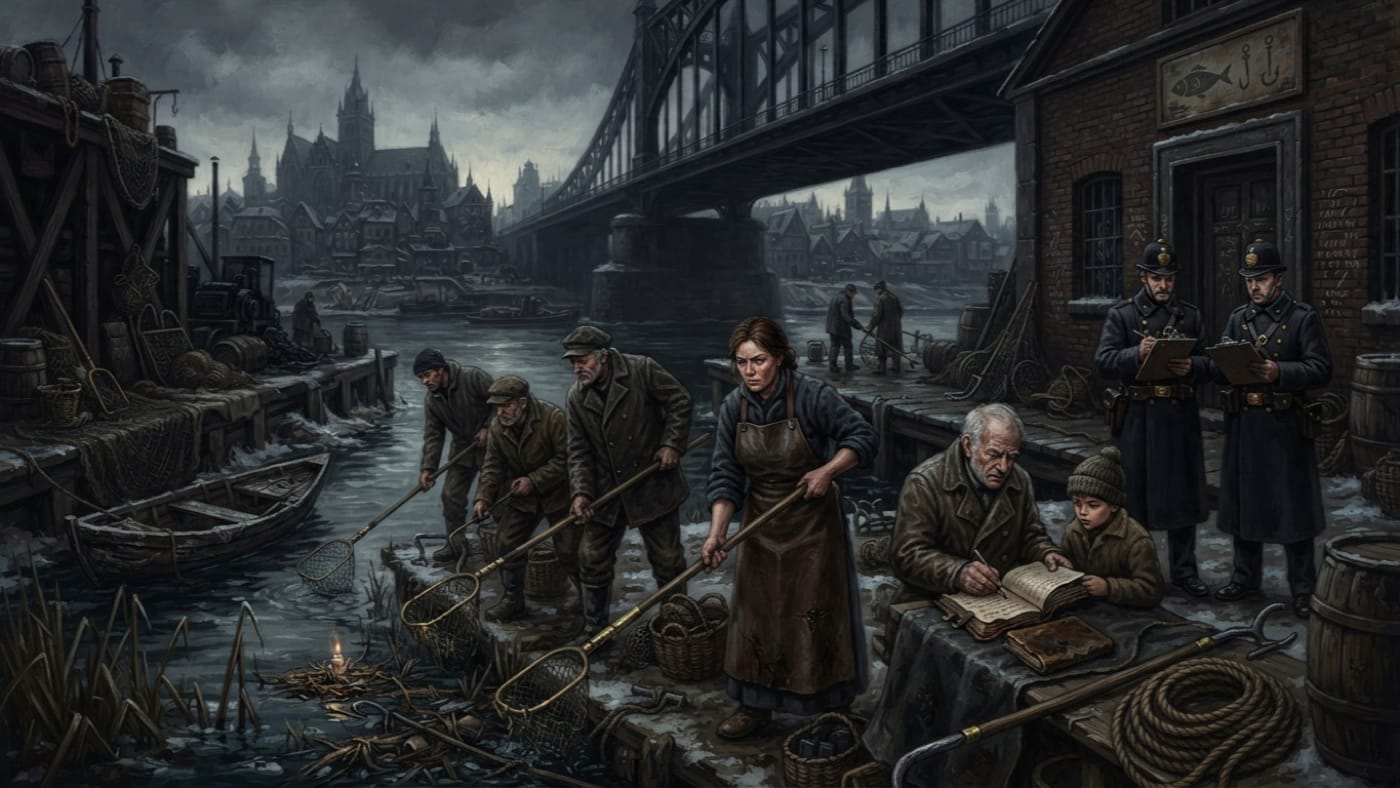
The guild house stands near the lower wharf. Its marks are a fish, a hook, and forty-seven small cuts in the doorframe, renewed each Martius. The Bureau of Heraldry objects to the cuts as unregistered symbolism. The guild calls them maintenance scars. Neither party has yielded, and the door goes on being maintained.
#On the Bodies and the Damaged Copy
On 17 Martius A.S. 18, during the Night of Knives, forty-seven clergy had their mouths wired shut and were thrown from Dębnicki Bridge into a river still carrying ice. Kraków kept the bridge. The guild took in what the bridge sent downstream.
The town's own account places the first body among ice and alder roots before dawn on the second day. Others followed one at a time, by noon, by evening and through the days after, until the count stood at forty-seven by the ninth day. Lifting a body and naming it were separate jobs. The fishermen knew wire, water and the weight of wet wool. The names came later. They were reached by comparison with the Kraków arrest lists, Sister Agata Wiśniewska's testimony, garment marks and parish scraps, in work that later passed into Records files.
The entries survive in damaged copies. They record date marks, water conditions, clothing remnants, the state of the wire, hand injuries, approximate ages and the order of lifting, written by hands that were cold or frightened or both. Records has since produced cleaner copies. The clean copies keep the information and lose the shaking. I prefer the shaking. It is the only signature those men were allowed.
RECOVERY LEDGER — SANDOMIERZ FISHERS' COPY, A.S. 18 Entry Seven: young Carmelite; face bruised left; wire three turns, one broken end; shoulder mark from water strike; hands bound, right thumb split; recovered with reed ice at lower bend. Marginal later hand: probably Brother Paweł Nowak. Handling note: shoulder detail sealed; devotional reenactment risk.
The copies disagree most loudly over Brother Paweł Nowak, a nineteen-year-old Carmelite and the youngest of the forty-seven. If the guild log is read in the order the Bureau of Doctrine now authorizes, he was recovered on the seventh day. Earlier copies place him on the sixth. "Entry Seven" in the fishers' copy is a ledger designation, not a calendar day, and pilgrims who read it as a calendar day have been corrected at length. No miracle is recorded at his lifting. The log records a split thumb.
#On the Punishment of Witnesses
The Rationalist authorities then made the error that fixed the guild's record for good. They prosecuted the fishermen for harboring enemy combatants.
The Sandomierz account says the tribunal lasted twelve minutes and the sentence was twelve years. Records keeps the twelve years because the figure repeats well. The same account says the terms varied, that several men came back to their boats with backs ruined in labour camps, and that one died before release. The survey sources do not say how many men stood before the bench. They give neither their names nor the magistrate's, and I decline to supply any. Brechtold did not attend; his paperwork attended for him. The ruling supported Kraków's story of ritual suicide. The charge itself punished something else: it punished the men who handled the evidence. Sandomierz keeps the two lies apart. One explained away the dead. The other jailed the people who lifted them.
A Rationalist tribunal digest describes the Sandomierz proceeding as "public safety review concerning unlawful custody of hostile ecclesiastical actors."
Corrected. The proceeding punished witnesses for pulling evidence out of the water. The digest is kept for instruction in how a sentence learns to wear gloves.
Each year, after the wick count, the municipal hall reads the charge aloud once. The guild attends. Nobody preaches afterward.
#On the Wick Wardens
The Wick Wardens are a smaller body than the guild. The guild elects them each year from its own members to run the Martius collection. They are a different generation from the men of A.S. 18, who are dead and deserve better than to be confused with their successors. The town calls the link an inherited duty. Records has no genealogy to prove it and has wisely stopped asking.
The Sandomierz survey describes the Wardens by role: three older fishers, two boatmen still strong enough for bad current, one widow who can keep a ledger, and one boy chosen to learn reverence before profit gets to him. That adds up to seven people. The local procedure stamp in the same survey, reproduced below, says six, locally chosen and confirmed by the Bureau. No authority has reconciled the two figures. I have counted the description and read the stamp, and they disagree. This survey records both and certifies neither, which is the only honest option for a man who has no vote in the election.
The widow usually runs the operation. The men allow this by calling her the clerk.
#On the Martius Work
Mourning on the river began without any decree. The formal Vigil of the Drowned Priests came in A.S. 148, when the Fifteenth Doctrinal Congress ratified Sister Agata's testimony and made the Sandomierz Recovery Chapel the recognized final station of the rite. The guild's present work depends on that ratification. No date survives for the first informal wick-gathering, and I will not manufacture one.
Each 17 Martius, Kraków keeps its hour of Bell-silence, carries forty-seven candles onto Dębnicki Bridge, puts them out at the midpoint and drops the wicks into the river. Then Kraków goes home. Sandomierz waits on current and thaw, which follow no calendar the Bureau of Festivals has managed to issue.
The work proceeds in a fixed order. The Wardens search the banks and reeds with small nets and reed hooks, gather what they find, and dry it under supervision. They count the wicks on the cloth, record their condition and any irregularities, seal them, and report. The wick room beneath the Recovery Chapel holds trays, drying racks, seals, count sheets, basins for wax scraps, and an iron stove that smokes. Each tray is marked with the year, the count, the condition, any irregularities and a dispatch mark.
The river does not cooperate. Some wicks sink. Some lodge in reeds where nobody finds them. Boys steal others. Some arrive carrying additions the Bureau of Rites never licensed: hair, thread, lumps of wax, private petitions.
Popular broadsheets claim every wick reaches Sandomierz by miracle.
False, and corrected again for the benefit of broadsheets that reprint themselves. In ordinary years some wicks never arrive. The Wardens go out regardless. That is the whole procedure, and the whole of its merit.
The register for A.S. 191 records forty-seven wicks received, one of them wrapped around a child's nail-paring with red thread. That total belongs to that year alone. Doctrine wanted the paring removed, Rites wanted it interpreted, and Records wanted a subcategory for it. The fisherman who entered it, in handwriting that suggests irritation, wanted breakfast. The paring was retained, not displayed and not destroyed. No meaning has been assigned to it. Its tray is still labelled.
#On Trade and Present Custody
Fish sales continue through Vigil week, at prices that make visiting clergy rediscover poverty as a sermon topic. Pilgrims push up the price of carp and herring. The Bureau of Tithes raises stall levies to match and licenses the trade with the expression of a creditor at a christening. Guild members dislike officials on the wharf, yet they count side by side with officials in the wick room. Both habits are sound.
A second market runs around the guild without belonging to it. It sells false wicks, bottled recovery mud, wire fragments said to be Brechtold's, and ledger copies full of spelling errors. The Bureau of Purity raids a few stalls each year. The survey sources do not show the guild making any of these goods. I record that absence with the satisfaction of a man who expected otherwise.
Custody is shared, and so it is argued over. Doctrine, Records, Bells, Festivals and Tithes all supervise the collection. The guild works under that supervision and owns none of the trays outright. Authentication goes only so far, and pilgrims would rather not hear where it stops. The boat-hook in the chapel side case is labelled traditional recovery hook, and the label is exact: tradition is all that has been proved of it. The sources give no seal design, no dispatch destination and no complete chain of custody. This survey does not invent them to look thorough.
The guild's duties for the coming Martius are unchanged. Its members will fish until the Vigil, watch the current, elect their Wardens, and go out with the nets to count what the river delivers and record what it does not.