
#On the Surviving Report
The First Unhymn Winter survives as a lesson. It does not survive as a file. This is a survey, made in A.S. 201, of the account as the Orison Signal Engineers still teach it to apprentices, and of the procedures their profession now keeps under its shadow. I have been asked for reconstructions before. The most admired ones always carried the least evidence.
The account is brief. A rival city inverted the ration broadcasts of another city. Thousands starved under panic that arrived bearing every mark of authorization. The feed was traced. Those three statements and the name above them are the whole inheritance, and the engineers pass them down the way a coil room passes down a cracked fork: carefully, and without asking where it was first struck.
The account names neither the city that bent the signal nor the city that received it. It gives no year, no span of months, no operators, no orders, no exact count of the dead, and no method of tracing. A careless clerk would read a calendar into "First" and a season into "Winter" and file both as fact. I have read many such filings. They burn well.
#On the Ration Voice
To see why the profession keeps this example, one needs to understand what a ration broadcast is now. I am describing the A.S. 201 arrangement. The account does not tell us what receivers, coils or kitchens the Winter's city had, and I will not furnish them for it.
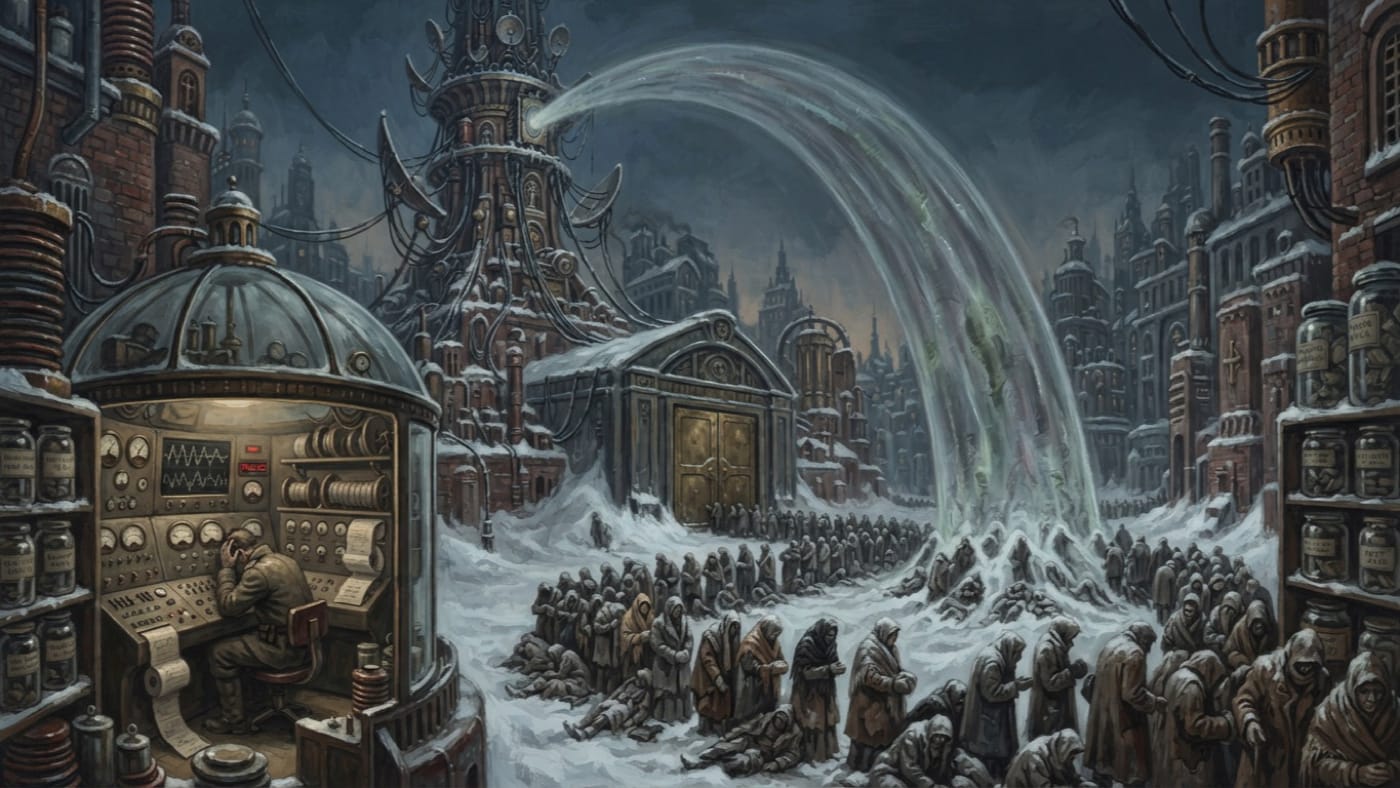
In the present service, the broadcast houses carry ration schedules, curfew amendments, military orders and the daily Orison Hour through the same apparatus. Kitchens wait on the feed before they unlock flour. A ward clerk receives the schedule and posts it. A depot opens or stays shut according to the hour the voice names. Carters hold their mules. Queues form where the notice says they should form and break up when it says they should break up. One transmission becomes ten thousand small obediences, each of them reasonable, each of them performed by a person who has every reason to trust the voice.
That is the design. A provisioned city is a city that obeys its ration voice promptly, without convening a theological seminar at every depot door. The Bureau of Orison and Song counts that promptness as its chief accomplishment, and it is right to. Bread that waits for debate goes stale, and so do the people waiting for it.
The same design multiplies an error. A false sermon offends a congregation. A false ration notice moves grain, closes doors and sends households to the wrong place at the wrong hour, and every hand that trusts the notice passes the mistake along faithfully.
#On Inversion and Authorized Panic
Jamming is crude. A jam says nothing, and people ignore noise. Inversion is the profession's word for the subtler injury: the corrupted message stays intelligible. The speech is still recognizable, the cadence still official, the voice still the voice that has announced the bread every morning for years. Its apparent authority survives intact. Its integrity does not.
Those are two separate properties, and the Winter is taught as the place where they came apart. Authority is a matter of who seems to be speaking. Integrity is a matter of whether what arrives is what was sent. A listener at a receiver can judge the first by ear. The second can only be judged by an engineer with instruments, a log and a reason to be suspicious.
The parent account puts "authorized" in quotation marks, and I keep them there. The panic wore permission. The account does not say whether the inverted broadcasts themselves called for the panic, or whether panic followed from contradictory schedules, or from depots and households acting on instructions that should never have reached them. I will not write the false orders. No surviving text gives them, and inventing them would be the kind of scholarship that earns promotion and deserves the pyre.
No one in the account is said to have been compelled. The receiving city's clerks, depot-keepers and families are not described as entranced, possessed or emptied of judgement. They acted as instructed people act, because a ration voice exists to be acted upon. That is a worse indictment than sorcery, and a more useful one. Doctrine has its own views about what listens in static. This account does not share them.
The attribution to a rival city belongs to the account, and I report it as such. The figure of thousands also belongs to the account. It is a teaching scale. It is not a casualty ledger. The records I consulted contain no proof file and no reconciled count. Their silence on these points proves no suppression either, however much the romantics in Records would enjoy one.
#On the Feed That Was Traced
The account ends with the tracing, so the survey ends its history there too.
The statement establishes this much: at some point the corrupted feed was followed back far enough to be called a feed, a thing with a path and a source, as opposed to weather, misfortune or a clerk's bad handwriting. The account places the rival-city attribution and the tracing in the same breath. It does not say that one proved the other.
It establishes nothing more. It names no discoverer and describes no signal fingerprint, no captured tower, no timetable of investigation and no instrument that rang true at the decisive moment. It does not say whether tracing the feed stopped the transmission, whether the receiving city's own houses went silent, or how many days passed before flour moved again on honest instruction. The word "before" in the parent account carries a cruel arithmetic: the starving happened first. The finding came after.
A trace is a diagnosis. It feeds no one.
#On Present Safeguards
What follows is A.S. 201 procedure, attributed to the profession as it now stands. None of it is offered as the Winter's response. No source I consulted records which of these measures existed when the Winter occurred, or which, if any, were used.
A present engineer first verifies the message's authenticity: wax, cipher, seal, witness mark. They then select a dust blend. Saint-grade serves doctrinal broadcasts, front-grade serves military orders, and port-grade serves the fog towers. They calibrate the carrier's frequency and its harmonic guard bands, introduce saint-dust through micro-venturi or coil-film apparatus, run a test prayer packet to check for inversion and parasitic chorus, transmit, monitor, and log every variance in enough detail to identify whoever will be blamed.
The order of those steps matters. Authentication certifies that a message left its office with authority. Carrier integrity concerns whether it arrived as it left. A perfectly sealed ration schedule can still be bent in transit, and the Winter is the profession's standing reminder that a seal guards the paper while only the carrier work guards the air between.
Engineers watch for the documented warning signs: backward consonants, timing drift, chorus-phase anomalies. These are entries in the professional manual. They are not recorded symptoms of the Winter, and anyone who teaches them as such has confused a syllabus with a chronicle.
When onset is suspected, the present countermeasures are to adjust the dust fraction and guard band, overlay counter-orison, introduce a bell reference from the Bureau of Bells standard, cut and reseal the packet, and disable a repeater when capture is suspected. The last is the cleanest remedy and the most expensive. A silent repeater tells the waiting kitchens nothing at all, and kitchens waiting on nothing make their own decisions.
Saint-dust practice grew out of field experiment. Engineers found that certain relic residues reduced parasitic inversion, and the Synod turned that improvisation into regulated sacramental engineering, graded and sealed through houses such as the Cooperage of Mournwater and counted by the Bureau of Records. The protection is real, and so is its price. Contaminated or short-weighted dust compromises the shield it was bought to provide. Excess dust clogs the coils and causes bloom. Inhaled dust rots the engineers' lungs, one shift at a time, which the Bureau records as wear on personnel.
unhymn
Corrected per standing Bureau usage: counter-hymn. The classroom keeps the older word in this account's title, because titles are harder to amend than adjectives, and because field crews have never accepted the correction.
#On the Classroom Account
The profession keeps the Winter because it lacks particulars. A lesson tied to one city's towers would be obsolete the moment those towers fell. A lesson stripped to a voice that kept its authority and lost its integrity can be carried into any coil room on the Line. Apprentices learn it before they learn the blends. Some of them later learn it again, at a console, at the wrong hour.
It should not be mixed up with its neighbours in the curriculum. The Repeater Massacre concerns a front repeater taken by infiltrators and the engineers executed afterward as accomplices. The Port Fog Choir Events concern sea-static and the districts that came after it. The Shipka conduit infiltration of A.S. 163 concerns resonance pipes and a gasket, has its own discoverer and its own reform, and lends this account neither a date nor a method. Each incident is taught separately, and each is entitled to its own dead.
The Winter remains what the account makes it: a city starved by the voice it was built to trust, and a trace that came too late to feed anyone. I certify the lesson. I decline to certify its details, since no one has submitted any.