
#On the Designation
The full term is First-Order Miraculous Emission, Category: Martial. It occupies one line of one retrospective authentication in the Bureau of Relics file on the Last Stand of Kalnik Ridge. The Codex now asks me to spread that line across several pages without inventing anything the line declines to say. I accept the commission. I have stretched thinner vellum.
On its one well-documented page, the designation names an event at Kalnik in the spring of A.S. 48, three years after the Sundering. A casket bearing relics released light, and the forces of Wrath gave ground. "Miraculous" records the Church's judgement that the act was sanctioned and was no counterfeit. "Emission" records that something went outward from the relics. "Martial" records that its effects fell upon an enemy in the field.
"First-Order" is the difficulty. No surviving instrument in the archive defines it. No threshold is printed, no Second Order sits beside it, and no rubric tells an examiner when a glow becomes an order. Readers who take it to mean the greatest miracle, or the earliest, or one requiring a fixed number of bones are writing their own taxonomy and forging my signature to it.
One distinction governs everything below. There was a manifestation, and there was a record. The manifestation happened on a limestone ridge to frightened people. The record was compiled decades later by clerks who were warm and fed. The seals put the event in order. They did not cause it.
#On the Seventeen
Kalnik Ridge is a spine of limestone in the Croatian highlands, honeycombed with cave-chapels that had hidden relics and fugitive priests through the Atheist Wars. In A.S. 48 it held what remained of a rearguard: fragments of the Levy, clergy and conscripted civilians. The parent record puts them at approximately four hundred souls. They were retreating west ahead of Maldrake, the Sin-General of Wrath. The Great Retreat had begun that year. It had seventeen years still to run.
At the crown stood Brother Tomislav, a half-blind Franciscan who had carried a gold-and-iron casket out of his ruined Dalmatian monastery and refused every request to surrender it to someone more senior. The casket was dedicated to Saint Isidore, but its contents had grown beyond him. Through root cellars, false-bottomed carts and the hands of the Cellar Saints, other sacred matter had passed into Tomislav's keeping. By Kalnik the vessel held seventeen objects: the original Isidorean bone, apostolic phalanges, fragments of martyrs, sealed ash, and a link of chain from a burned chapel.
The dedication on the lid is Isidore's. The congregation inside is mixed. Pilgrims who kiss the casket as though every splinter belonged to the same Iberian saint are owed a gentle correction and a donation box.
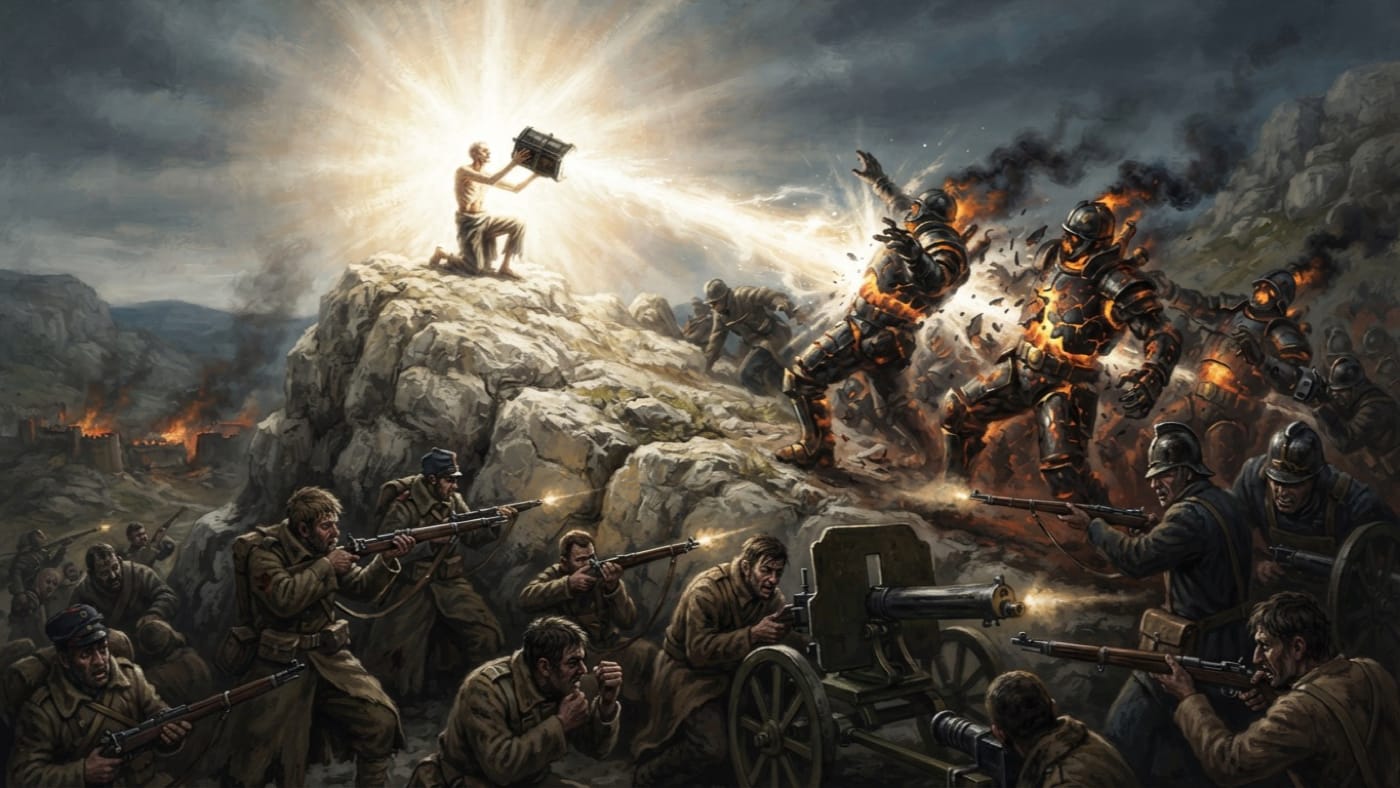
Maldrake's Wrathforged vanguard came up the eastern approach with Charnel host elements behind it. They were iron-scaled and furnace-hot, and the air bent around them. The lower shrine fell. The defenders fired what they had and prayed in whatever dialect their terror had left them.
Tomislav raised the reliquary. The record states that all seventeen relics ignited together. The light was white and gold, and it was hot enough to matter: it burned the shadows of kneeling men into the limestone and fused stone at the crown into the ridge-glass that pilgrims still visit. The Wrathforged recoiled. The vanguard halted.
Afterward the rearguard went on dying, more slowly and to better purpose.
#On the Evidence
Four kinds of evidence survive. The Bureau's popular pamphlets have made the mistake of pouring them into one cup.
The first is the witnesses. The parent record confirms forty-three surviving depositions. They come from people who saw light, felt heat and watched an enemy step back. They are precious, and they are also what frightened, half-deafened people remembered.
The second is the physical traces: the etched kneeling shadows, the ridge-glass and the reliquary itself. Pilgrims testify that bones can be seen sealed inside the glass. That testimony is admissible as devotion. Nobody has yet ruled on it as anatomy.
The third is the continuing reports. Residual fragments are said to glow faintly when Wrath's pressure rises beyond the plains. I record the report. I do not certify the fragments as a gauge, and I advise any captain against garrisoning a ravelin on the strength of a warm splinter.
The fourth is the authentication. Its particulars, as reproduced in the Kalnik record:
Read the hostile effects. Recoil, line break and command hesitation are all enemy behaviour observed in the field. None of them measures the light. The classification is martial because of what the enemy did, and an examiner who grades a future emission by its brightness has misread the stamp.
Read the method. "The bones burned demons" is the most honest sentence the Bureau of Relics has ever filed, and it is useless as a general test. It describes what happened at Kalnik. It cannot be handed to a novice as a procedure, because there is rarely a demon handy at the examining bench.
The Kalnik file was entered in A.S. 92. That is also the year the Bureau of Relics was constituted, two years after the formal Synod. The coincidence tells us when the file came into the Bureau's custody. It does not tell us when anyone devised the words "First-Order," and I will not pretend to know.
#On What Was Paid
When the light ebbed, Brother Tomislav was still kneeling on the cairn with the reliquary raised. His body had become warm white ash that kept the posture. The recovery party had no rite for this. They set coats around him against the wind and argued in whispers over what touching him would make them.
Church teaching holds that a miracle is a costly alteration paid for by the faithful, out of their bodies, hunger, memory and years. Sorcery takes its payment out of Creation itself. Doctrine reads Tomislav's ash as the bill for Kalnik, settled in full by the man holding the box. That is the Church's reading, and I sign it. The same teaching has its objectors, however, and the Church has never promised that a sanctioned miracle would be gentle or fully understood by whoever invokes it.
His status is less settled than his ash. A deposition is alleged to have been taken from him three days after the event. His canonisation has been pending since A.S. 52 because his death has never been conclusively demonstrated. The Codex calls him Brother Tomislav and will go on doing so until the Ledger says otherwise.
People often hang the Bell of Saint Isidore on this story. Its origin is disputed between the aftermath of A.S. 48 and a casting tradition of A.S. 49. Tradition binds Debrecen's twenty-year lifespan debit to the bell, and no instrument I can find binds it to the casket's emission. The classification concerns the reliquary. The bell may keep its own quarrels.
#On the Bureau's Use
The Bureau of Relics keeps remains, provenance and custody. The Bureau of Doctrine says what they mean. The Kalnik classification serves both.
To Relics, the file is a precedent of custody. It records a vessel, an inventory of seventeen, a bearer, a chain of witnesses and a residue. A Relic Authenticator working a contested object today reconstructs its provenance, takes testimony, examines it, grades it and quarantines it. None of that apparatus existed on the ridge. The men who carried Tomislav's ash away in mess tins were following no procedure. Procedure was written later, partly in their honour.
To Doctrine, the file is proof that the enemy's advance could be checked. Kalnik did not destroy Maldrake or his army. It turned a rout into a withdrawal that kept its formation. The habits of that withdrawal became, by about A.S. 65–68, the first defensible stretches of the Sagittal Line.
Two cautions belong in every chaplain's satchel. First, glow alone proves nothing. Plenty of things glow, and some of them were made by Velmora's counterfeiters. Second, a classification is no recipe. Packing seventeen relics into one casket will not reproduce Kalnik. Any quartermaster who requisitions "a First-Order kit" can expect a reprimand and a hymnal.
Earlier catechisms taught that "Kalnik ended the Retreat."
Corrected. The Retreat ran from A.S. 48 to A.S. 65, and Kalnik fell in its first year. The children may keep the verse if they learn the remaining seventeen years along with it.
#The Recorded Holding
The Ledger can hold this much. On a ridge in the Croatian highlands, the relics in one casket blazed, an army of Wrath stepped back, and about four hundred people bought time with it. Forty-three lived to sign. The rest of the definition is in someone's drawer, and when it turns up, the Bureau will date it to whatever year is convenient.