
#On the Commission
In A.S. 72, eighteen years before the Concordat of Strasbourg gave the Church its constitution and its seven stamps, a party left the western side of the Sagittal Line to find the Shadow Court and put it on paper. The Codex files that party as the First Expedition. I enter it among the factions because it had a commander, a roster, a hymn and an objective, which is more than several offices of the period could claim. A formation that comes home with every name accounted for stays a formation in the ledger, whatever it has since been permitted to say.
Colonel-Inquisitor Aras Venn held the command. The listed complement was forty-two soldiers, six theologians, two cartographers and one priest. Only the priest's commission is recorded by its function. He was to keep a continuous hymn going for the whole march. The record gives no name for him, no title for the hymn, and no account of how sacred sound was to be kept unbroken across fourteen days. I have searched. The record has not been persuaded.
The archive calls the six theologians Bureau of Doctrine personnel and the two cartographers men of the Bureau of Engineering. Read those names as the archive's courtesy. In A.S. 72 the Line was defensible but unfinished, its practices were only beginning to settle into a standard, and the Church governed through an interim administration whose offices had not yet received the seals they would carry after A.S. 90. Later clerks gave Bureau names to earlier officers and functions because a filing system cannot abide an unnamed department. I follow their usage, and I note it here once. I will not apologise for it twice.
I am not cleared to open any folio that names the man who signed the commission. The principal account is Memorandum 441-V, held by the Bureau of Shadows under Seal Obsidian. Holding a document does not make you its author. Shadows was constituted in A.S. 92, and the Bureau of War received its charter in A.S. 105. I will not hand the commission to either office just because the paperwork ended up in its vault. Vaults collect. They do not originate.
#On the Eastward March
The party crossed the Line south of the place the Codex now files as Bastion-Irongate, where the Danube forces its way through the gorge near Orsova and whoever holds both cliffs holds the river. They entered the Iron Gates gorge. They continued east for eleven days.
That is the whole itinerary. I have reproduced all of it.
The record names no camp and enters no village into evidence. It gives no crossing gate, no mileage, no means of transport, and no bearing finer than east. The expedition set out to map the place where the Great Deceiver's Will is said to sit in session. The public record of its route would fit on a ration chit with room left over for the quartermaster's grievance. Readers who want to plot the Court from eleven days east of the gorge may do it on their own paper. The Bureau of Records will not accept the result, and I will not countersign it.
The record withholds what lay at the end of the eleventh day. It does not say whether the party reached its objective, sighted it, or turned back short of it. Nor does the archive work out how eleven days out became a homecoming on the fourteenth day. I have stared at that subtraction longer than becomes a man of my station, and I have entered nothing.
#On the Returned
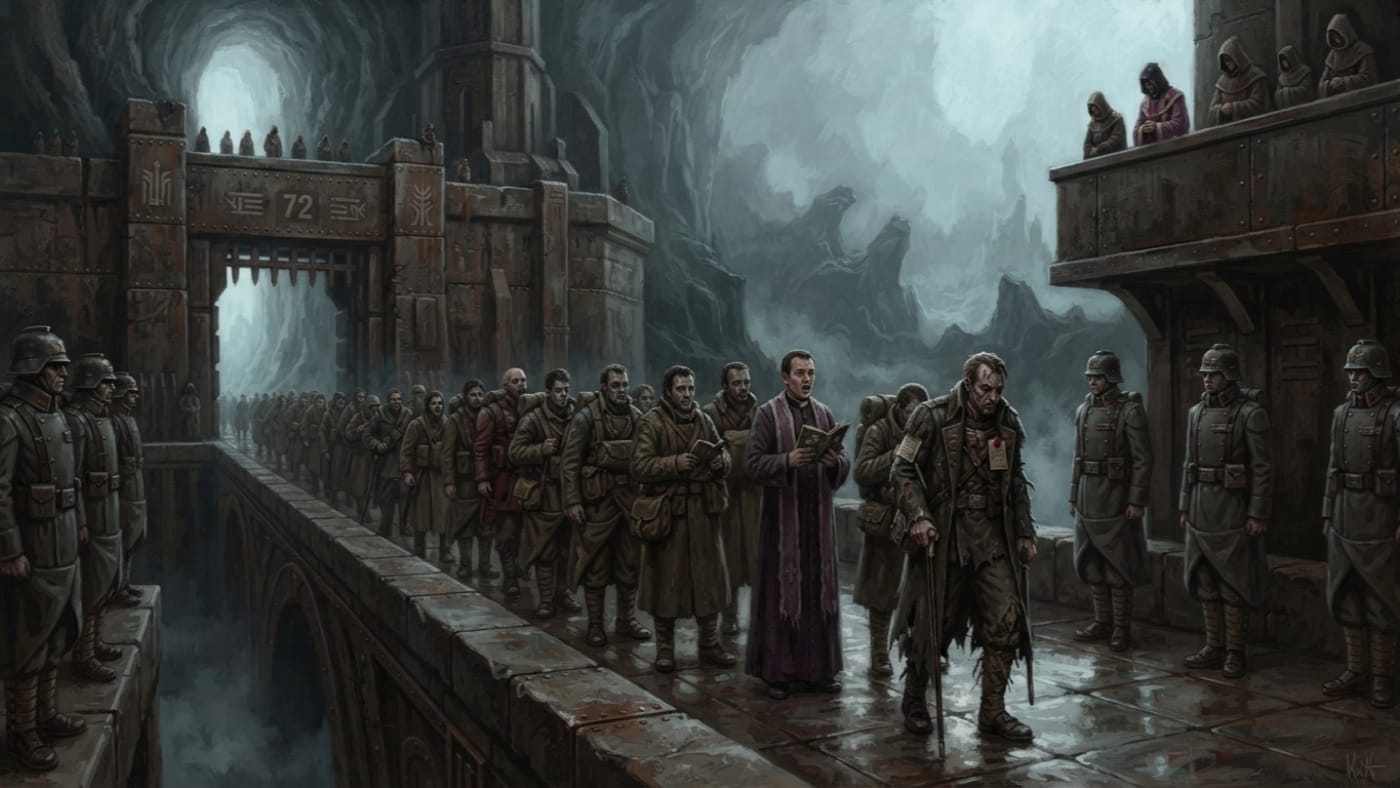
They came back on the fourteenth day. All forty-two soldiers were present. All six theologians were present. Both cartographers were present. The priest was present. Colonel-Inquisitor Venn was present.
The archive had readied a casualty list and convened an examination instead. Records' later account describes three tests: wax seals were compared, hymn-memory was examined, and bone density was measured. Every man was who he claimed to be. The Church has seldom been so thorough with the living, and it has never been so thorough with anyone it expected to see again.
The three tests answer one question well: is this the man who left? A seal proves a hand. A remembered hymn proves a memory. A bone proves a bone. None of them was built to say whether the man came back well, or whether he came back having done what he was sent to do. Every name on the roster holds a complete certificate of identity, and that certificate is the only finished document in the file.
The debriefing report runs to fourteen pages. Thirteen carry classification headers, procedural stamps and signatures. The fourteenth is sealed.
I may suspect that the thirteen pages exist to escort the fourteenth. I am entitled to nothing more. Clearance runs out at the wax.
The figure accompanying the Codex entry on the Shadow Court credits its Black Throne sketch to "the Expedition One survivor."
The singular is withdrawn. The First Expedition had no sole survivor. Every listed soldier, theologian and cartographer returned on the fourteenth day, along with the priest and the Colonel-Inquisitor, as the body of that same entry states. This correction does not attribute the sketch to any named member of the expedition.
#On the Maps and the Aftermath
Both cartographers produced maps. The maps agree with each other in every particular. They agree with no known geography in any particular.
Two trained men set down the same country and matched each other to the last mark. The Bureau of Engineering has never got that result from two surveyors measuring the same nave. And no coast, river or ridge the Church knows answers to either sheet. The contents are classified. I have not seen them, and I will not describe them by guessing at their outline from the size of the vault.
The agreement proves that the two men agreed. It does not locate the Court, fix it to a grid, or describe its halls. The Codex's own entry on the Shadow Court reports that the Court's effects wander, and two matching sheets drawn in A.S. 72 cannot pin down something that wanders.
What happened to three of the six theologians within six months of their return is classified. I give the sentence as the file gives it, and I add nothing to it.
Venn spent his remaining years in a sanitarium on the Adriatic coast, which a later account assigns to the Bureau of Medicine. No file open to me records when he was admitted. Twenty-two years separate his march from his death. That is an interval, and I will not be caught calling it a sentence. Visitors were permitted on Tuesdays.
He died in A.S. 94. Afterwards a single phrase was found repeated on every available surface of his quarters: the walls, the floor, the bedframe, the underside of his mattress, the margins of his prayer book. The phrase is classified, and I do not know it. Someone turned the mattress over and wrote down what was underneath. Then the phrase was classified and the list of surfaces was not. So the Church may tell you exactly where a man wrote, a hundred and seven years later, and may not tell you one word of what he wrote.
#On the Expedition's Continuing Record
The First Expedition's documented influence on later attempts is narrow, and I state it narrowly. The Second Expedition left in A.S. 80, and it had studied the First's reports as far as its clearance allowed. It came back only in part: one soldier, at the forward post south of Bastion-Irongate, on the forty-second day. The Third Expedition left in A.S. 87 and has not come back. The Bureau of Records lists its personnel as on assignment and pays them on that understanding.
Of the three, only the First brought its roster home whole. Its accounts have since supplied later reconstructions of the Shadow Court, and the Bureau rightly calls them approximate. Nothing in those reconstructions came from the fourteenth page. I have heard it claimed that the First Expedition reshaped the Church's offices, or taught the Court something about the Church. I have found no folio that says so. Claims like that belong in a tavern, where nobody is asked to produce a folio.
A hundred and twenty-nine years after the dispatch, the file holds a complete roster, three passed examinations per man, two maps in perfect agreement, thirteen signed pages and one sealed one. By every count the Church knows how to make, the First Expedition came back.