
#On the Cut Leaf
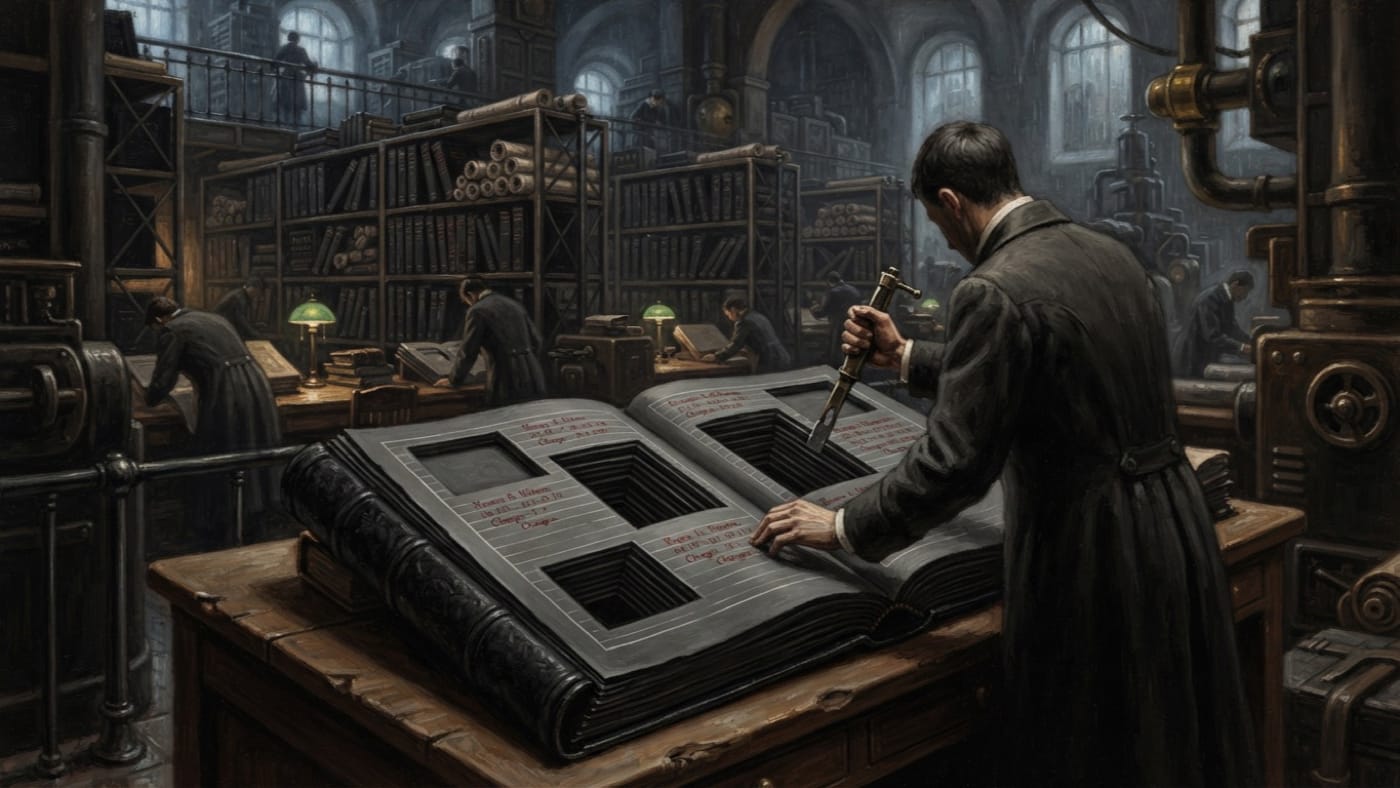
An Extraction Folio is a black-bound register kept by the Order of the Shroud, and its leaves are made to be cut. Every account that reaches my desk agrees on the essentials. The parchment is ruled for the census. Rectangles have been cut from it with a precision no frightened hand achieves. Beside each opening is a label naming the person whose line once filled it: name, parish, charge, date. The Order keeps the label and it keeps the hole. The line itself goes elsewhere, or nowhere, as policy and the season require.
I have handled one leaf, and I describe that one, because I do not certify a standard I have not seen. Prior Sebald Voss put it in my hands. It was thick vellum dyed grey-black and ruled in white ink, the ruling so fine it looked scratched rather than drawn. Twenty-four windows had been cut from it. Beneath each absence stood a name in red. The openings were clean enough to shame a surgeon and square enough to shame a mason. The vellum around them had not buckled, and that tells an archivist more than any confession would: the knife was sharp, the leaf was pinned, and the cutter had done this many times.
Twenty-four was the count on that leaf. I have no warrant to call it the capacity of every leaf, and a Prior who heard me do so would correct me with the patience of a man who corrects for a living.
The red is the detail that stays with you. Records writes in iron-gall black, and Doctrine keeps its red for feasts and anathemas. The Shroud writes its departed in red, as if each extraction were a minor holy day kept by a congregation of one clerk.
#On the Arithmetic of Mercy
Public punishment manufactures martyrs. Every inquisitor knows it. Purity learned it at the stakes of the Toulouse campaigns, where the crowd took home fear and a few of them took home faces. The Order of Ash answers the difficulty with more fire. Purity's own account places the Shroud's origin in the years around A.S. 93, in the reckoning after Toulouse. It answers the difficulty with stationery.
I will be exact here, because the Order's admirers are not. No surviving document names the first Extraction Folio, its maker, or the day a knife first entered a census leaf under Purity seal. The memorandum De Subtractione Misericordiae survives in a copy redacted by the Bureau of Silence, with one page cut away as a rectangle. It is a separate document with a separate wound. Anyone who calls it the first folio is presenting a shared technique as a family tree, and the Order is happy to let them.
The folio solves a problem of evidence. A trial leaves a transcript. A burning leaves a square, a date, and a smell the parish will remember long after it forgets the charge. A Shroud extraction leaves a window, and pilgrims do not travel to see a window.
The Order calls this the Mercy of No Martyrs. I record the phrase as theirs.
#On the Permitted Record
The folio has three functions, and the Order recites them with the satisfaction of men who have reduced a sin to a form.
It records that an extraction occurred. It keeps ordinary clerks from learning what was extracted. It lets the Order count its work without keeping ordinary case dossiers, which grow fat, attract readers and collect sympathies in their margins.
Observe what is kept. The name remains, and so do parish, charge and date. The folio identifies its absences more plainly than many baptismal rolls identify the living. What it withholds is the case: the denunciation, the witnesses, the household, the reasoning. It also withholds the lines on either side of the cut, which might have shown who stood beside the condemned at the font or in the bread queue. A clerk reading a Shroud leaf learns that a man was removed on a stated charge. He cannot learn whether the charge was true. The evidence that would let him argue left with the knife, and it now sits with an office he may not enter.
That is the whole cleverness of the instrument. The absence is acknowledged and never examined. It carries a signature and allows no appeal.
I file these rules as discipline. I know of no certified harm from a thumb on the cut edge. The Order forbids it anyway, as Doctrine forbids laymen to handle the chalice, so that the novice learns the leaf is not his. The ban on the word hole is grammar enforced as obedience: a hole is damage, and damage implies a victim. The rule against placing a face behind the opening is aimed at the novice who holds the leaf up so that a colleague's eye appears in the window. Apparently this happens often enough to need a rule. Clerks are children with ink on their cuffs.
#On Reconciliation
Here the folio leaves the Order's cabinets and becomes my profession's disgrace.
The Bureau of Records exists to preserve entries. Its clerks are taught that an entry once made remains answerable, and that a clerk who loses a name should lose his post. The Shroud returns mutilated registers to Records, and Records is obliged to reconcile its master copies against them.
Consider what that obligation means at the counter. A parish register comes back with a rectangle missing, while the master roll still carries the name. Records cannot leave the two in disagreement, because disagreement is the one sin its clerks are trained to smell. It also cannot ask the Shroud for the missing context, because the folio exists precisely to deny that context to clerks. So Records amends. The ration book is corrected, and bread stops being issued to a mouth no longer on the roll. The baptismal list is corrected so the household's count matches the leaf. Then the family is charged a fee for the amendment.
I repeat that fact without decoration. They pay for the correction.
I do not claim that every copy everywhere is destroyed. Records keeps more than it admits, and the Shroud cannot cut what it cannot find. I do claim this much. The office of preservation certifies, in its own hand and under its own seal, that its archive conforms to a deliberate excision, and it bills the bereaved for the clerical labour. The Shroud holds the knife. Records holds the pen that makes the cut lawful.
My colleagues detest the arrangement and depend on it. I detest it with considerably more elegance, and I depend on it all the same.
#On What Remains
The folio does not visit households. Other hands do that. The Order's aftercare teams clear out what a life leaves in a house: written names, combs, shoes, stitched initials, half-finished letters. They bring the paperwork that the reconciled registers now require. People who keep remembering are classed as remainder witnesses and visited until they stop, or until the arithmetic calls for another window. Mourning is prohibited. Black cloth, bells and graves all count as evidence of unauthorised recollection.
None of this is done by the folio, and all of it serves the folio's count. A window claims that a line no longer belongs to anyone. Aftercare makes that claim true in the kitchen as well as on the vellum.
The difference from the Bureau of Shadows matters to anyone who must testify. Shadows deals in blank receipts and deniable carriage. Its paper says nothing because its authority, officially, is nothing. The Shroud writes the name in red and signs under Purity seal. Shadows wants no trace left at all. The Shroud wants its traces filed where only the permitted may read them. The window should also not be confused with the instruments of administrative dissolution, whose notaries cancel identities under their own warrants and keep their own files. Three offices, three methods, three sets of grievances. The families observe none of these niceties.
From my earlier account of the black folios: "I asked a Shroud Prior if he considered this murder."
Corrected for public editions to read purge. The instruction came stamped and gave its reason: clarity breeds panic. The Prior's answer stands unaltered. They consider it editing.
#On the Count
The folios are kept in cabinets of cedar and iron. The windows are aligned from leaf to leaf, so a Prior lifting a closed folio sees through the names to the back panel of the cabinet. I have done it. It is like looking down a well whose walls are inscribed in red.
The Order counts by those windows. It keeps no dossiers to count, and bodies are another office's concern. The tally goes up to Purity. I am not cleared to say what Doctrine does with it. Strasbourg files it.
Necessity licenses the instrument. The front presses, the cities must eat, and some heresies grow when they are named. I concede all of it. I note only that necessity never asked for red ink or white ruling. It never asked for cuts so clean that a Prior lifts his leaf to the lamp to admire them. Those are the craftsman's pleasures, charged to the Creator's account.