
#On the Page and Its Authority
"A blank argues best." — Custodian proverb, overheard and regretted
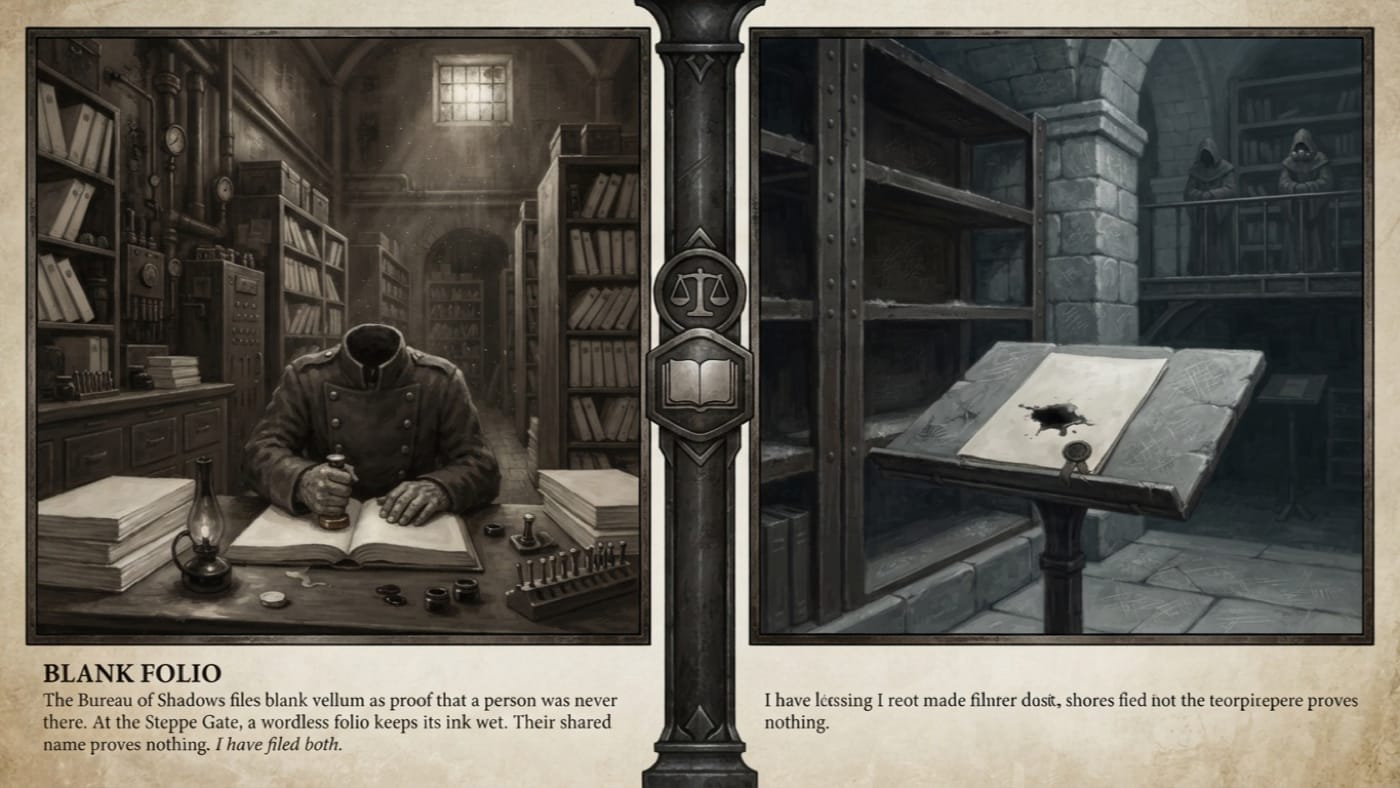
Every instrument of the Synod is judged by what it says, with one exception. The blank folio of the Bureau of Shadows is a sheet of clean vellum, sealed with grave-dust wax and marked by a Custodian's press. Once properly authenticated, it is legal proof that a named person was never present in the recognized record. It carries no charge, no verdict and no signature. It does carry a faint smell of lamp oil, which is the closest thing the Bureau has to a letterhead.
The law rests entirely on the gap between a blank folio and a sheet of unused stationery. A sheet in a clerk's drawer is paper awaiting employment. A sheet that has come out of the white ledger, taken its wax and been filed against a name is evidence. To the eye the two are identical. What separates them is a press, a hand, and an institution that does not exist.
It should not be confused with the Night Paper that hooded couriers run across the bridges. A Night Paper is full of authority and blank by morning. The folio is blank from the start, and no record I have seen shows its effect ever expiring.
#On Proof by Omission
"File it white."
The Custodians collect people, and the paperwork comes after. I have pieced the sequence together from documents that should never have reached my desk, and it has four movements. First, the subject's ties to workshop, route and parish are cut. Second, the subject is removed, usually after the final peal and usually by wagon. Third, anyone who noticed is persuaded to stop testifying, or to testify about something more wholesome. Fourth, the blank proof is filed. The Custodians call the whole business whitework. The Bureau of Records calls the last stage reconciliation, and Records is what gives an omission its practical force. A blank folio lodged against a parish roll means the roll was wrong. Records corrects errors, and it is very good at it.
The household learns what happened when the corrections come back. The name has gone from the parish roll. The debts are cleared, and the creditors accept this with remarkable grace, because nobody will ever audit a debt owed by no one. A stranger sits in the chair at the table who, according to every document that remains, has always lived in that house. I have written that sentence before, in an earlier survey. I have not improved it, because the documents have not changed either.
The neighbours, of course, remember otherwise. Memory is not admissible. The folio does not touch the past. It touches every paper anyone could use to prove the past happened, which in Strasbourg is a distinction for theologians and a matter of indifference to bailiffs.
The Bureau of Purity despises the practice, and its reasons are evidentiary enough that I nearly sympathize. Purity builds its cases by piling things up: signed confessions, witnesses deposed until they run dry, ledgers fattened by the Penitential Shadows, who are Purity's informants and belong to Purity alone, whatever the confusion of names suggests. A confession is an asset. It can be read aloud, displayed in procession, and quoted from the pulpit until the parish learns the shape of its own fear. A blank folio removes that asset before Purity can bank it. Every man filed white is a heretic Purity will never get to exhibit. Purity measures its piety by the length of its shelves, and it calls this theft.
#On the Press and the Notary
Each Custodian is issued a white ledger, which is a book of blank folios, along with a wax press. The book is counted at the start of every shift and must still tally at its end. It must also be free of accidental ink. A Custodian with a spotted folio owes the Bureau an explanation, and the Bureau has never accepted explanations from anyone. It accepts Custodians.
Rumour gives the stamping of blank proof to the Omission Notary, a specialist said to rank above the Custodian proper. I repeat the rumour because it is the only account there is, and because the Bureau has never denied it. Denying would require existing. I do not know the Notary's name, whether there is one Notary or a dozen, or what hand closes the press on any given night. The only person I knew who asked was soon a subject of the press himself. I say this with the precision the matter deserves: I cannot prove he asked.
The Bureau's own auditors check two things. The wax comes first: the wrong scent means a forged omission. Then they look at the pattern. Too many blanks in one district suggests a Custodian selling omissions on his own account, a trade his colleagues call freelancing, with their usual delicacy. Two dodges are well known. In double-blanking, two pages are filed so the auditor assumes a clerk duplicated one. In the borrowed denial, a Shadows folio is pinned behind a Records refusal to make the refusal look official. Both are offences, and both, I am told, are routine.
Older pamphlets claim the wax is rendered from human fat. Those pamphlets come from the kind of man who writes pamphlets. I have not tested the claim, and I decline to.
#On the Three Sheets
I file reports to the Bureau that does not exist. On three occasions, an answer has come under my door at an hour when nobody should have been in the corridor: a single sheet of blank vellum, sealed with grave-dust wax.
These three were never proof of anything concerning anyone else. A folio filed against a name says that name was never there. A folio slid under the door of a living Hieromnemon says something else. The difference is the whole reason I still eat breakfast.
The wax carries no device. It carries a pressure mark, as if someone had leaned on it with a thumb while thinking. I have learned to read that weight. A heavy press means satisfaction. A light press means continued attention is expected. That reading is mine, built from three specimens, which is the evidentiary standard of a frightened man. No manual confirms it, and I have never been shown the other side of the correspondence.
The third sheet had smooth wax and no press at all. I have no reading for it. I have tried several. I have not reread it since, which is an absurd thing to say about a blank page.
None of the three should be confused with the ninth decree of the Bureau's nonexistence, which hangs framed above my desk and has words on it, and corrections.
"They respond with silence, which I have learned to interpret as satisfaction." — the present author, on the Bureau of Shadows, in his survey of Strasbourg.
Narrowed. The Bureau answers with sealed blank sheets, and the sheets carry pressure. Only a heavy press has ever read to me as satisfaction. Every other silence remains under nightly review by its recipient.
#On the Folio Beneath the Steppe
The second specimen has nothing to do with the Bureau, so far as any document shows, and I want that written plainly before anything else. I have no evidence that a Custodian's press has ever touched a shelf at the Steppe Gate. As a servant of the Synod, I have every professional reason to say so loudly.
The Burnless Archive keeps the originals of the Treaty Ring, on the Moldavian edge of the steppe, under stones older than the Triune Alphabet. Paper there does not burn, and it does not leave. My account rests on the dossier of High Arbiter Senn Vark. According to that dossier, living addenda have appeared in the Archive since A.S. 194 (1904 CE). They are clauses in wet ink that no living hand wrote, carrying proper witness seals, and they amend treaties and rulings with flawless procedure. In A.S. 199 (1909 CE), a rubbing of the southern face of the Third Treaty-Stone vanished from its vault. On the shelf where it lay there is now a blank folio, and its ink is still wet.
I set that sentence down as I received it and refuse to fix it. A blank page should have no ink. This one has ink with no words in it, and the ink will not dry. I have no explanation to give, and I will not supply invisible writing, a prophecy or a recovered rubbing so that the reader can sleep. The Paper Keepers guard the folio as they guard everything there, like a relic that might bite.
During an emergency session in A.S. 200 (1910 CE), the Caravan Court recorded one further fact:
PAPER KEEPER SELD: The blank folio changed weight this morning. VARK: By how much? SELD: ██████████████████████████████ VARK: Enter it.
That entry contains no amount, no cause and no meaning, and I add none.
Vark's part in this is legal, and he does not pretend to explain anything. He speaks only before witnesses, and he has put the same question to his court in session after session. Does an addendum bind if it satisfies the form? The court says yes. Do the addenda satisfy the form? The court says yes. Can the court reject a binding form because its author has no pulse? The court says no. His ruling 201-Blue/17 closes the matter: review suspends enforcement only when the reviewing authority outranks the instrument, and the Caravan Court does not outrank the Treaty. So valid amendments with no accountable author are in force at the Steppe Gate today.
Nothing establishes that the wordless folio is one of them. It has no clause for the stones to recognize. It simply occupies a shelf. As far as the published minutes show, Vark has ruled on its siblings and never on the folio itself.
The two folios share a name and nothing that can be proved beyond it. One institution makes blank paper carry force by design. The other has wet ink nobody authored and a shelf that holds the result. Both still honour the form.
#On the Present Application
The white ledgers are still counted at every shift change. The presses are still issued. Parish rolls are still corrected without protest, and the strangers in the chairs still eat at tables they have always owned. I still file my reports. Nothing new has arrived under my door since the smooth wax, and I have learned to treat that interval with the same suspicion as the sheets themselves.
At the Steppe Gate, the Paper Keepers keep custody of a folio that nobody claims and nobody can remove. Its weight has been entered, its ink is still wet, and its author is unknown. The Caravan Court charges filing fees on everything near it.