
#On the Permitted Adjustment
Fog is weather. Absence is a choice. The Protocol exists to tell them apart, and has managed it seven times.
The Environmental Adjustment Protocol permits a Sky-Sermon Attendance Auditor to modify a district's Choir Rate calculation to account for atmospheric interference. That is the whole of the grant. It speaks of the air. It is silent on horns that crack, relays that short, receivers rotting behind damp plaster and shrines stripped for copper. Those belong to the Engineer's log and the Auditor's suspicion, and the Protocol keeps a polite distance from both.
The stakes are plain to anyone who has stood in a ration queue. A Choir Rate entry decides ration priority and curfew hours. It decides whether a purple mark appears beside the district's name on the compliance board, and on which morning a stairwell is emptied into forced assembly. An Auditor permitted to adjust that figure holds, for the length of one form, a small key to the larder. The Bureau has arranged that the lock almost never turns.
#On the Fog Weeks
The Protocol was born of embarrassment, the only parent the Bureau acknowledges in writing.
During the Fog Weeks the port districts went deaf. Maritime murk rolled over the rooftop horns, and the sky-sermon dissolved somewhere between the brass and the nearest open window. Receivers hissed at empty kitchens. Families who had stood at the casement with tokens in hand heard salt, gulls and their own breathing. Attendance collapsed into figures that the Bureau of Orison and Song declined to post where children could read them.
The Auditors blamed the Orison Signal Engineers, on the principle that a sermon which fails to arrive was badly sent. The Engineers pointed at the sky. Inquisitors came to settle the question and punished both professions with the even hand of men whose own work is never audited for weather.
When the culling was done, a problem remained on the ledger. The Metric Sanctification Edict of A.S. 158 had already declared compliance scores to be indicators of spiritual health. Orison and Song issued it jointly with the Bureau of Tithes. Doctrine approved it and Records filed it. Now a sacred number had fallen through the floor. Either whole port districts had apostatised in the same fortnight, or the air had intervened. The Bureau could print neither answer.
It conceded the air. The Protocol was introduced after the Fog Weeks and before the Methodist quarrel of A.S. 171. This survey has not been licensed to recite a promulgation date, and I decline to manufacture one for the comfort of schoolmasters.
#On the Evidence Submitted
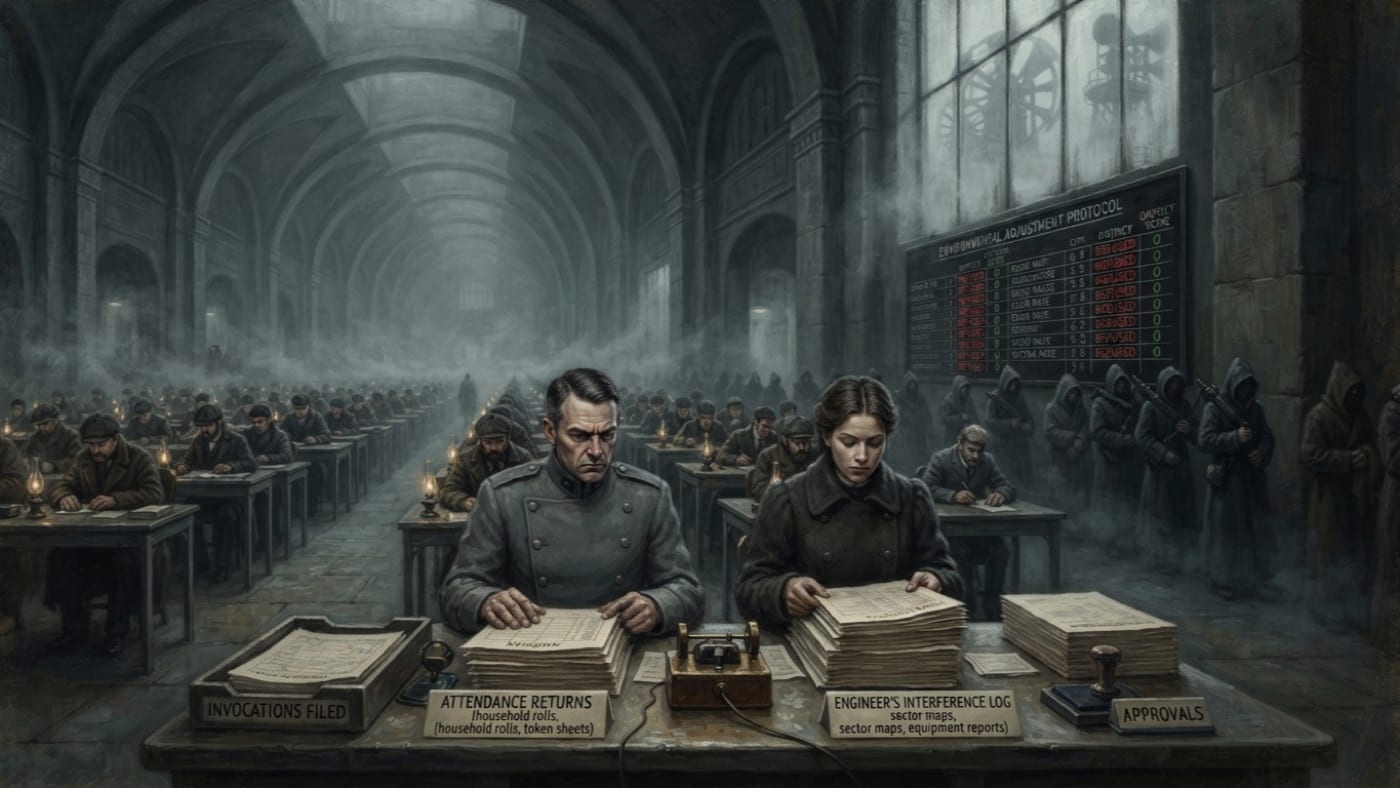
An invocation begins in an Auditor's office that smells of wet wool, lamp soot and the cheap ink that bleeds whenever the door opens on a port morning. Two kinds of paper lie on the desk, and the whole Protocol depends on keeping them apart.
The first is the attendance return: household rolls taken stairwell by stairwell, token sheets, open-window inspection notes, and the tone checks made with the portable tester every Auditor carries in a grey coat pocket. This paper concerns persons. It says who stood at which window and whether a tone sounded in that room at that hour.
The second belongs to the Engineer: sector coverage maps in smudged chalk, interference records, repair logs, and the Clean Carrier certificate swearing that the sermon left the broadcast house intact. This paper concerns the signal. It records what was sent, how far it carries on a dry day, and where the static was logged.
An Auditor who invokes the Protocol must argue from one stack to the other. Proof that a transmission was degraded is proof about air and apparatus. It cannot establish that the widow on the fourth landing heard nothing. Proof that a household heard nothing is a claim about the household, and households are presumed to lie. Fog lives in the gap between the two stacks. The Bureau keeps its eyes on that gap with great discipline and sees nothing there.
Households still bring excuse slips to the counter in the ordinary way, citing illness, work duty, a funeral or war service. Those are judged under ordinary practice. The Protocol's own language concerns the Auditor's calculation. A family may weep at the counter, but only the Auditor may move the figure, and only the Auditor is named when it stays where the fog left it. A refused invocation leaves the unadjusted rate on the board. The ration notice goes up on schedule, still damp.
#On Four Thousand Invocations
The reported administrative tally runs as follows. There have been four thousand invocations and seven approvals. The remaining three thousand, nine hundred and ninety-three were refused for insufficient evidence of fog.
The figure reaches this desk without a stated period or territory. I will not call it annual or bastion-wide, and I will not trim it to look reasonable. It is the number the Bureau tells about itself, and that makes it more instructive than the truth.
Consider the refusal in its proper setting. An Auditor files from a port office where the window has been white since dawn and the chalk will not take on the wet map. A reviewing clerk reads the file in a dry room further inland, by a lamp that does not gutter, and finds the fog insufficient. Both men are acting correctly. The Protocol requires evidence of fog, and fog is the one witness that cannot be summoned, sealed or made to sign. By the time the file reaches review, the witness has blown out to sea.
The seven approvals are recorded only as seven. Their districts, their Auditors and the nature of the fog that satisfied the clerks are absent from the figure I hold. I will not invent their circumstances. Seven is a respectable liturgical number, and I suspect it has been kept for that reason.
An internal schoolbook described the Environmental Adjustment Protocol as "a standing avenue for just correction."
Corrected. It is a drain that is built, consecrated and inspected regularly, so that mercy can be seen to have somewhere to go. The drain is in good order. Almost nothing passes through it.
#On the Methodist Enlargement
The Signal Methodists looked at the Protocol and saw a small door painted onto a wall. They proposed a larger one.
Their Signal Condition Index would have placed six columns beside every Choir Rate ledger: Horn Reach, Relay Integrity, Receiver Function, Shrine Uptime, Weather Impedance and Deadzone Risk. Under their scheme an Engineer would confirm the condition of the apparatus, penalties would wait until that confirmation arrived, and any district flagged as a Deadzone would be reviewed automatically before a single Brand was drafted. None of those provisions belongs to the Protocol. They belong to a scheme that was proposed and defeated.
The difference is the whole of the quarrel. The existing Protocol asks a question about the sky, and the sky has no budget, no directorate and no cousins. The Methodist Index asked questions about the apparatus. The apparatus has a maintenance schedule, the schedule has a procurement chain, and the chain has authors who sit in chapel stalls and seal things. Weather Impedance was the only column the Bureau had already conceded. The other five would have run the blame up through Engineering and procurement to the acoustic standards of the Bureau of Bells, and on into every office that had moved copper and labour to a more fashionable crisis.
The interested bureaus answered according to their natures. Tithes saw slower penalties in precisely the districts where ration pressure pays best. Purity saw every delayed Brand as time for silence to breed. Doctrine saw the worst of it. If attendance is allegiance, an excuse for failed delivery implies that the Synod owes the faithful a working voice. Records saw more columns.
The reform was defeated at the Fourth Compliance Congress in A.S. 171. The official account calls the vote unanimous, though the sealed tally cannot be reconciled with that word. Some of the vocabulary survived in maintenance appendices and training manuals, with its authors' names removed. The doctrine did not survive, and the faction was given no recognition. Anyone who calls the Protocol the Methodist programme under a quieter name has mistaken a drain for a river.
#On Present Application
As of A.S. 201 the Protocol remains in force. Auditors still carry their testers into wet stairwells and file their invocations in fog. Engineers still chalk interference across their sector maps. Clerks in dry rooms still find the fog insufficient. The Methodist doctrine remains denied, and its columns are quoted in manuals that never name them. The Fifth Compliance Congress of A.S. 198 rejected a column for emotional context, which was a different proposal and met the same end.
The allowance stands for the same reason the refusals continue. A permission that exists shows that the Bureau can be merciful. A permission that is almost never granted shows that the Bureau will not be made a fool of. The Bureau needs both kinds of paper, so both are kept.