
#On the Designation
"Listen for the second voice." — Street-Vicar proverb
Echo Season is the name the Bureau of Doctrine gives to any period in which it judges that a district's public recitation has been contaminated. The suspected source may be the agents of Velkara, the drifts of Syrion, or some third hand the Bureau has not yet troubled to name. A designation is declared, not discovered. No one has shown that the condition keeps a calendar. It has no fixed month, no favoured weather and no recorded first year. Anyone who claims to remember the first Echo Season is remembering a story told to him in a chapel annex.
The record does establish two things. Crowds that answered correctly in a manner that was somehow wrong compelled the Doctrine Street-Vicar corps to adopt cadence tests and wrong-hymn protocols. And the designation has never been retired. The Season produced the procedure. The procedure keeps the Season open.
I write in the present year of the Synod, A.S. 201, as a survey of a standing threat. It is a peculiar danger. Heresy usually has the decency to get a word wrong.
#On the Second Voice
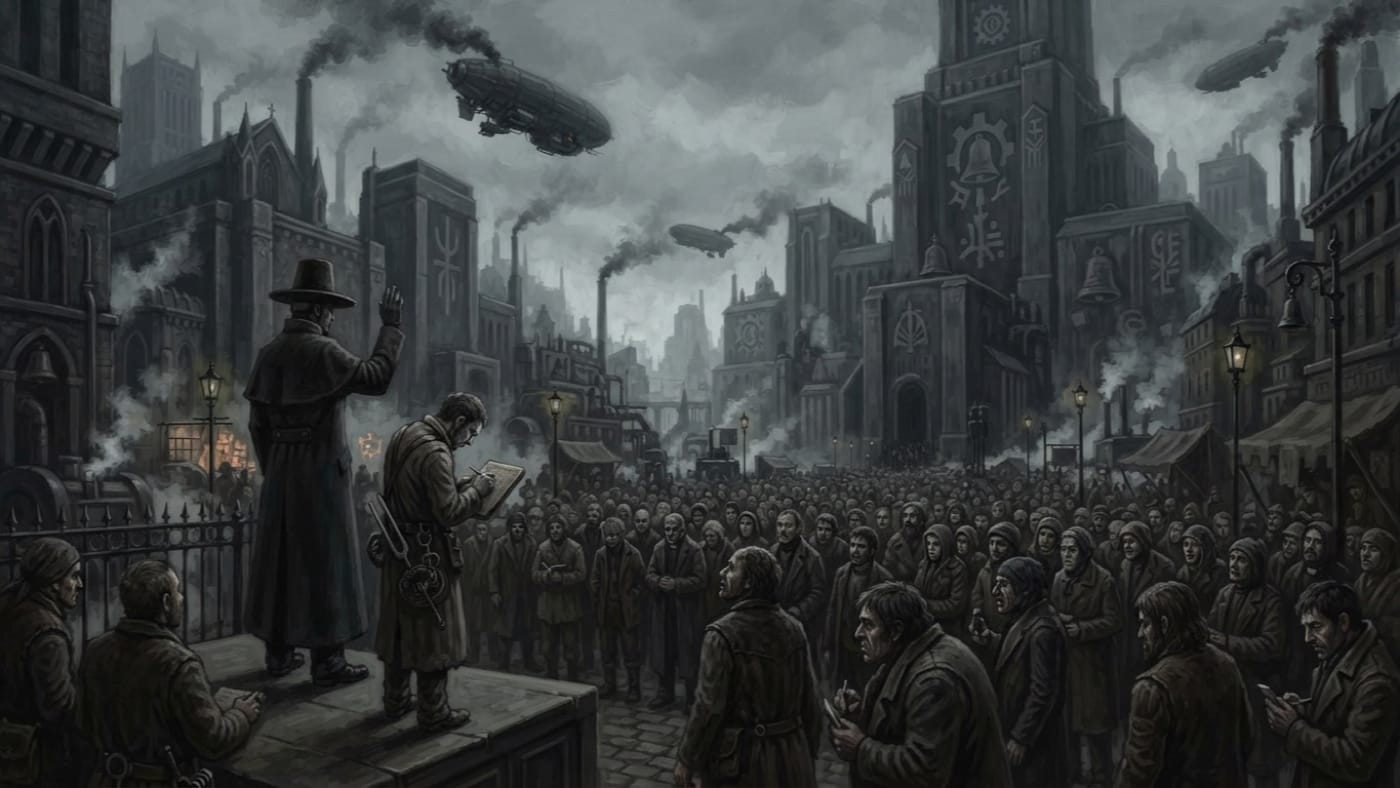
A square-stop proceeds as square-stops do. The Vicar raises a hand. The carts halt, and the fishmonger stops shouting halfway through a price. The Vicar calls the first line of the Eternal Creed and the square answers. Say thirty voices, for the sake of the illustration the Bureau itself prefers.
The words are correct, and so is their order. Somewhere in the answer, though, a vowel is held half a breath past its measure. A consonant is softened where orthodox pronunciation hardens it. The officer feels, before he can say what he has heard, that another throat has begun to lead the chorus.
That is the whole of the symptom. Everything after it is interpretation, and the Bureau keeps two.
The Velkaran reading holds that the chorus has become a performance. Every part of devotion is present and nothing stands behind it. The faithful go through the motions of the Creed the way Velkara's Hollow Ones go through the motions of pleasure. The Syrionic reading hears something slower: an answer that arrives a fraction late, an echo that seems to come before the sound that should have made it, a line the square has somehow already said. Doctrine files both readings. It has never shown that either one explains a given square, or that the two Sin-Generals work in concert. I will not do that work for them.
Note what is absent. The Great Deceiver does not climb into a cooper's wife and sing through her teeth. The demons of this world cannot take a body or override a will. They tempt, they deceive, and they wait. A chorus may sound steered. Whether it is steered, and by what, is the one question the officer is forbidden to answer on the spot.
#On Examination and Withdrawal
The ordinary Street-Vicar is given one instruction and is expected to obey it without improvement: if cadence feels wrong, end the stop and report it. He is not asked to diagnose anything. He is asked to stop talking.
Above him stands the Cadence Examiner, the corps' specialist in the Echo Season, who carries two instruments. The first is a tuning fork blessed by the Bureau of Bells. The second is a wax tablet. On it the Examiner incises the rhythm of the crowd's answer stroke by stroke as it is given, while the square stands in the drizzle wondering why the priest is writing. The fork sets the measure and the tablet keeps the evidence. Neither is a weapon, and neither cures anything. A man who strikes a blessed fork at a crowd and expects the Deceiver to flee will be disappointed, and quite possibly beaten.
The threshold is written plainly. A deviation of more than one-eighth of a beat triggers standing withdrawal. A deviation of exactly one-eighth is merely an untidy chorus. Past that point the Examiner releases the crowd, reports the district and walks away. Whatever happens next belongs to the Bureau of Purity and its own specialists. The Street-Vicar's part ends at that moment, and he is wise to let it end.
I admire this procedure more than its authors deserve. It is the only protocol the Bureau of Doctrine owns whose final instruction is leave.
The confessional keeps a smaller version of the same rule. A Confessor-Booth Clerk who hears wrong cadence through the grille closes the shutter and reports it. The booth has its own specialist for the Season, the Contagion Screen Clerk. That office was the profession's answer to the Echo Scares, when the Bureau feared that mimicry was coming through the screen itself. The Codex Doubt Auditor records pauses and phrasing as well as content, checks his sources against one another, and escalates suspected echo speech quietly, never in public. That makes three offices with three habits. Whatever a nervous registrar may tell you, no single Echo Season authority binds them.
#On the Cologne Record
The principal dated precedent is Cologne, A.S. 178.
The account I set down in the corps' own entry runs as follows. A district chorus answered the Creed in a cadence that matched no orthodox pattern. The Examiner present transcribed it. When the wax was read, the incisions formed a shape the Bureau of Doctrine recognised as the signature of a Pale Chanter unhymn. The district was evacuated.
That is everything the file says, and I have read the file. One district was cleared. The file attaches no casualty roll for me to inflate and mentions no fire. The Bureau's own sentence, that the protocols saved Cologne, is the sort of thing institutions say about their paperwork. In fairness, the paperwork did its work.
The Examiner who heard it was promoted. He was then reassigned to a filing annex in Sofia, far down the southern corridor, and there the record leaves him counting paper. The file gives no reason for the posting and does not say whether he asked for it. One man's ear told the Bureau that the enemy's choir had reached a Rhineland market. The Bureau rewarded the ear and sent it as far from any market as the corridor would allow.
Draw what conclusion you like. I draw none in writing.
The Cologne transcription formed "a Pale Chanter unhymn signature."
Per the Orison Fifth Revision, "unhymn" is withdrawn as insufficiently reverent of structure, and current usage is counter-hymn. The historical file keeps its original wording and is quoted above as written. The corrected term changes nothing about the shape on the wax.
#On Errors of Hearing
A chorus is a crowd of mouths, and mouths fail for ordinary reasons. Hungry people drag the line and exhausted people slur it. Grief bends a vowel out of measure as reliably as any demon, and the corps' own training warns against mistaking grief for drift. The Vicars have a proverb, never test the hungry, which they learned from riots. The ration-hall queue at dusk will stray by an eighth of a beat because half of it has not eaten since the morning bell.
Then there is the officer himself. An Examiner whose ear can clear a district is an Examiner whose ear can be borrowed. A rival's shop, a debtor's courtyard, a household that declined to pay the wash fee: each is one reported cadence away from Purity's attention. The threshold may be precise, but it is measured by the man holding the fork. The tablet records what he incised. It cannot record why.
Bells are offered as the remedy, and against the Chanters in the field they often are one. The account from Vienna is enough to stop me promising more: there the peals were bent off-key and turned against the line they were rung to defend. As to where the Chanters come from, Doctrine says heretical priests. A redacted line from Records says echoes of our own songs. Both opinions remain on file.
#On Present Application
The Echo Season remains a standing threat, and few ears are trained for it. The Quiet Purges of A.S. 112 removed four hundred and eleven teachers, choirmasters and Street-Vicars from their Rhineland postings and thinned the experienced ranks. The Bureau has never published how many of the dismissed could hear an eighth of a beat. Examiners remain scarce. The corps fills the gap with junior Vicars who have been taught the single rule and told to trust their chill.
The specialty is paid for in the body. Examiners count the pauses in ordinary conversation, and they flinch at unison. They rinse their mouths at the end of a shift so as not to carry wrong words home. Some of them cannot hear a children's choir without reaching for the wax.