
#On the Field and the Cloister
The eastern seminary field belongs to Prague the way a debt belongs to a family. It lies in the Forward Heartlands, Zone 3 by the Registry maps, inside the Bohemian Severity District, whose officials have never once been accused of leniency. The Sagittal Line runs its long north–south course well away from here. Prague feeds that Line with rail, clerks and penitents. It does not stand on it. Whatever the enemy did on this ground in A.S. 167, it moved no frontier. Prague's citizens repeat this whenever a visitor looks too long at the grass.
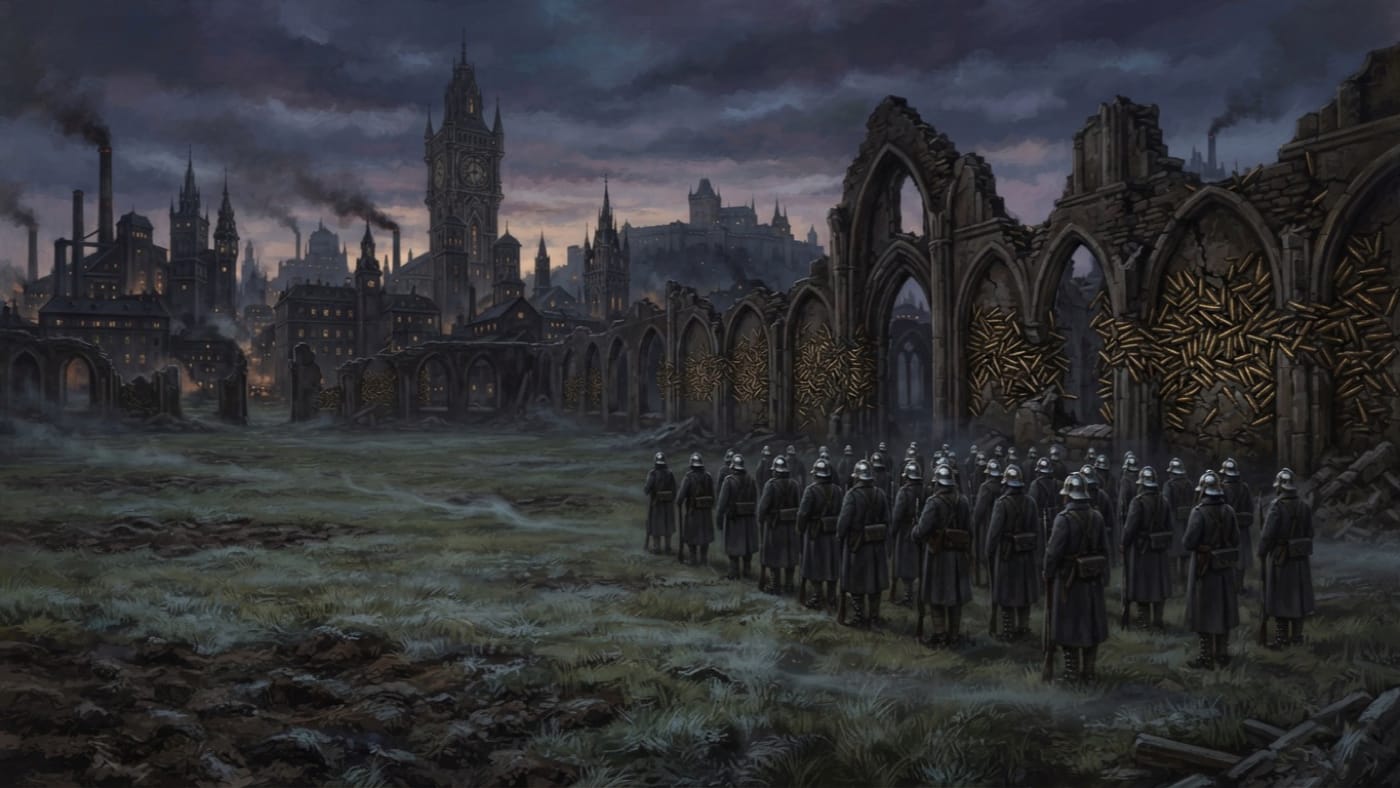
The field has almost no architecture. It is open ground, wide enough for a regiment to dress its ranks and keep its eyes on a banner. On the far side stands a ruined cloister, all that remains of the seminary that gave the field its name. This plate does not certify that seminary's proper name, its dedication, its founding or the year it fell. The cloister keeps walls, arches gone soft at the edges, and cracks. The cracks are where the field keeps its record.
No shrine stands here. Prague has never been short of instructive stone, and it chose to add none.
#On the Banner's Measure
The failure on this field only makes sense once the reader understands what the Radiant Fusiliers are for. They load together, by prayer more than by drill, and every cartridge and every ramrod stroke goes with its syllable of psalm. No Fusilier watches the enemy. He watches the consecrated banner above his line. The mirrored plates on his helmet reflect it back at him until even the edges of his sight are full of holy cloth. White tunics, black gloves, powder-burn stripes: the uniform exists to make a regiment look like one instrument.
The banner governs the firing. It flares once and the first volley goes. It dims and the second follows. It blazes white, and the third volley belongs to the Creed entire. Firing out of order is heresy. Firing alone is damnation. Generals have been executed for calling a volley before its cadence, and Fusiliers shot in the back by their own brethren for raising a musket without the cue.
A regiment built that way does not hesitate. It waits for the banner and then it fires, and its theology allows nothing else.
#On the Night of Silent Steel
In A.S. 167, which the profane calendars call 1877, a regiment of Radiant Fusiliers formed on this field to deliver its triple volley under banner-light. The rifles were loaded. The powder was dry. The officers were ready. The regiment's number is disputed. The narrative timeline calls it the Fourth, and the Bureau of Records insists that it was always the Seventh. This plate prints both numbers and endorses neither.
Seven Pale Chanters had taken position in the ruined cloister across the field. They are the Shadow Court's choir: emaciated, rag-hung, with ruined throats and ulcerated tongues. From the cloister they began a slow, droning inversion of the Kyrie Eleison, the Church's mercy prayer, sung backward into the mouth of a regiment that had been taught to fire on a prayer.
The banner rose. It flared white. The order was given.
No volley followed. The Fusiliers stood with their eyes open and their rifles loaded, and they forgot to fire. The enemy surged across the ground between the cloister and the line. Forty-three men died without discharging a single round.
The ordinary sequence puts a flare and a dimming before the white blaze. The accounts of this night do not say whether either came first, and I will not give a regiment volleys it never fired. Readers who want the whole engagement, its approaches and its aftermath, should go to the Night of Silent Steel. This plate concerns the ground it happened on.
The name flatters the evening. The field was loud with the enemy's singing. The steel was what stayed quiet.
#On the Recorded Explanation
Bureau annals file the incident as command miscommunication. Prague's own register credits that phrase to Records, and public War circulars repeated it, since a circular exists to repeat things. The regiment's commanders swore afterward that their men had never once disobeyed an order. The soldiers who walked off the field had their own name for it: the day the Creed went silent.
So there are three accounts of one patch of grass. One blames the chain of command, one vouches for the obedience of the men, and one blames the Creed. The first is official. The second is sworn. The third is repeated in barracks and has never been withdrawn by anyone, because nobody ever authorised it.
The causes are argued as fiercely as the names. The Bureau of Doctrine holds that the Chanters' voices are sorcery. Engines & Furnaces answers that their singing lines up with certain subterranean acoustics, and it cites vibrations measured in trench walls, inside helmets and in the marrow of the men wearing them. Veterans call it being sung by your own skeleton. Neither bureau has explained what happened on this field to the satisfaction of the other, and I do not propose to settle a doctrinal dispute over forty-three graves. What can be observed is enough to file: a banner raised, an order given, rifles loaded and eyes open, with no volley.
Older files describe the Chanters' song on the eastern seminary field as an "unhymn."
Corrected per Orison revision: read counter-hymn. The earlier term was found insufficiently reverent of structure. The correction applies to the noun only. The classification of command miscommunication stands as filed.
#On the Corrections Carried Elsewhere
The institutions answered the field in the only way they know, which is with procedure. The Bureau of War revised its cadence drills. The Bureau of Bells added banner-tone anchors, so that the banner's cue would have a sound to hold onto as well as a light. The Bureau of Doctrine forbade the soldiers' phrase.
Catechism has long named bells as the answer to the Pale Chanters. Enough sanctified peals are supposed to drown them out and break their resonance. Catechism is tidy. At Vienna the Chanters sang through the peals and bent the tones until the bells themselves rang off-key and the soldiers' own defence turned against them. Engines called it prayer-jam. Doctrine called it impossible. This plate makes no promise that any correction has closed the gap that opened at Prague. The drills, the anchors and the ban went out to the regiments.
The field kept its grass, its ruin and its cracks.
#On What Is Left in the Cracks
Prague marches the condemned across its bridge in the Procession of Tongues and has made a civic art of public instruction. It did not think forty-three men whose deaths the annals put down to a misheard order needed a monument. So the soldiers made one out of the cloister, and they did it without asking anyone.
They leave spent cartridges in the cracks of the masonry, pressed into the gaps where mortar has given up. The distinction matters, and visitors keep getting it wrong. On the night, the rifles were loaded and the rounds stayed in them. The brass in the cloister now is empty, fired somewhere else, on some other field, under some other banner that was answered. It is empty by regulation and loaded by memory. The men who leave it are bringing proof that the volley still comes, eventually, to the ground that was denied it.
Locals say that at dawn the brass grows cold enough to burn skin. This is their testimony, and it is entered as such. No Bureau has certified it, no clerk has volunteered to measure it, and this plate records no injury. Prague's published advice is not to test the matter with bare fingers and not to visit the field at dawn. I pass that advice on unchanged. It is prudence, the most respectable form of cowardice, and current doctrine permits it.
The cloister has collected brass for thirty-four years, and the cracks have not filled. The grass is mown by nobody in particular. The field has no shrine, no plaque and no signed explanation.