
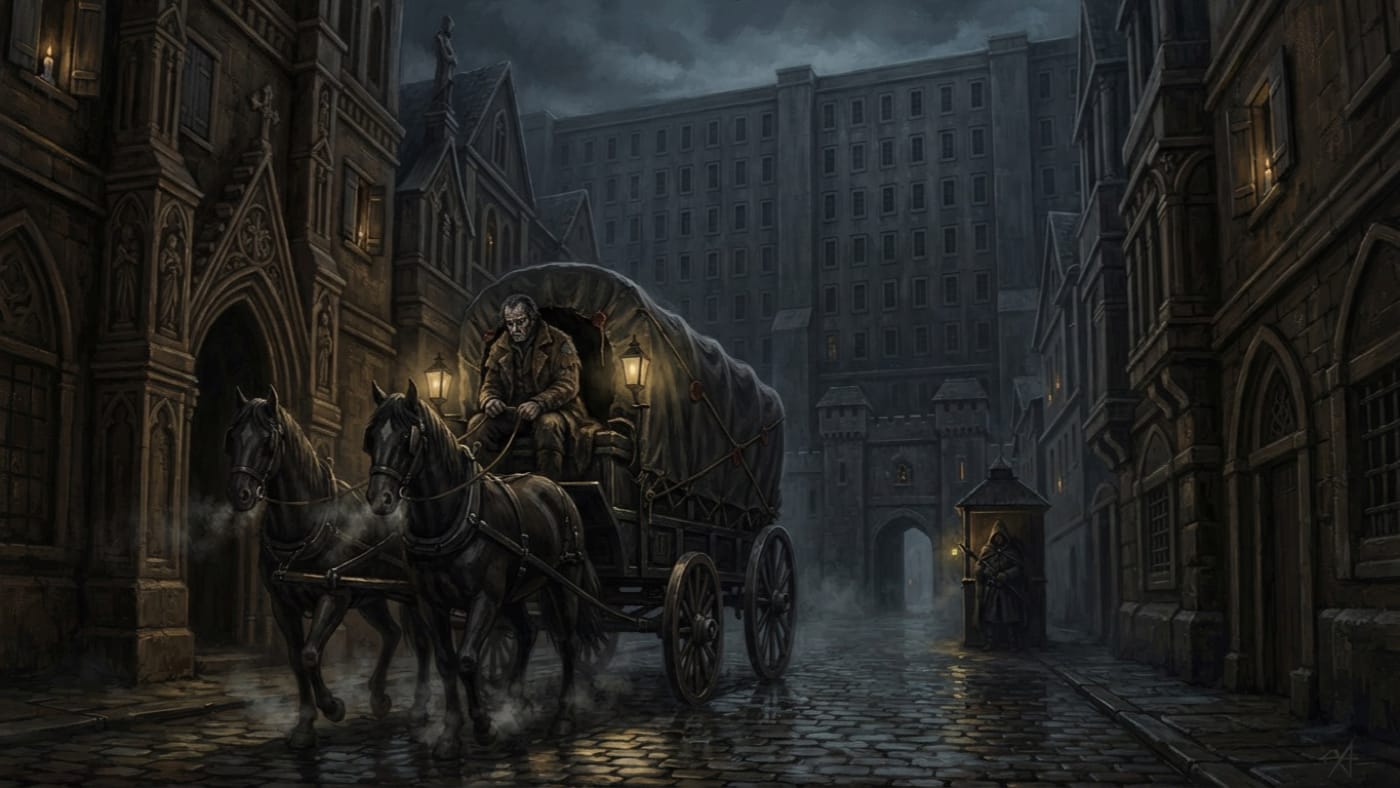
#On the Title
“Driver of the Unmanifest.” — formal style, entered in no document that admits to it
The street says Night Carter, Blackwheel, Corpse Cabby, Void Mule. The barracks say worse, and with gestures. The Bureau, on the rare occasions it says anything, says Driver of the Unmanifest. The Night Wagon Driver answers to it the way a tired confessor answers to “Father”: in the proper room, and without pleasure.
The title is precise, which is more than can be said for most Synodal honorifics. A manifest is the paper that tells a gate what a wagon holds, tells a tariff clerk what it owes, and tells a magistrate whom to hang when the count comes up short. The unmanifest is everything that moves without that paper: persons, inconvenient bodies, sealed orders, relic-fragments, and the occasional crate the driver has been told to call straw if anyone asks. To drive the unmanifest is to answer personally for movement that the Synod’s ledgers have been instructed never to receive.
Mark the grammar. The title does not name a driver of wagons. Any drunk with a mule can drive a wagon. It names a driver of the unmanifest, a man who answers for the gap in the ledger the way a sacristan answers for the plate. When the gap shows, the driver pays for it.
#On an Office without a Register
The Bureau of Shadows employs no drivers, because the Bureau of Shadows does not exist. The drivers are fed regardless. They sleep in stable corners that somebody assigns, burn fuel that somebody issues, and wear gray wax under their nails from a seal kit that no quartermaster admits to stocking. Their legal condition is erased-but-used. The canonists have never written that category down. Every stablemaster in Strasbourg can recite it.
There is a practical reason for keeping no register. A registered driver can be summoned, deposed, cross-examined and asked to name a route. An unregistered driver can only be found, and finding him is reserved to the Bureau.
The title got its public reputation, though not necessarily its origin, in the Year of Smoke, A.S. 180, when silent wagons left Lübeck by night and the harbour lost its guilds, its records and its habit of counting. The parent account gives eleven wagons. I let the figure stand, since I am too well bred to recount a convoy that officially had no members. The stable-yards claim an older lineage, all the way back to the First Carter of Strasbourg, who is unnamed in every apprentice’s telling and always waiting under a bridge. I record the legend and certify nothing. No charter, first appointment or first journey has come down to us. After Lübeck, everyone knew what a wheel after curfew might mean, and the office never needed any other document.
The Driver of the Unmanifest carries no papers of any kind.
Corrected: the driver carries no manifest. He may carry a Night Paper for onward delivery, a sealed instruction, or a gray-vellum slip that names a pickup by description. Those are orders, and orders travel. What he may never carry is a written account of the cargo itself: what was loaded, where, and whose it was. The earlier wording treated the absence of an inventory as the absence of orders, and a Carter who believed it would turn up at a bribed gate with nothing to show. The earlier wording was mine. The Bureau of Doctrine has noted my candour and declined to reward it.
#On Route Authority
Full route authority is what separates the Driver proper from the Carter below him. A Carter is told where to go. A Driver decides where not to.
The method is called driving the negative. The driver plans the route by striking things out. He strikes the conspicuous gate, then the bell-tower while its bell is still warm, then the watch lane, then the square whose windows face inward. Any approach he used this week goes too. Whatever survives is the road. The Bureau of Bells supplies the timing without meaning to: the gaps between sanctioned peals and the slack minutes in the curfew that a careful driver learns the way a cantor learns his intervals. “Don’t outrun the bells” is the trade’s first proverb. It means the window is fixed and the horse is not.
A working day under this authority runs in a fixed order. By daylight the driver does honest cover work, such as sanctioned carting, stable duty or chapel ash, because nothing hides a wagon better than a neighbourhood bored with it. Late in the day he checks the axles, fits the lamp hoods, changes the harness, inspects the compartment and goes over the negative route once more. At night he collects. Before dawn he burns the straw or replaces it, washes the wheels and pays the gate-men who cooperated.
Payment is a liturgy of its own. The first bribe buys passage. The second buys forgetting. A driver who pays only the first has purchased a witness on credit. When a gate grows expensive, an experienced driver will tuck in behind a sanctioned grain convoy, so that the guards remember the official wagons and lose count of the one extra.
The authority runs in both directions. A Driver may redirect to a different quiet door, and he may refuse a handoff when the road smells wrong. Refusals are rare, and the Bureau remembers every one. He keeps his own map of these judgements in a place auditors do not kneel, scratched into the underside of a seat board. Private route maps are forbidden. Every Driver keeps one.
#On the Handoff
Three trades meet at a midnight bridge. Ballads blur them, so I set them apart.
The Gauze-Masked Custodian collects the target and arranges the omission that follows: the parish roll corrected, the house reassigned, the neighbours given reasons to recall a different family. The Night Papers Courier carries authority, meaning a deniable warrant with a deadline written into its nature. The Driver moves what the other two produce: the person, the order, the body, the box. The trades touch at the handoff and nowhere else that the Bureau will acknowledge. A Driver is no Custodian. He composes no warrant and judges no one. He gets the cargo to the door.
That division is where blame comes to rest. If the Custodian misjudged a target, the error was in the collection. If the courier came late, the error was in the paper. If the cargo reached the wrong door, or the right door with a witness, or the right door after the window closed, the error was in the transport. Of the three, only the Driver can be found with the evidence still in his wagon.
Dawn makes the pressure worse. A Night Paper expires at sunrise unless the Shadows countersign it, and then it lasts. Drivers repeat a saying that “if dawn finds you holding the order, you fulfill it,” and they treat it as law. Couriers tell the bearer’s danger differently. Doctrine has not clarified, which is how Doctrine keeps a superstition in useful working order. Every account agrees that a late paper turns a cart into a race, and that the Driver chooses between speed and mercy within a single street.
At the top of the trade, the Corridor Master knows Strasbourg’s unmarked doors: which tariff chapel gives onto which berth, and which bridge stair joins the proxy corridors. The Corridor Master delivers to the door. Nobody pays him to describe what lies beyond it, and the wise ones never try.
#On the Driver’s Debt
The Driver is paid in rations, housing corners, fuel access and silence rights, meaning immunity from the small prosecutions that would otherwise finish a man who keeps such hours. No document records a wage. He also accumulates debt: to a depot, to a Custodian, and to the wax itself, which drivers speak of as if it kept accounts.
The danger to him is existence. Any clerk of the Bureau of Records who decides that a particular Driver exists on paper can ruin him with a single signature, and possibly ruin the routes, doors and gate-men who rely on his absence too. For that reason the Driver bribes gate-men, stable chiefs and depot chaplains. When pressure rises he sacrifices Wheel-Boys and passengers. He never sacrifices the wagon.
Failure has three outcomes. The visible one is reassignment to front convoys under the Bureau of War, where artillery finishes the lesson. The quiet one is erasure. The instructive one is a ride in the compartment he used to check for splinters.
The Gray Wax Men keep strict obedience to the paper. The Blackwheel Freelancers sell unmanifest transport to smugglers, rebels, abbots and anyone else who can pay. Take care with the word: “Blackwheel” is also plain street slang for the whole trade, and a fishwife who uses it has not accused anyone of defection. She is simply vulgar.
The Driver’s own body keeps its accounts. His speech shrinks to negatives: not late, not seen, no one. He counts peals when drunk, rubs wax between thumb and finger at table, and flinches at a wheel squeal in daylight. First he forgets the passengers’ faces. Then he forgets their names. Then he prefers it that way. I will not grant him innocence on the strength of that suffering. He heard the bargaining in the dark compartment and drove on. Every passenger who asked where they were going got the old answer, “Not where you were,” and the man who gave it knew it was true.
#On the Present Service
As of A.S. 201 the office is busy and denies it. In Strasbourg the midnight bridges carry more traffic than the depots report. In the Latchford Permit-Yards, where every movement is a fee, the unmanifest wagon goes through the permit bottleneck by never joining the queue. Along the verges of Queue Road, institutions that live on charging for passage find their revenue thinned by wagons that were never there. Gray wax and wheel-wrappings are bought in quantity by buyers no Bureau will name.
The Shadows deny the cartage. Records logs routine supply. Doctrine advises citizens to sleep through curfew. The Drivers wash their wheels before Matins, and the title stays unwritten in every ledger in the Church.