
#On the Spur, and Why Anyone Should Care About a Feeder Line
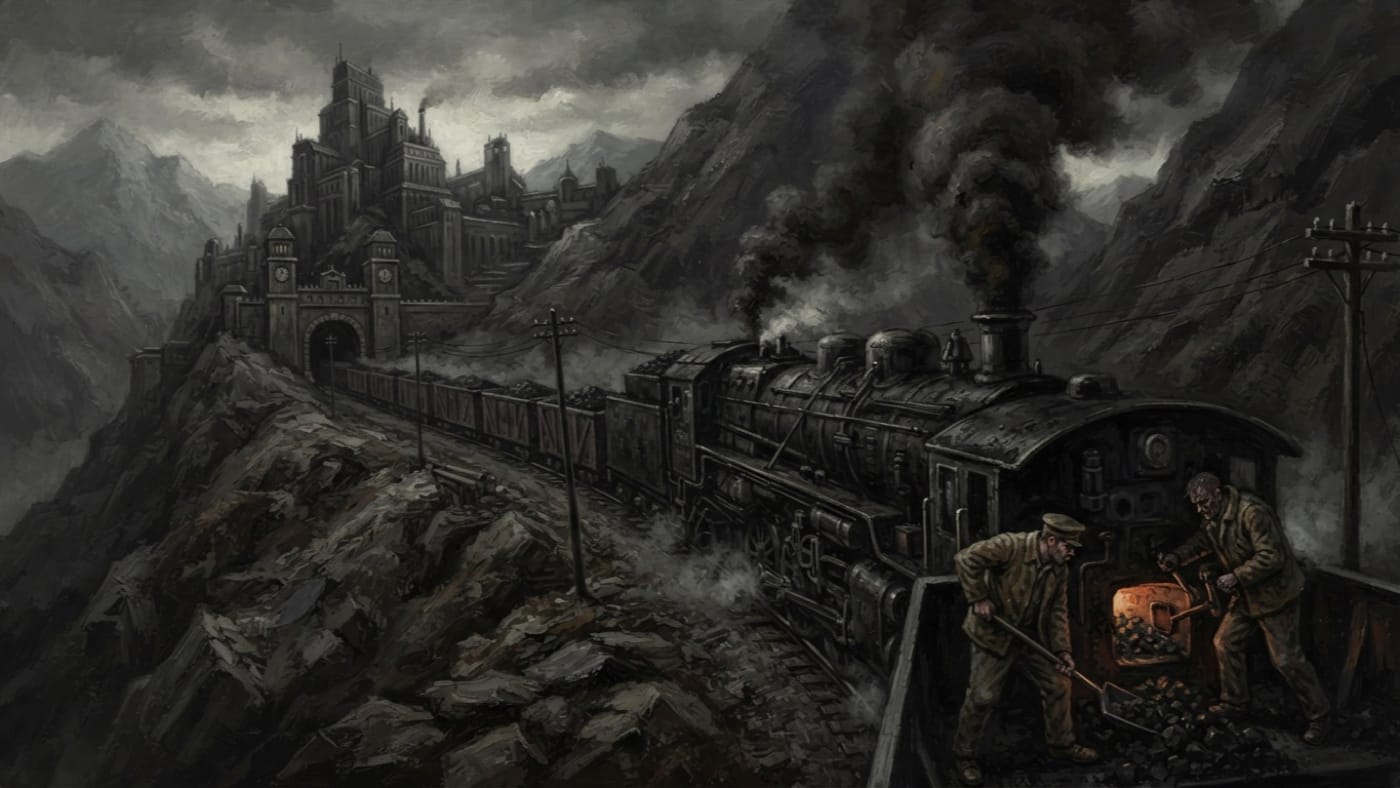
The Drava spur is a southern feeder line. It runs freight from the Heartlands depots to the Balkan bastions, and the bastion it chiefly feeds is Bastion-Shipka, which guards the mountain pass on the southern reach of the Sagittal Line and eats whatever the rails bring it. Coal, powder, grain, replacement sleepers, and men going up the line to be spent: a feeder carries what the war needs, and it gets there no faster than its steepest gradient allows.
Nobody writes hymns to a feeder line. The Church sings of walls, of bells, of the Line itself cut across the continent like a seal pressed into wax. It does not sing of the gauge rod or the ballast fork, or of the fireman who feeds a firebox through a long shift while a schedule clerk further down the line watches the minute hand and gets ready to be disappointed. A spur matters exactly as much as the bastion at its end needs feeding. Shipka always needs feeding.
No file I trust records when the spur was built. I leave its junctions, waystations and terminus unnamed because the record leaves them unnamed, and a Hieromnemon who invents a timetable deserves to ride on it. What the record does hold is a complaint. Four years and three Bureaus spent declining that complaint, and at the end of it the Synod had a new department.
#On the Run of A.S. 130
In A.S. 130 (1840 CE), a locomotive crew brought their engine along the Drava spur and filed a complaint with the Bureau of Engineering. The particulars are few and they do not bend. The train left a scheduled waystation at the correct hour by the waystation clock. It reached its terminus at the correct hour by the terminus clock. Every timepiece consulted put the elapsed run at four hours and eleven minutes.
The crew reported nine hours, and every one of them agreed on it.
Think what nine hours means on a footplate. It means the shovel lifted long past any reason for lifting it. It means thirst, then a second hunger, and a back that keeps complaining to the spine. Crews do not report such things to the Bureau of Engineering for amusement. The Bureau of Engineering is not amusing, and the hour a working man spends writing a complaint is an hour he does not get paid for.
The difference between the two accounts is four hours and forty-nine minutes. I give the figure because the Bureau of Records would insist on it. It is a subtraction of one account from another. It does not prove that those minutes were taken from anyone, kept anywhere, or owed to anybody.
Engineering sent an inspector named Aldric Wentz. He checked the clocks, the rails and the gradient, then the coal and the water. He found no mechanical fault, which was true. He then filed a supplementary report, which was also true in the narrow sense that every word in it was spelled correctly. It noted that the crew's canteen held a spirit of uncertain provenance and recommended disciplinary proceedings for intoxication on duty.
The crew lost three days' pay. The matter was closed.
Look at how cheaply it was done. The instruments were consulted and believed. The men were consulted and charged. Nobody proved them drunk. The report proved there was a canteen, that its contents were uncertain, and that the inspector recommended discipline, and the paymaster saw to the rest. As administrative self-preservation the report is a model of its kind. I have signed worse and had them gilded.
#On the Second Crew, and the Annotation
In A.S. 131 (1841 CE), a second crew reported the same discrepancy on the same spur, and a third report followed it. The file does not say whether these men carried canteens. It did not need to. Engineering already had a method for such complaints, and an established method costs less than a fresh thought.
Other complaints came in from the region over the same years, on dates the record does not give. At Shipka the dawn bell rang on time by the bastion clock, roughly forty minutes after the sun had risen. A telegraph operator synchronising his sounder to the master clock found it had drifted seventeen seconds in six hours. That is an eternity to a gunner who aims by bell-count, and bell-counts are the business of the Bureau of Bells, which had its own reasons to frown.
The two cases differ in a way that matters. At Shipka the instruments disagreed with the sky and with each other. On the spur every instrument agreed, and only the men dissented. Engineering found the second kind of evidence much easier to punish.
By A.S. 133 (1843 CE), the complaints had piled up past the point where Engineering could put them down to humidity, diet or drink. A theologian of the Bureau of Rites was consulted and passed the question on to the Bureau of Doctrine. Doctrine sent it back with an annotation:
"The Creator's time is inviolable. Investigate the clocks."
The clocks had already been investigated, and that was the whole difficulty. Of everyone involved, the clocks were the only party that had given perfect satisfaction. Doctrine read a file in which the instruments had been examined and cleared, and it ordered the instruments examined again. In the language of the footplate, it shovelled the matter back down the line and shut the firebox door.
#On the Re-Examination
The Bureau of War had no theological position on elapsed time. It had timetables. If the men and the clocks on a feeder line cannot agree how long a run takes, nobody can schedule that line with confidence. Artillery fires by the bell and trains arrive by the clock, and if either one is wrong in the south, Shipka finds out first and finds out hungry. War does not care whether a discrepancy is heresy. It cares whether the powder arrives.
In A.S. 134 (1844 CE), the Bureau of War constituted the Bureau of the Hourglass and housed it in Lyon. The new Bureau's first act was to re-examine the Drava spur.
The founding survey ran from A.S. 134 to A.S. 136 (1844–1846 CE). It established that temporal drift along the Sagittal Line is real and measurable, that it is attributable to the influence of Syrion, and that it is distributed unevenly across the seven bastion sectors. The findings were then classified, and the Synod has filed them away as carefully as it files everything it does not wish to read.
The attribution in the survey is general. It does not put the Languid Dreamer on the footplate, blame a particular locomotive, or mark the stretch of track where a crew's nine hours fit inside a clock's four. If a reader wants a mechanism, the reader may submit the request in triplicate. The Bureau of the Hourglass measures. It was founded to stop people guessing, and I will not begin guessing on its behalf in its own origin story.
Nor did the survey say anything about the paymaster. Recognising that the problem was real is one thing and refunding three days' wages is another, and the Synod keeps the two in separate ledgers. Whether anyone ever reopened the second ledger, the record does not say. On money it has actually paid out, the record is rarely so quiet.
Earlier Bureau of War assessments (A.S. 130–133) attributed all temporal irregularities along the Balkan corridor to "equipment degradation under field conditions" and "operator error compounded by altitude, humidity, and diet." The Drava spur complaints were disposed of on these grounds, with intoxication noted.
The founding survey of the Bureau of the Hourglass (A.S. 134–136) established that temporal drift along the Sagittal Line is real, measurable and attributable to Syrionic influence. The earlier assessments are reclassified as provisional. The canteen remains of uncertain provenance.
#On the Present Record
In the Codex, the Drava spur survives as a short sequence of documents: a complaint, an inspection, a deduction, an annotation, a survey, and a seal. The Bureau of the Hourglass now keeps stations at every bastion on the Line and files quarterly reports that the Synod declines to read. It traces its charter to a train crew that was docked for drunkenness. The adepts in Lyon do not advertise this. Institutions prefer origins with banners in them.
The Hourglass did not discover anything on that first run. The crew did, and they reported it through the proper channel, on the proper form, to the proper Bureau. They were the first people on the Sagittal Line to give the Synod accurate testimony about Syrion's influence on time, and three Bureaus spent four years refusing to believe them. The instruments, which were in perfect working order, missed it entirely.
As for the spur today, I cannot tell you whether it still runs as it ran in A.S. 130, what its clocks read now, or what drift its stretch of track carries in A.S. 201. None of that is in any file opened to me, and I will not make up a timetable to fill the gap. The Bureau of Engineering has already shown what happens to people who report a journey the clocks will not confirm.