
#On the Complaint
In A.S. 130 a rail crew on the Drava spur filed a complaint with the Bureau of Engineering and accused time of misconduct.
They did not put it that way. Rail crews rarely accuse abstractions. They accuse foremen, axles and the weather. As the file preserves it, the complaint says only that the run they had just finished lasted nine hours by their own reckoning, and that every clock on the run recorded four hours and eleven minutes. Subtract one from the other and four hours and forty-nine minutes stand unaccounted for in the ledger. That figure is the Codex's arithmetic, not the crew's. The crew claimed one duration and the clocks claimed another. Nobody in A.S. 130 claimed that anything had been taken.
The spur was a Balkan feeder, one of the lines joining the Heartlands depots to Bastion-Shipka at the southern hinge of the Sagittal Line. Shells, flour, lamp oil, replacement men and the sacramental wax that certifies all of the above went south on lines like it. A general forgets his feeder line until it clots. The files give it the name of the Drava, which the Codex now lists as a yellow-grey artery of the Blightmarsh. The name tells us how the line was filed. It settles nothing about where the rails ran, or who held the water in any given year.
The record names no crewman, no engine, no cargo and no station. The Bureau of Engineering kept the numbers and lost the men, which is the usual ratio.
#On the Agreement of the Clocks
If one clock had dissented, the matter would have been mechanical: an escapement, a spring, a careless winding at the depot. Engineering would have pulled the offending instrument, written a requisition for its replacement and gone to lunch.
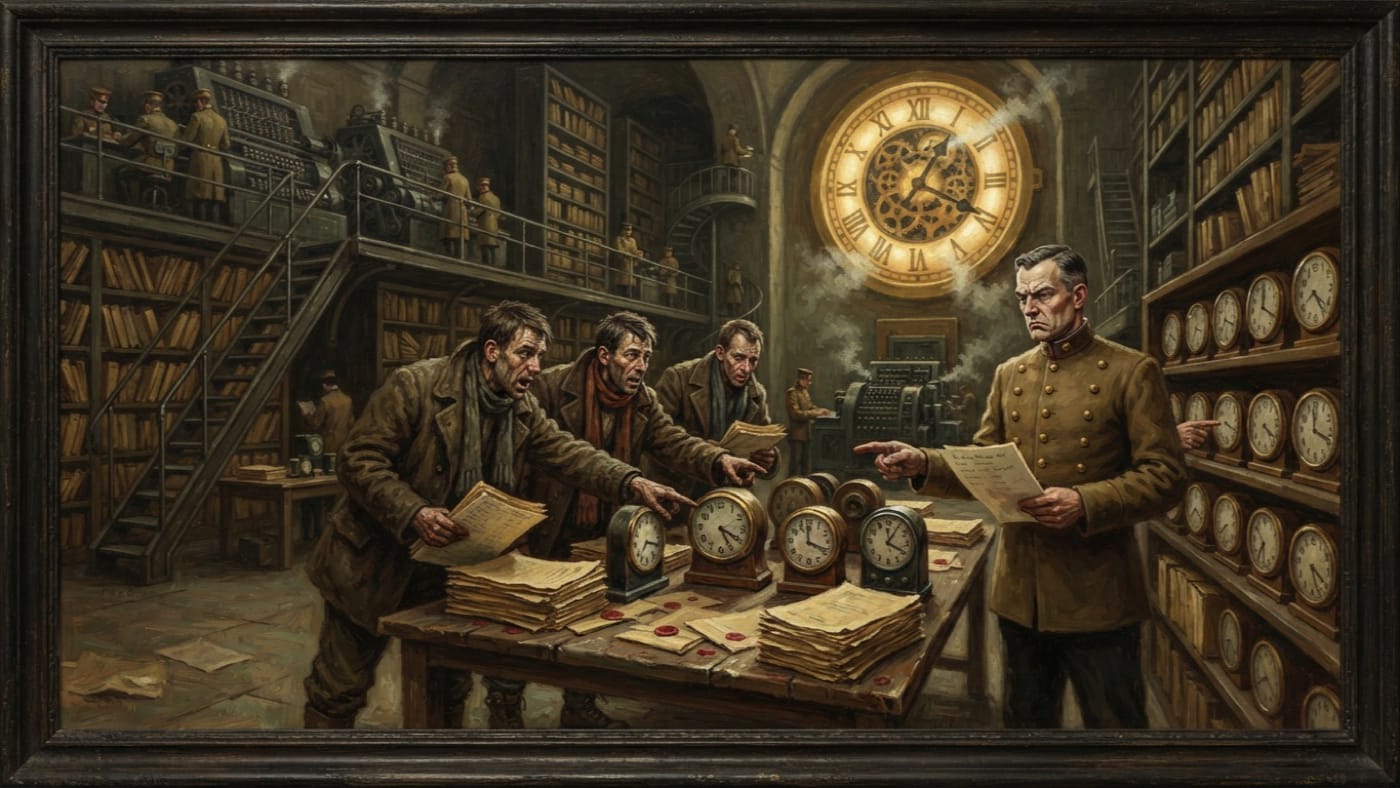
The clocks agreed, every one of them. Instruments that agree make the most persuasive testimony an office can receive, because brass has no family, owes no tithe and has never been seen in a tavern. Against that choir stood a few exhausted labourers with grease in the creases of their hands, claiming that their bodies had worked a longer shift than the dials allowed.
The inspector chose. He filed intoxication charges.
I will say this for him: the charge was efficient. It explained the crew's error, put the fault in the witnesses rather than in the regulation, and required no further correspondence. It also protected the clocks, which belonged to the Bureau, at the expense of the crew, who belonged to nobody in particular. The record does not establish that any man was drunk. It records no conviction, acquittal, fine, flogging or apology. The charge was filed. Filing is a complete act in its own right. The Synod has built an empire on it.
#On Closing the File
The complaint was closed. Then it was reopened, closed and reopened again, three cycles in all through A.S. 133, because identical anomalies kept arriving at the desk in the same shape as the first. The file does not say how many crews, runs or signatures were involved. It says the anomalies multiplied and that no closure held.
The procedure has a liturgy. A file is opened under a number, receives a finding, and is tied with tape, sealed and shelved. Then a fresh report arrives that matches the old one in every particular that matters, and some unlucky clerk must cut the tape, break the seal and tell his superior that the dead have risen. Engineering performed that office three times and shelved the thing three times.
By A.S. 133 the matter had passed to the Bureau of Rites. Rites did what it always does when a question frightens it and asked someone grander. It consulted the Bureau of Doctrine, which returned the file with a single annotation in the confident hand of an office that has never ridden a train.
It is a magnificent sentence. The first half is theology, and contesting it means a pyre. The second half is an errand, and it sends the investigator back to the one witness already found perfectly reliable. Doctrine's ruling left the crew no room to be right, yet the same stroke implied that the clocks might be wrong, the exact opposite of what the inspector had decided in A.S. 130. Nobody seems to have noticed. Both positions stayed on file under different seals, each correct within its own jurisdiction.
#On War's Arithmetic
Doctrine can afford to wait on the Creator's time. The Bureau of War keeps a timetable.
A feeder line exists for one purpose. A relief train leaves the depot at the hour stamped on its orders and arrives at the hour the requesting bastion expects. Between those two hours sit the quartermaster's tallies, the escort's rotation, the bell schedule, the ration count and the gun crews waiting for shells. If the clocks say four hours and the men say nine, one of two catastrophes is true. Either the crews are lying, and the whole southern supply establishment is staffed by drunks and perjurers, or the clocks are lying, and every timetable on the Line is devotional fiction. No army can fight on either.
Engineering could shelve a complaint. It could not shelve four years of them. War never cared whether the labourers deserved belief. War needed to know which number to plan by.
In A.S. 134, after four years of clock-complaints that Engineering could not dismiss, the Bureau of War constituted a dedicated office in Lyon.
Observe the verbs: measure, classify, report. The warrant never says believe. War did not found the Bureau of the Hourglass to vindicate a crew on the Drava spur. It founded an office whose clocks would outrank everyone else's. That is a different mercy, and a colder one.
#On What the Survey Admitted
The founding survey ran from A.S. 134 to A.S. 136. It found that temporal drift was real, that it was measurable, that it was attributable to Syrionic influence, and that it was spread unevenly across all seven bastion sectors of the Line.
Real and measurable: the two words the inspector of A.S. 130 had refused to consider, now set down by an office of the Bureau of War under a seal no Engineering clerk could overrule. The survey put the drift down to Syrion. It did not say that the first crew had met him, or that every later anomaly on every line had the same cause. It did confirm that clocks and men could both be honest and still disagree, which is the most expensive finding in natural philosophy.
The survey was classified immediately.
The Codex entry on the Hourglass Monolith states that rail crews "swore that four-hour journeys had taken nine hours."
Clarified. The record gives a journey of nine hours by crew reckoning against four hours and eleven minutes by all clocks. "Four-hour journeys" rounds the clock figure for summary and refers to the same complaint, not a second incident or a scheduled duration. No timetable promising four hours survives in the file.
The Bureau's later hunger for a single standard starts here. If each bastion keeps its own clocks and each crew keeps its own body, nobody can say whose hour governs, and War will not fight on an argument. The Lyon Monolith eventually answered that demand, though its own files disagree about when it arrived. The Bureau says A.S. 142. The delivery ledger says A.S. 139. Its crate wax bears a seal discontinued in A.S. 136. The Lyon Academy designed its housing in A.S. 142. None of that machinery existed when the Drava crews filed. Their complaint was weighed against ordinary brass, and ordinary brass won.
No record I have been shown withdraws the intoxication charges of A.S. 130, and none withdraws Doctrine's annotation. In the end the clocks were investigated, as Doctrine instructed. It took an office built by War two years, and the answer was sealed before Doctrine could object to it.