
#On Its Warrant
"Everyone's equal at the blessing. Then they hand out the bread." — Orchard Ring, overheard
The Doctrine of Equality Before the Divine is short enough to recite between a sergeant's call and the issue of bread, and that is where most of the Theocracy hears it. It makes three propositions. All human beings stand equal in the sight of the Creator. Rank is earthly and temporary. Pride is sin. The Bureau of Doctrine files it among the Synod's defences against Atheron, Sin-General of Pride, and that is where I found it: a teaching in daily use, cross-indexed under countermeasures, with no founding instrument attached.
I searched and I requisitioned. I spent two afternoons in the reading room with a clerk who brought me every folio bearing the word equality and seemed personally wounded that there were so few. The registry holds no decree of promulgation, no sealed original and no council minute recording a vote. Whoever first taught it did not sign it. I suspect this was deliberate. A signature would have been the first rank in the text.
I do not supply what the archive withholds. This assessment concerns the teaching as it stands in A.S. 201: how it is recited, how it is administered and how it is disobeyed. In other words, it concerns how the teaching exists.
#On Equality and Office
Precision is required here, because the teaching gets misread in two directions at once.
It does not say that all humans are equally capable. A gunnery sergeant who has laid shells on the Ebon Heights for eleven winters knows more about elevation than a curate fresh from seminary. A curate who disputes this should be kept away from the guns and, if he persists, introduced to the Lictors. Competence is real, and so is responsibility. The Doctrine leaves both standing. What it denies is that either one adds worth in the Creator's sight. The sergeant is not a heavier soul than the curate. He is a better gunner.
Self-respect survives the Doctrine as well. The dedicated lore on Pride, unusually among our sources, calls confidence and self-worth healthy and human. Pride, in the Doctrine's usage, is the inability to see another person as an equal. The proud man hears every objection as noise, ranks everyone he meets on sight and treats correction as a wound to be avenged. He may know a great deal. He can no longer learn anything from anyone beneath him, and he has placed everyone beneath him.
Then there is the Synod. The Synod keeps its Hierarchs, Bishops-Praetorial, Wardens, Inquisitors and Confessors, all overlapping and all jealous of their autonomy, and it holds that this order is divinely authorised. The Doctrine and the order are proclaimed from the same pulpit. The official reconciliation rests on the second proposition. Rank is earthly and temporary, a commission held in trust that death revokes if nothing revokes it sooner. The ordained exercise authority without possessing superior souls.
The officers' quarters at Przemyśl are on the upper terrace. The reconciliation does not reach the stairs.
#On the Injury Pride Exploits
The Doctrine was not written for the comfortable. It is aimed at a wound.
Atheron's influence-demons look for wounded dignity. They find the engineer whose design was rejected by a committee that could not read it. They find the officer passed over three times for men with better uncles, and the clerk told in front of the whole counting-room that he does not matter. These are often capable people, and their grievance is often correct. The demon begins by agreeing with them. Agreement is the cheapest thing in the world, and the rarest at Przemyśl.
You deserved better. That is true. They did not see your worth. That is often true. You are above them. The poison enters with the third sentence. The first two describe an injustice. The third passes a verdict on other human beings, and it ends with the injured party beyond anyone's correction, since everyone else is now lower.
The Doctrine takes its position at that third sentence. It does not require the overlooked engineer to call the committee wise, and it does not ask the humiliated clerk to agree that he is nothing. A teaching that told the injured to accept degradation would deliver Atheron his recruits by the cartload. The Mirror-Lords already do a brisk trade in men who believe themselves worthless, and such men will kneel to any hierarchy that promises them someone below. The Doctrine holds that the engineer and the committee stand level before the Creator. The wrong done to him is real. The elevation he is offered is not.
The demons cannot compel that final step. Free will holds within Synod territory: the whisper persuades, and the listener chooses. That fact is both the Doctrine's hope and its indictment, because every pedestal at Przemyśl was climbed.
#On the Disciplines
A doctrine that is recited and never practised is a hymn. The Synod attaches four disciplines to this one, and each has a documented fault.
Humility Practices require officers above the rank of captain to perform tasks beneath their station each quarter. They wash the feet of enlisted men, serve at the common table and scrub what they would ordinarily inspect. The theory is that a body taught to stoop will teach the mind. The Bureau of Purity administers the programme. It records compliance in a ledger with two columns, performed and not performed. An officer who has knelt at the basin for four consecutive quarters, without complaint and without delegating the task, has shown by that obedience that he is free of the condition the basin exists to treat.
...has shown by that obedience that he is free of the condition the basin exists to treat.
The author withdrew this before sealing. The dedicated lore records two common results of compelled humility: resentment, and the private conviction that one is superior because one submits to exercises that lesser men would refuse. The ledger can certify that feet were washed. It cannot certify who was doing the washing. The author notes that he drafted the withdrawn sentence while thinking of his own attendance record.
Rotation of Command moves officers between posts before they can mistake the post for themselves. It slows the fusing of man to office. It also drains away expertise. The commander who has finally learned which ridge the spires conceal is transferred to a sector where that knowledge is useless. His successor must learn it again, and the cost is counted in the dawn harvest.
Confession of Pride asks the penitent to name his moments of contempt. It draws honest testimony from the people who least needed to give it. A man must see his own contempt before he can confess it, and much of the condition consists in not seeing it.
Peer Accountability makes equals answerable to equals. It fails exactly where it is needed. The proud recognise no peers, and they receive correction from a man they regard as lower as impertinence.
Beyond the disciplines stands the scaffold. Those who show advanced signs are executed. The signs are rigidity, refusal of all correction and the physical changes recorded in the Atheron dossier. The Synod calls the execution mercy, on the ground that death is better than eternal frozen elevation. I record that claim as the Synod's. The dedicated lore holds that no corruption closes the road to repentance. A fused spine may never bend again, but the will inside it can still choose. The death sentence is an administrative verdict that the Synod no longer wishes to wait.
The Humility Assessments are a separate matter and must not be confused with the Practices. Under the Bureau of Purity's advisory of A.S. 199, garrison commanders at Przemyśl undergo them quarterly, conducted jointly with the Bureau of Doctrine. A commander who fails is relieved. The advisory does not say whether the Assessment measures the same thing as the Practices. It is kept in a different ledger.
#On Its Application at Przemyśl
Bastion-Przemyśl holds the western Carpathian sector of the Sagittal Line and faces Atheron's spires across the eastern heights. It recites the Doctrine more often than any station I have audited: at muster, at confession and at the ration blessing before dawn. The words are correct. The bread is not distributed by them.
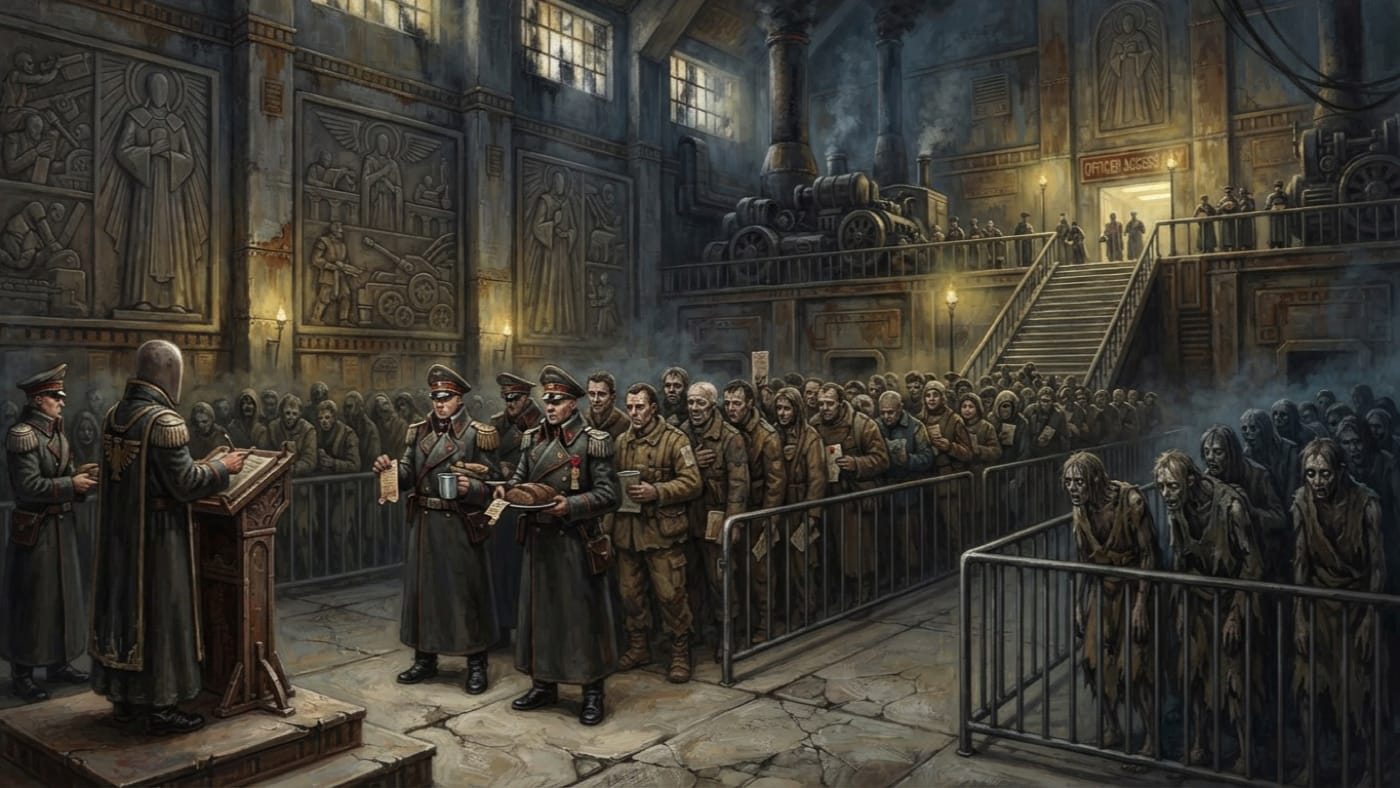
Przemyśl runs on tags. A wax-sealed, dated ration tag admits its bearer to food, to shelter and to the Ledger. Without one, a person has no lawful existence. The station's own lore records the order of provision with admirable candour. Synod clergy and the Provost eat and sleep warm. The guild sealwrights eat, and they fear audits. Labourers eat sometimes. The drafted and the imprisoned freeze. The Erased receive nothing and are hunted. Their tags have expired, been confiscated or were never issued.
The ration blessing is said over this queue, and the Provost's men eat first, as policy requires. The sealwrights' wax decides who exists, yet their own security lasts exactly as long as their next audit. The Erased are absent from the blessing, as they are absent from everything that requires a tag to attend. The garrison recites that all humans are equal before the Creator. Then it looks left at the Provost's table and right at the empty-handed, and it reaches the conclusion any child of six would reach.
Confessions go to the Chapel of Counting, where the slips are indexed three levels below the floor. When a man confesses contempt for his inferiors, he is entered in the vault, and so, the station's records make plain, are his debts, his associates and anything that can be used against him. At Przemyśl a confession slip serves reassignment and blackmail as readily as absolution. Penitents learn quickly which sins are safe to name.
On the Bureau of Purity's registers, Przemyśl's officers are no more given to cults than any other station's, and I have stamped no broader finding. Atheron does not need them to be. From the Crownspire he can see the queue.
#The Ratification
I certify that the Doctrine of Equality Before the Divine is correctly taught at every station audited, that its disciplines are administered on schedule and that its failures are recorded where the Bureau may find them.
I also certify that I am fit to make this assessment. Someone must judge whether others have understood that no one stands above anyone else. In its wisdom, the Bureau chose a man who understands this better than most.
I have read that sentence twice. It stays.