
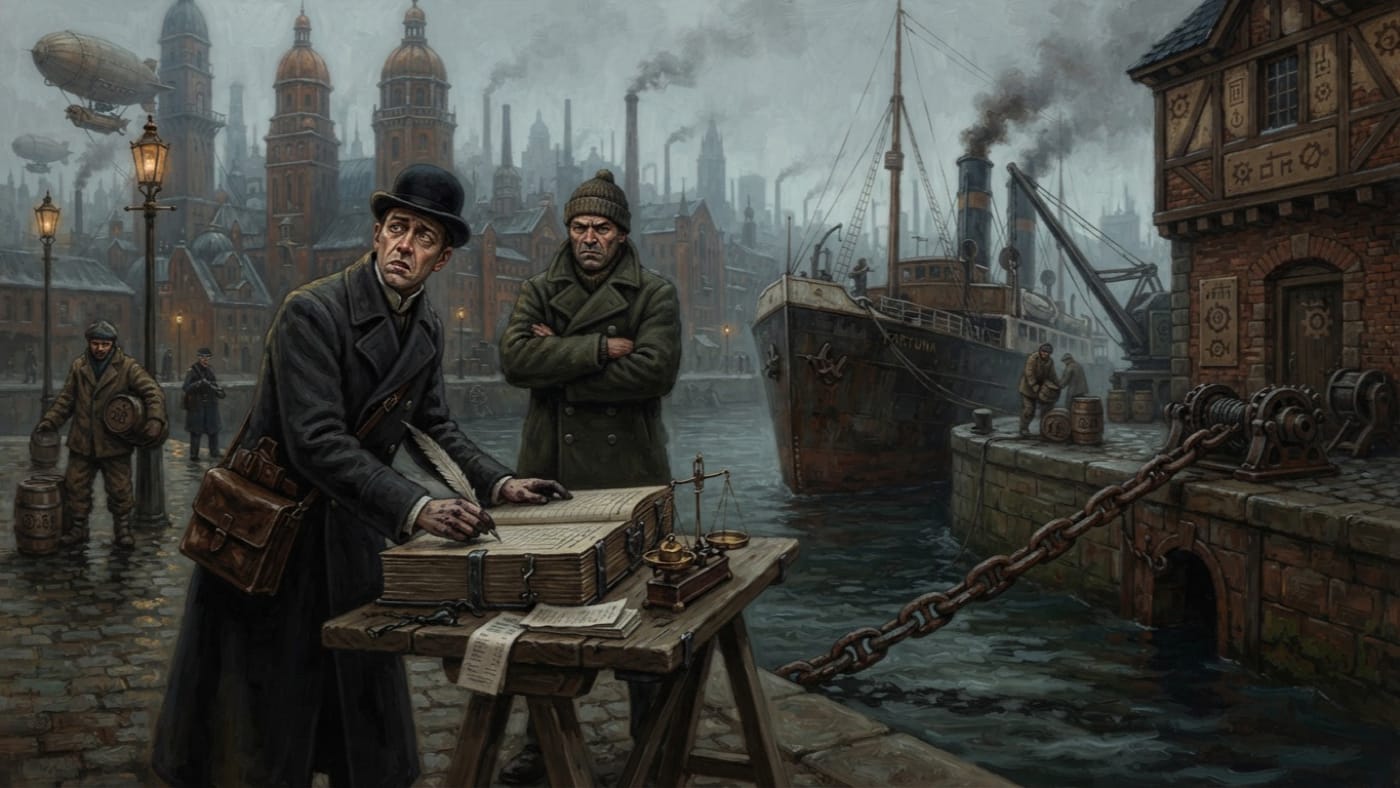
#On the Danish Waters
Accessible: the Bureau of Records' word for Denmark, used in roughly the sense that a locked strongbox is accessible to anyone standing next to it.
There is an office in Copenhagen where a servant of the Bureau of Tithes writes down what passes through the harbour. There is also a chain across that harbour, and the man who works it does not answer to the office. Everything the Synod knows about Denmark, and most of what it pretends to know, lies in the few yards of wet stone between the ledger and the chain.
Denmark belongs to Zone 8, the Fractured North, alongside Norway, Sweden and the contested Baltic littoral. The Scandinavian assessment of A.S. 201 treats the Danish portion as the region's exception. It is flatter, warmer and closer to the continent. It is made of lowland and islands. It has no mountain spine for an argument to break against and no fjord deep enough to lose a Prior in. A courier sent from the south arrives without sledges, without a guide paid in lamp-oil and without first making his will. The Bureau of Records has seized on these mercies and called Denmark "administratively accessible," and on the narrow question of whether a clerk can reach the place, the Bureau is correct.
Getting there is the easy part. The Danish islands anchor the northern approach to Hamburg. Northern seal-oil, timber, iron and salted herring pass through Danish waters before they reach the continent, and so the most obliging coast in Zone 8 is also the one the Synod can least afford to offend. Pilgrims go where they please. Cargo goes where the harbours let it.
#On the Harbour Compacts
The Fractured North has no central government. It runs its affairs through clan moots, elder councils, regional assemblies and harbour compacts. In Denmark the harbour compacts are the bodies that concern the Synod, because they hold the quays. They decide who lands, who loads and who waits. They also decide whether a southbound hull clears its moorings this tide or sits until the matter has been discussed to everyone's satisfaction.
The Bureau of Tithes keeps a permanent assessor in Copenhagen, and the Danish harbour authorities tolerate him. Tolerate is my Scandinavian assessment's word, and I keep it. The assessor has his ledger, his scales and his seal cords, and a drawer of printed receipts from a Bureau a long way south. When he ties a cord around a barrel, the knot certifies that the barrel has been counted. It does not certify that the barrel will move. That certificate is issued by the chain.
In a Synod-controlled district an assessor arrives with the powers of his office behind him, and the parishioners know exactly what the scales are for. The documented arrangement in Copenhagen gives him the right to assess. It gives him no right to govern the stevedores, the pilots, the coopers or the harbour officials who stand in his doorway. Permission to count a people's cargo is a long way from authority over the people carrying it. The Danes grasped that distinction before the Bureau did and have shown no wish to explain it.
Each year Danish negotiators sit down with the Synod's representatives and agree the rates charged on northern trade heading south. I stress agree. The Norwegians disregard those rates entirely. The Danes negotiate, sign and largely abide by the result, which makes them the region's most cooperative partner and so its most troublesome one. A man who ignores you can be written off as a heretic or a savage. A man who bargains with you every year, keeps his word and returns to the table has to be treated as an equal. The Bureau has no form for that.
#On Cargo and Credit
Three trades meet at a Danish quay and get confused in the Synod's paperwork. Producing a commodity is one trade, handling it is another, and paying for it before it arrives is a third. Denmark is principally engaged in the second and third.
Take seal-oil. The rendering is Norwegian. By my Scandinavian assessment, the yards of the northern coast produce about sixty thousand barrels a season, and that is a Norwegian figure. About forty thousand of those barrels go south through Hamburg's docks, and the other twenty thousand stay in the North to be rationed, traded and, in shrinefjords such as Hrafnvik, exchanged for the grain and tools the clans cannot make for themselves. The southbound share reaches Hamburg by way of Danish waters. Danish harbours did not render it, they cannot always tell which clan rendered it, and they collect their fee whatever the answer.
Timber goes the same way. The Bureau of Engineering holds a standing order for northern pine of more than forty thousand cords a year. That figure is a request. It is neither a delivery record nor a measure of anything grown on a Danish island. Iron goes the same way too, and here the Synod's documents argue with themselves: my own assessment calls the ore Swedish in one paragraph and the iron Danish in another. I record only what the evidence supports, which is that northern iron passes through Danish ports. A barge does not know its own baptismal record.
Once these cargoes reach Hamburg, they enter the Northern Corridor and turn into continental supply. The route runs from Hamburg to Kanzleiburg, on to Warsaw, and from there to Bastion-Brest and to Bastion-Königsberg, the Baltic northern anchor of the Sagittal Line. The Bureau of War's A.S. 200 assessment credits Zone 8 as a whole, with no figure broken out for Denmark, with thirty-one per cent of the northern front's operational fuel reserves and forty-four per cent of its construction timber. In practice this means a harbour official in Copenhagen who delays a hull by a fortnight is also delaying the lamps in a gun-gallery hundreds of miles to the south-east, along with the bracing in its trenches. He knows it. The garrison may not.
Credit adds the final indignity. The Synod's war budget regularly runs ahead of its tithe collections, and the shortfall is covered by northern credit passed through Hamburg's banking houses. Under that credit sit advances against future shipments. The harbour compacts of Copenhagen and Bergen guarantee those advances, and they secure them against seal-oil futures and timber contracts. There is no Danish treasury in this arrangement and no Danish national debt office. What exists is a set of compacts with good books and long memories, standing behind barrels that have not yet been filled. The Church's war against the Great Deceiver is partly paid for with promises written on a Copenhagen quay, and those promises are honoured more reliably than many of the Synod's own.
#On Faith and Jurisdiction
The Danes worship the Creator, and their faith is recognisably that of the Concordat settled at Strasbourg in A.S. 90. The older atlases of the North still circulate, and they describe the whole region as pagan and heretical. The Bureau of Rites has superseded them. They are now evidence of the atlas-makers' attitude and of nothing in the North.
The governing classification belongs to the region as a whole and dates from A.S. 199. Denmark shares it with the cliffs and fjords to the north. The Bureau of War observed that antagonising the seal-oil settlements during a fuel-short winter would be a strategic form of self-harm, and the Bureau of Rites concluded that the North was devout enough after all.
Shared devotion does not bring shared administration with it. The Bureau of Bells sent Investigation 447-N north in A.S. 199 and documented non-compliance in fourteen northern settlements. Nothing in the material available to me places a Danish parish among the fourteen, and I will not put one there to make a tidier chapter. The severe northern fasts, and the dark-houses cut off from the shared warmth, belong to the clans further up the coast. So does the fog at Hrafnvik, which answers prayers, and which I documented in A.S. 197 and classified as acoustic distortion. These are Norwegian matters, attributed to Norway. Denmark has no need of borrowed terrors.
What Denmark offers the Synod's theologians is quieter and more irritating. Here is a devout people with harbours that function, bells that ring and a tithe-man nobody throws in the water, and the Synod still cannot issue them a single instruction that the harbour compacts have not already agreed to.
#On the Present Condition
Denmark is of the North, and it is the part of the North the continent can reach. Its people keep the faith that Strasbourg recognises and the harbours that Strasbourg needs, and they keep both on their own terms. The Winter Watch, the region's militia, answers to the local moots, and the Bureau of War lists it as non-integrated irregular auxiliaries. No Danish command, captain or campaign appears in the record, and I will not invent one. Denmark's real strength is a ledger it allows the Synod to keep, beside a chain the Synod is not permitted to touch.
The Synod cannot coerce Denmark and cannot afford to try. Every year it sends its negotiators to Copenhagen and receives an agreed rate, a tolerated assessor, a stack of receipts and an advance against oil that is still swimming. In return Denmark receives a continental market and an unarmed southern guest with a good pair of scales. Both parties call the result compliance.
Erratum — Filed by the Author, A.S. 201: The Bureau of Records describes Zone 8 as "Partially Independent, Economically Marginal." My Scandinavian assessment has already corrected the first term, and the correction applies with particular force at Copenhagen. Danish harbours are independent. That independence is limited by economic interdependence and theological kinship, and the limits are real, but they are not subordination. The second term fails before any argument is needed. A region whose harbour compacts guarantee the Synod's war credit is not marginal. It is a creditor, and it is entitled to the courtesy creditors receive. Filed. Not ratified. The chain has not been consulted.