
#On the Standard Chosen
The Crimson Pennant of Saint Marcellus is a campaign standard of the Vexillators of Strasbourg. The Codex knows it chiefly by one night's work. In A.S. 172 / 1882 CE, Warden-Submarshal Calev Rohn, acting under Bureau of War authority, chose three standards to force the Danube on the forward corridor between Budapest and Bastion-Irongate. The Brass-Lipped Banner of the Sixth Levy went to the Chain-Pier Ruin. Widow's Rag, which a clerk of rare tonal deafness filed as Standard 14-D, Hydrological Operations, went to the drowned pontoon at Mark Seven. The Crimson Pennant went to Saint Hadrien's Ford. The dispatch behind the Night of the Three Bridges names the pennant among the three. Its assignment to the ford is recorded in War's own instructional doctrine and in the file on Rohn's command, and I cite those files because nothing else records it.
War's account states that all three standards were consecrated at Strasbourg and stitched with fragments of pilgrim-cloth from the Continental Levy musters. I set that sentence down as War wrote it and leave War's name on it. The Levy decree is dated A.S. 110. That date tells the reader when the musters were licensed. It tells him nothing about when a particular scrap entered a particular seam, when this pennant was cut, or whose needle did the cutting.
The rest of the individual record is a short shelf. It names no maker and gives no year of manufacture. It records no day of consecration, no measurements, no full account of the embroidery and no earlier campaign. Of Saint Marcellus the Ledger keeps a dedication and declines to keep a biography, and I will not stitch one up for the occasion. Pilgrims ask which of the saint's bones lies in the hoist. No document admits to any. A name on a standard is a dedication. A reliquary needs a receipt.
#On Cloth in Formation
Why send cloth into a river at all? At night, under artillery, in water to the chest, the ear is the first organ of command to fail. Drums drown. Officers become casualties, then rumours. A voice shouting across the Danube in winter reaches the next man, who is occupied with breathing and has stopped taking orders from sound. The eye lasts longer. A standard held up out of the smoke tells a rank that someone has decided where forward lies.
Vexillary doctrine goes further, as doctrine must. Sanctioned cloth marks a formation and also creates one. A soldier within sight of it remains legally in formation unless declared otherwise. The pennant at the ford therefore held two offices at once. It gave the men a bearing, and it kept them on the Bureau's books as a unit and out of the category of crowd. A crowd drowns one man at a time. A formation drowns as a single line item.
The corps manuals list the furniture of the trade: relic-thread, socket, signal rings, campaign plates and coded tassels, with iron-cored staffs and weighted sockets for river service, all inspected under Form 9-V. That is the general equipment of a Vexillator's standard, and it is no certified inventory of this one. Several river requirements were written after A.S. 172, partly because of A.S. 172. I will not fit them backward onto a pole that no clerk measured.
Nor did the cloth work alone. The Tribune-Chaplain held the ear for as long as he had a jaw to hold it with. The Litany-Engineers held the riverbed. The bearer held the eye, under the corps prayer of Saint Hermas, Keep the cloth upright. Hermas is patron of the Vexillators. Marcellus is the dedication of one pennant. The two saints should not be made to share a pew. The surviving record attaches no name to the bearer of this standard. War describes chaplain, engineer and Vexillator as three hands of one instrument. At the ford, for once, the description was accurate.
#On Saint Hadrien's Water
The necessity was simple enough for War to grasp at first reading. Forty-seven wagons bound for Irongate's southern works were trapped against the western bank. They carried rifle cartridges, consecrated bridge-chain, three portable bell-frames, two sealed ossuary reliquaries, and the grain that kept the Sibiu-Irongate corridor from starving. The river was high and the bridges were gone. The enemy held the far bank, and its gunners had the flats ranged.
Rohn sent all three passages into the water at once. That is the only reason the pennant's companions enter this article. Batteries forced to choose among three standards choose slowly, and fire split three ways reaches each passage at a third of its appetite. The men behind the Crimson Pennant were no braver for this arithmetic. They were simply shot at less.
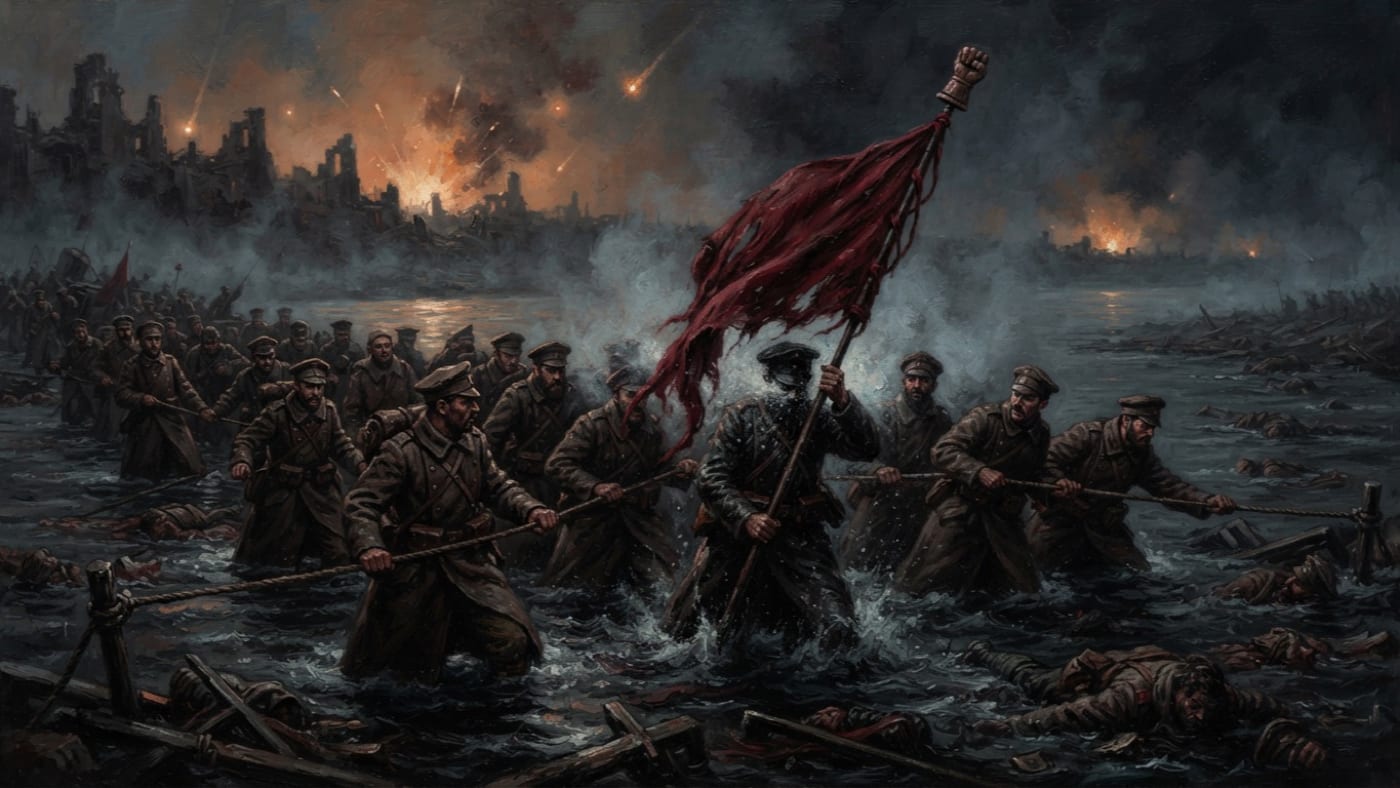
At Saint Hadrien's Ford the water reached the chest before the column had gone ten paces. The Litany-Engineers went ahead with iron pegs and drove them into mud they could not see. They strung guide-cords along the current for the ranks to grip. The first cord snapped. The second sang. The third held.
Tribune-Chaplain Sorellus began the Psalm of Iron. In the fourth verse he lost his lower jaw. The men sang on without him, one hand on the cord and their eyes on the red cloth somewhere ahead in the smoke.
Here I am more careful than the pamphlets. Sorellus was the chaplain. He was not the bearer. The Codex records no name for the Vexillator who carried the Crimson Pennant into the ford. It records no signals given and does not say whether the hand on the staff at the eastern bank was the hand that lifted it on the western one. Readers who want a hero at the hoist may apply to the sister standards, which have heroes. This one has a column of men in black water following red cloth. That is all the record holds, and it is a good deal.
War's clock for the crossing is precise. The three assault crossings together took under seven minutes. By the ninth minute a ragged line stood in the mud of the eastern bank. By the fourteenth the first wagon chains were hauling. By dawn the supply column had crossed. Broadsheets compress all of this into seven minutes, wagons included. Forty-seven loaded wagons do not cross the Danube in seven minutes for any saint the Church has yet canonised.
#On the Motion Ratified
War classified the Night as a miracle of locomotion and ratified it as martial obedience. The formula fits on a muster card and can be recited in sleet: the men did not swim; they were carried. The crimson cloth at the ford falls under that formula along with its two sisters, and the Bureau of Doctrine teaches it to recruits who have never seen a river in flood.
The veterans tell it otherwise. They speak of the current dragging sideways, the press of the ranks behind, the drowning in front, swimming in full kit, and a red shape in the smoke to swim toward. Doctrine tolerates their account under a pastoral clause reserved for men who were inside the miracle. Both versions sit in the file, sealed and cross-indexed. I do not rule between them. How the Creator acts upon a body in winter water is above a Hieromnemon's seal, and the soldier in that water had no interest in the question.
The dead were counted for the whole operation. The first roll gave 4,200 dead, drowned, missing, frozen or otherwise removed from formation. On War's petition the Bureau of Records revised it to 1,800 casualties and 2,400 martyrdom-translations. No surviving figure divides these between the ford, the pier and the pontoon. I will not invent a ford share to make the paragraph weep on schedule. The families of the pennant's men were sorted by the same arithmetic as everyone else's: pension for some, ribbon for the rest.
Rhineland digests set the Night of the Three Bridges, and the standards carried on it, at a bridge-demolition along the Rhine at Mainz, Worms and Cologne. They dated it to a year the calendar has not yet reached and filled the water with drowning refugees.
Corrected under Timeline Harmonisation A.S. 201. The Crimson Pennant crossed the Danube at Saint Hadrien's Ford in A.S. 172. The Rhine has drowned enough people on its own account and may not claim this river's.
#On What Survived
All three standards survived the crossing. The record says so, and I am glad to copy it. The record is just as exact about what it leaves out. It does not say whether the staff came through whole or whether the bearer did. It does not say who held the cloth afterward, or where it lay in A.S. 173, or where it lies now, twenty-nine years on. There is no custody chain, no chapel inventory and no accession number. Survival is certified and the address is blank.
The annual commemoration sets out three bowls of river water, three soaked banner-cloths and one empty pair of boots. Nothing establishes that the soaked cloths are the standards that crossed. Pilgrims who kneel before the red one are kneeling before a length of cloth wetted for the service. The Creator may accept the substitute. The Bureau already has.
The pennant's lasting mark is in the regulations. River work became a discipline of its own. Sleeve reinforcement became mandatory so that the river's returns could be identified. Hydrological standards now carry waxed seams, bell-rings and recovery tags inked to stay legible after three days under water. Every river standard issued since the Danube carries Saint Hadrien's Ford in its specifications, whatever its seams contain.