
#On Whose Doctrine This Is
Ask an instructor of the Bureau of War what Bureau doctrine means and he will give you one sentence before he gives you anything else: a sanctioned standard marks a formation and creates one. Everything after that is drill, liturgy and paperwork, in that order of expense.
The doctrine belongs to War. War writes it into musters, drills it into Vexillators and spends men on it by the column. War does not interpret it. Interpretation is the property of the Bureau of Doctrine, which decides what a battle meant once the smoke has thinned enough to read. The orthodoxy of everyone involved falls to the Bureau of Purity. The final tally goes to the Bureau of Records, which keeps the account and, on petition, revises it. No campaign plan crosses a river until Doctrine and Purity have sealed it. The seals do not follow the men into the water. They wait on the bank with the clerks.
The practical half of the claim is as old as armies. Frightened men look for a fixed point. Voices drown under artillery, drummers drop their sticks, and officers are reduced to whatever the shell left. A cloth held upright on a pole gives the eye what the ear has lost. The theological half is War's own invention. Sanctioned cloth gives a man permission to continue and obliges him to do so. A soldier who can see it is still in formation, whatever his legs think about it.
#On Cloth, Voice and Calibrated Powder
War's doctrine has three instruments, and it insists they be played together. The Vexillator commands the eye. The Tribune-Chaplain commands the ear. The Litany-Engineer commands whatever must be pegged, strung, packed or detonated under the noise. All three serve beneath military command in parallel trades. None is promoted into the others. A chaplain who picks up a standard has made an error of profession, and an Engineer who starts preaching has usually mistimed a fuse.
The grammar they teach is crude because crude grammar survives smoke. Lift: advance. Drop to shoulder: brace. Plant and kneel: hold. The chaplain's cadence sets the pace of the step, the Engineer's charges fire on the chaplain's count, and the standard tells the rear ranks where all of this is meant to happen. The Engineer recites his verses and checks his fuse-length in the same breath. Doctrine holds that both acts matter, and Doctrine is correct. A charge consecrated but packed wet does nothing. A charge packed dry but fired off the chaplain's count kills the wrong men. The Bureau does not ask which half of the procedure saved the breach, because the answer would cost one of the two budgets.
The First Continental Levy of A.S. 110 / 1820 CE made all this urgent. It turned ploughmen, apprentices and widows' sons into centralised manpower by the hundred thousand, and most of them had never seen a formation that was not a church procession. They did not need theory. They needed something tall and red to stand beside and a reason not to leave it. War gave them both and called the arrangement catechesis.
The Doctrine of Layered Death shows the method at its most procedural. Shields lock in the first rank. Engineers drive charges into the breach-side earth while reciting their verses. Ash Chaplains climb to the rear with relic-ash thuribles and lead the litany that keeps both layers on one count, and the band ties its drums to the brace-step and its pipes to the detonations. If every layer fails, the last layer is an entry in the ledger called the martyrdom dividend. That is one protocol for one emergency. The principle behind it, that a body under orders can be kept in formation by sight, sound and seal, is the whole of War's teaching.
#On the Danube as Proof-Text
Every doctrine needs a night it can point to. War's is the Night of the Three Bridges, A.S. 172 / 1882 CE, on the Danubian forward corridor between Budapest and Bastion-Irongate.
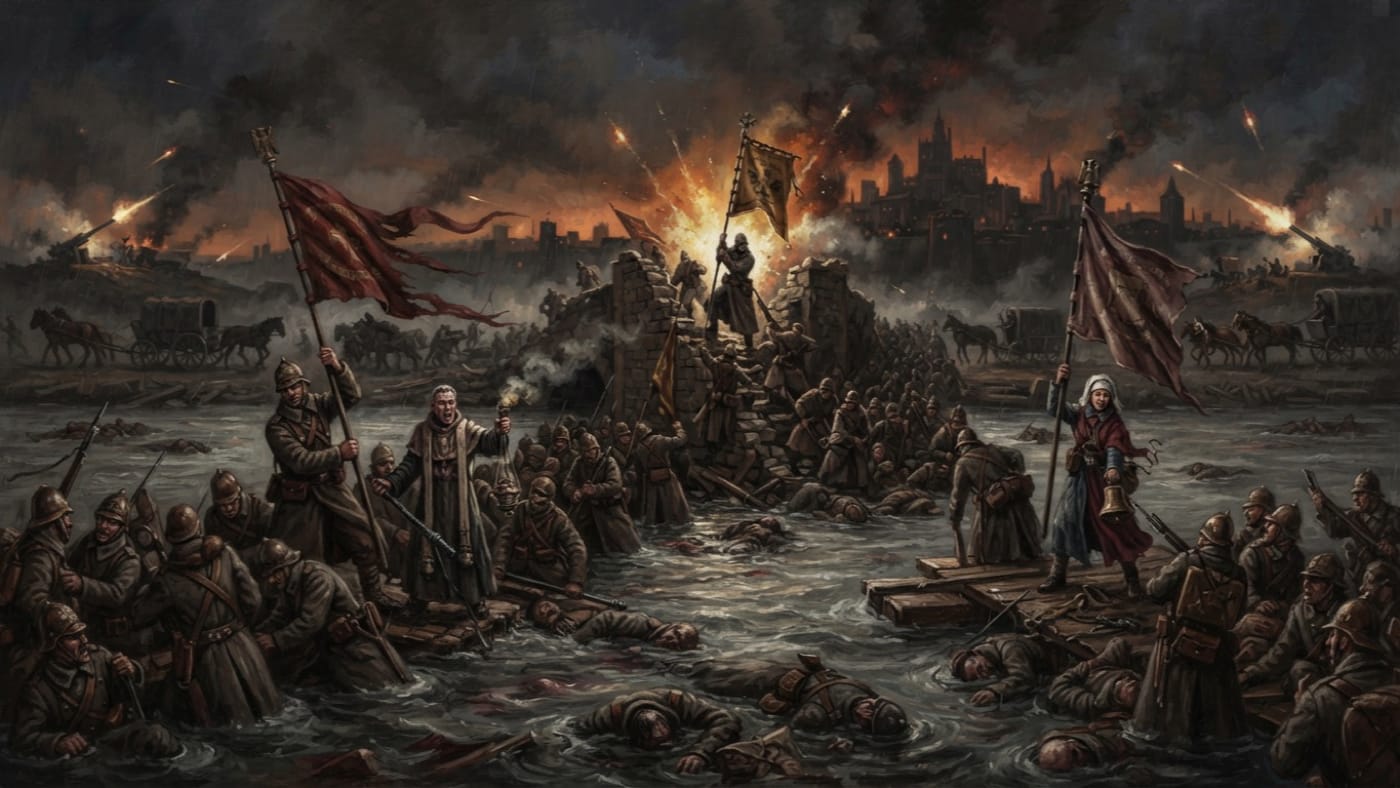
The facts that matter to instruction are few. A supply column bound for Irongate's southern works was pinned against the western bank. The river was high and the bridges were gone. Warden-Submarshal Calev Rohn sent Vexillators of Strasbourg across three passages at once: Saint Hadrien's Ford, the Chain-Pier Ruin and the drowned pontoon at Mark Seven. Three different standards went into the water. The Crimson Pennant of Saint Marcellus led at the ford. The Brass-Lipped Banner of the Sixth Levy went up the broken pier. Widow's Rag, officially Standard 14-D, Hydrological Operations, went to the pontoon.
Instructors stress that the crossings were simultaneous, and with good reason. The enemy batteries could not decide which crossing mattered, and their fire split between the three standards.
At the ford the Engineers drove iron pegs into the mud and strung guide-cords across the current. The first cord snapped, the second sang and the third held. Tribune-Chaplain Sorellus began the Psalm of Iron and lost his lower jaw on the fourth verse. The men went on singing without him. That is the doctrine reduced to its parts: a cord to hold, a cadence to keep and a reason to keep it after the man who started it could no longer speak.
At the Chain-Pier Ruin, Lorn of Metz wedged the Brass-Lipped Banner between two stones, and it stood for ninety seconds with no hand on it. Doctrine files this as Sign One. The banner's weighted socket is filed in the same folder.
At Mark Seven, Sister-Vexillator Anje Rusk planted Widow's Rag in the eastern mud and rang a hand bell until the striker froze to the rim.
The official account records the crossings in under seven minutes. A ragged line had formed on the eastern bank by the ninth minute. The first wagons were hauling by the fourteenth, and the column was across by dawn. Cadets who run these milestones together into one heroic seven minutes have their slates wiped and are made to recite them again in order. The column reached Irongate, and the southern works held through the winter.
#On Ratification and the Wet
The Bureau of War classified the night as a miracle of locomotion: martial obedience, ratified. Doctrine sealed it. The approved homiletic formula has been recited at every levy induction since.
The veterans tell it differently. They say they swam. They say the current pushed them sideways, the men behind shoved and the men in front went under, and the banners were useful mostly because nothing else could be seen in the smoke. None of this settles what carried whom, and the Bureau has wisely never asked them to settle it. Doctrine lets veterans dispute the miracle under a pastoral tolerance clause. A civilian who says the same words in a tavern is guilty of doctrinal trivialisation of ratified martial grace. The words are the same, and so is the tavern. The permission depends on whether the speaker was in the river.
Ratification also reached the dead, which is where it begins to save money. A casualty means a pension calculation, a family notice, an inventory of effects and a burial allocation. A martyrdom-translation means a certificate, a hymn and a ribbon. The Bureau of War petitioned for doctrinal review of the roll. The Bureau of Records obliged.
Night of the Three Bridges, casualty roll as first entered: 4,200 casualties.
Revised following War's petition for doctrinal review. Of the same 4,200 names, 1,800 stand as casualties and 2,400 are reclassified as martyrdom-translations. The total is unchanged. The category is not. Families of the translated receive commemorative recognition in place of the standard casualty entitlements.
No one in the Bureau has claimed the revision brought anyone back. It changed what each name entitled a family to. The original roll listed the dead together with the drowned, the frozen and the unrecovered, and Records has never pretended that every line was confirmed by a body. Some came ashore at the western bank by morning, and some lodged among the pier stumps. River patrols learned to identify Vexillators by the reinforcement stitched into their sleeves.
#On Instruction and the Unrepeatable
The Vexillary schools teach the Danube as standard curriculum. River work is now a separate discipline. Standards for hydrological operations must carry weighted sockets, waxed seams, bell-rings and recovery tags in ink meant to stay legible underwater. Each item answers a particular failure on a particular night, and that is how War writes most of its scripture.
The instructors teach the night in minutes. The cord comes first, the cadence after it and the cloth above both. Then come the ninth minute, the fourteenth and dawn. Cadets learn that the crossings worked because three standards went in together and the enemy could not choose among them, and that the chaplain's psalm outlived his jaw because the men had been drilled in it until they could no longer stop singing it.
Ratification does not make a precedent repeatable. Doctrine rules on events after they happen. It does not forecast them. A commander who orders a flooded river crossed "as at the Three Bridges" has quoted the homily and skipped the minutes. He also has no cause to expect that Doctrine's seal on A.S. 172 will reach his own crossing. If the river carries his men, Doctrine will say so afterward. If it does not, Records already has a column ready for them.
There is one item the curriculum leaves out. A Bureau of Shadows memorandum from A.S. 173 reports voices heard beneath moving water at Mark Seven, and one of them was reportedly giving tactical instructions. The memorandum recommends listening and makes no ruling. Doctrine has issued none either. The schools do not teach it, and the river patrols do not mention it.