
#On the Sanctioned Voice
A Covenant hymn is a working instrument. It is sung over loading trays, fuse-boxes, stretchers and reliquary carts. Beneath the carillon of Strasbourg Cathedral it is sung with great beauty, but it usually lives in mud, and it is usually accompanied by the click of a ramrod. The forges keep time with hammer-song, and processions walk to psalms. The Church teaches that each of these is sacred action, that labour sung is labour offered, and that Creation recognises the offering. I teach the same. I am paid to.
What the eye can verify is plainer. Two hundred men singing one line breathe together. Men who breathe together load together, step together and break together, which is why the line must be the right one. A licensed hymn is a known quantity: known length, known stresses, known pauses where a cartridge goes in or a boot comes down. An unlicensed tune is a stranger in the ranks. It may be a lullaby, and a lullaby will put a company to sleep at precisely the hour the enemy prefers.
There is no single book called Covenant Hymns. Three junior archivists and one bishop have asked me for it. What exists is a repertoire, licensed, regional, worn to rags and sung badly by millions. The title belongs to the practice.
#On Their Employment
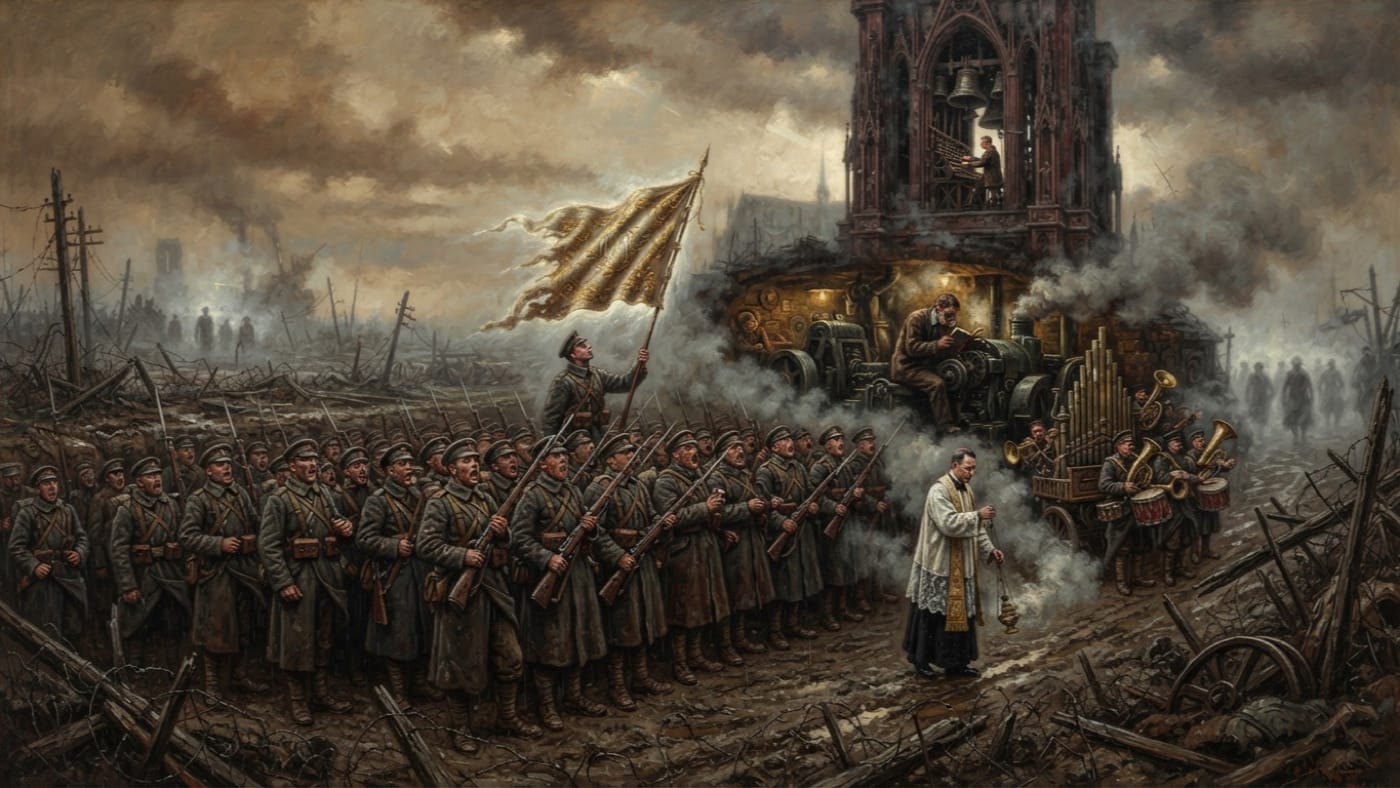
The Radiant Fusiliers are the clearest case, because their singing cannot be separated from their arithmetic. They load to the psalm: the cartridge is kissed on one syllable, the ramrod driven down on the next. No fusilier watches the enemy. He watches the consecrated banner above his line. It flares, and the first volley goes. It dims, and the second follows. It blazes white, and the third belongs to the Creed. Doctrine holds that firing out of order is heresy, and the Fusiliers have shot their own brethren to prove the point. The hymn paces the hands and the banner names the moment. A man who forgets the next line has broken both.
Behind them come the Ash Chaplains, their thuribles smoking with relic-ash, and the Processional Bands. Rain and shellfire have battered the bands' pipes, drums and horns so badly that a civilian would pay to have them carted off. Their music is fitted to the work: drums to boots, pipes to volley-fire, horns to the bell-cannon. A chaplain who died at Vienna left the regulation in five words: "A missed note is a misfire." When a band is lost, one voice must carry the company. Brother Mathis of Rouen did it from a parapet, bellowing the Litany of Stones for nine hours until his lungs were cinders. Records filed it as "local morale stabilization." I filed Mathis in my prayers, which are better indexed.
The Litany-Engineer carries the ugliest hymnal in the Church and the most honest. It is thick with oil, swollen with trench water and thumbed to felt at the corners, and its margins are crowded with charge weights beside stanza counts and fuse lengths reckoned in verses. In the motor houses the same men recite torque figures as litany and sing ignition in sanctioned intervals. Doctrine says the litany brings down the wall. Engines & Furnaces says the powder does, and leaves Doctrine its poetry. The hymnal records both positions on the same page, in the same grease.
Then there is the voice that has no singer. Sky-sermons from the Vigil Arks and the towers of Orison & Song are paced by the Bellways, so that a march-step far down the Line lands on the homily's beat. Orison's signal engineers keep that voice clean through labour that no psalm mentions. They verify the wax and cipher, blend and meter the saint-dust, calibrate the carrier and run a test prayer for inversion. They log every variance and sign a Clean Carrier certificate for the inquest that will follow any failure. Dust runs short. Coils clog. Lungs rot.
#On Custody and Correction
Orison & Song licenses hymnals. That sentence is the whole constitution of the matter, and every war-office clerk should copy it until his wrist fails. A hymnal without a licence is contraband. A melody without one is prosecuted as heresy, and Purity has never needed persuading on that point. In Vienna a folk lullaby once spread without sanction, and within the month the mothers who sang it had been branded.
The Bureau of Bells holds the clock: the liturgical calendar, the civic hours and the regional networks. It is the peal that tells a parish when to sing, and a peal is no hymn. On the Bellways the First Peal means stand-to and the Fifth means repentance. A bell may begin the hymn, interrupt it, or order the men to stop singing and dig. The Office of Bells was constituted in A.S. 52, and the present Bell Codex was ratified in A.S. 115. Men rang bells and sang long before either parchment noticed them.
The Bureau of Doctrine decides what the singing means. The Bureau of Records keeps what the singing did: attendance audits, field reports, onset logs and comparisons. That makes four bureaux for one hymn. Their jurisdictions overlap the way choir stalls do, with elbows and the occasional knife.
Pale Chanter emissions are hereafter designated "unhymns."
Corrected by Orison & Song. The term "unhymn" is banned as insufficiently reverent of structure; read "counter-hymn" throughout. The Bureau wished it understood that the enemy has no hymns of its own. It did not notice that its new word admits the enemy's sound was built to answer ours.
#On the Returned Cadence
The Pale Chanters sing or emit, depending on which bureau has the floor. Their sound passes through trench walls and helmets and climbs the marrow, and veterans call it being sung by your own skeleton. It leaves bone intact and empties the will to lift a rifle. Three reports concern us here, because in each the counter-hymn struck a sanctioned voice while it was being used.
At Prague, on the Night of Silent Steel, Radiant Fusiliers stood under banner-light with their weapons loaded and their eyes open. Across the field the Chanters droned a slow inversion of a penitential hymn. The banner flared white, and no volley came. The annals record "command miscommunication."
At Odessa, in the Weeping Trenches, the hostile cadence seeped into the engineering positions. Litany-Engineers tore at their hymnals and stuffed the pages into their mouths. The relief found them alive and wordless, their tongues gnawed to ribbons. Records filed the case as "voluntary disarmament of the tongue."
At Rouen, Saint Aurelia's relic convoy began to sway as one, humming against a chorus no witness could locate. Within minutes the procession turned on itself. Purity burned the survivors as prophylaxis.
In A.S. 187 Aldric Venn, an assistant copyist in Strasbourg's Auditory Correspondence Sub-Registry, filed Comparative Notes on Counter-Hymn Phrase Recurrence, Field Reports A.S. 167–187. He had set bell schedules, field hymns and sermon logs beside Chanter onset reports and found the intervals agreeing more often than he liked. He proposed that Covenant liturgical emissions might pass through Wound-Sites and return in hostile cadence. The memorandum was withdrawn within the hour. His public name was struck, the internal cross-reference was kept, and he was transferred to the Paper Mines of Ulm with speech and correspondence denied.
Doctrine's classification stands: Chanter sound is involuntary sorcerous emission, sin given throat. Venn's idea remains a proposition, and I record it as one. A matching interval is a matching interval. When a frightened soldier recognises the tune, that proves the soldier was frightened. On a sealed shelf in Records a redacted sentence suggests the Chanters may be echoes of our own songs, distorted across Wound-Sites. That sentence is just as unproven and just as sealed.
The proposition did one thing beyond dispute: it drew the bells in. If the hymn could serve as source-matter, so could the peal that paced it. The man who sets that pace for Strasbourg is Master-Carillonist Aldo Venn, on the ninth floor of the cathedral bell tower, brother to the copyist. The record is silent on whether Aldo knew of the memorandum, defended it or abandoned its author. It shows only that for forty-seven minutes, Bells was a possible supplier.
#On Continued Use
The singing goes on, because nothing else moves two hundred men on one breath. Without its psalm, a Fusiliers line is a mob holding muskets. A company without its chaplain breaks within minutes, and Records holds the notarized proof. When the Chanters come, the catechism prescribes bells: sanctified peals loud enough to drown the counter-hymn and shatter its resonance, with counter-toll operators to overwrite any foreign tone. Often enough, it works.
At Vienna it did not. The Chanters sang through the peals and bent the tones until the bells rang off-key, and the soldiers' own defence turned on them. Engines called it prayer-jam. Doctrine calls it impossible, and the incident is filed accordingly, under the impossible, which is a large drawer.
Orison goes on licensing, Bells goes on timing, and Records goes on comparing, with smaller desks and fewer copyists. Each season the hymnals come back from the front stained darker, and each season they are reissued.