
#On the Captured Apparatus
"Summa non est titulus." The sum is not the title. — the present writer, in the margin of every ledger he has audited
The Synod builds machines to count because it has more to count than any clerk can manage. Ration rolls, conscription lists, tithe receipts, baptisms, burials: a war that uses up men by the regiment uses up paper by the ton. Calculating machines, census-tabulation devices and the brass-and-iron clockwork of the Bureau of Records' provincial offices are honest instruments. Honest mechanicians built them, and clerks oil them on schedule after signing for the oil.
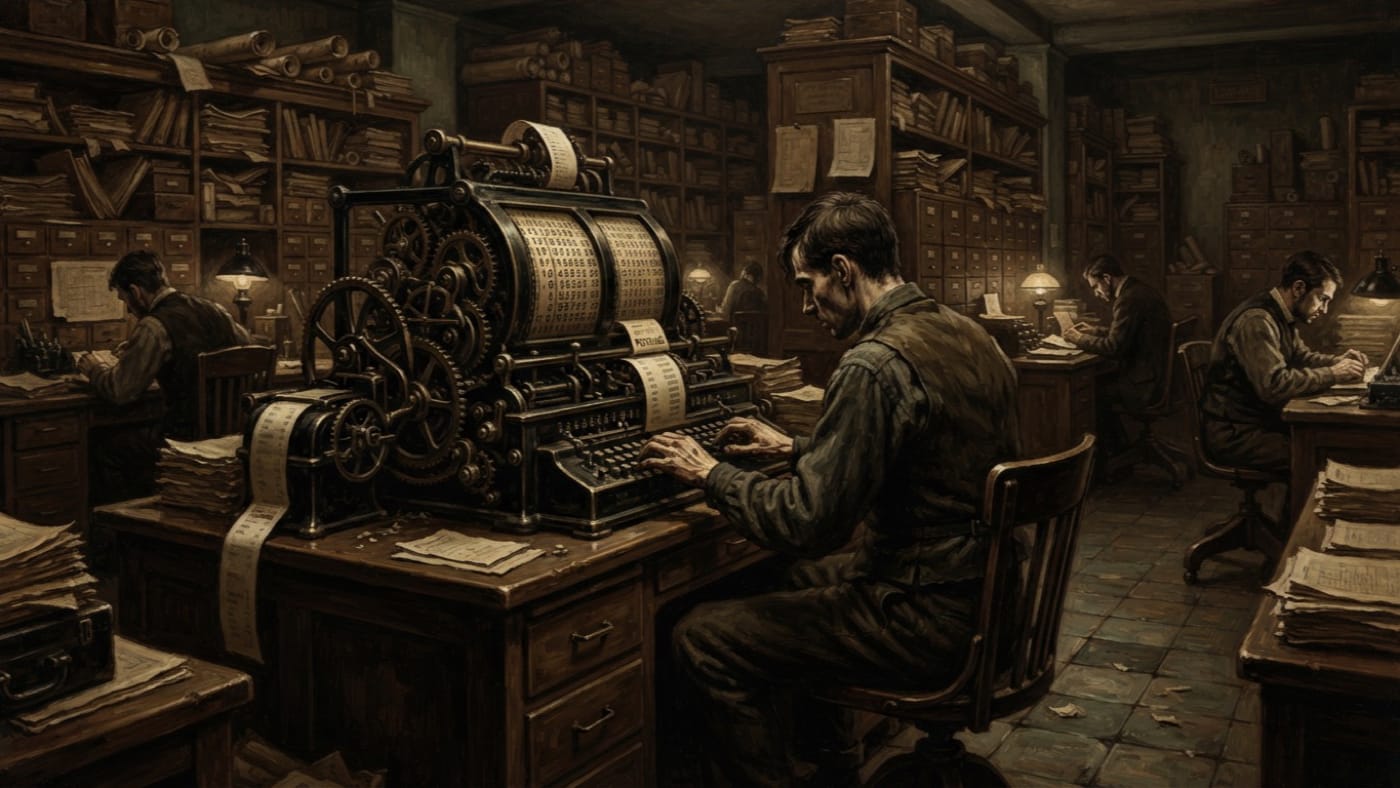
When Velmora's territory spreads over such ground, the machines keep running. The Bureau holds that demons cannot understand, replicate or operate human technology, and they have no need to. Whatever the Covetous Serpent's host captures, it corrupts. The apparatus carries on by a logic its makers never cut into the gearing. The Bureau files the results as Counting Engines. That is a family name for a class of captured apparatus. It does not name one model, one maker or one workshop. No record I have seen dates the first of them, to the Sundering or to any later year, and I will not supply a date for the reader's comfort.
They should not be confused with the Avarice Engine, the war-golem of fused gold and silver seen on the Sibiu approaches. The Avarice Engine walks. A Counting Engine stays where it was bolted down, in a room that still smells of ink.
#On What Is Counted
The gears turn. The mechanisms click. The numerals step forward on their wheels at the steady pace of a well-kept office. The Velmora dossier, as it stood at its A.S. 201 seal, calls the counting continuous, obsessive and perfect. I have no quarrel with perfect. No report known to the Bureau describes an Engine carrying a figure wrongly.
The trouble is what it counts. It counts coins that are not in the tray. It counts debts that no one has incurred. It counts souls that no one has sold, and it enters them as pending.
Every junior clerk learns the distinction in his first quarter, and it has been forgotten by every senior clerk who has looked too long at a balanced page. Arithmetic is one thing and entitlement is another. An Engine's total is correct the way a sum of imaginary numbers is correct: every column agrees with every other column, and none of them agrees with the room. The tally proves only the tally. It does not show that the coin exists, that a debtor ever put his hand to the terms, or that a soul has passed into anyone's custody.
The pending column worries the theologians most, and they are welcome to it. The Bureau of Doctrine reads a pending entry as a claim asserted, and has not ruled it a title held. Neither the Classification Record nor the dedicated lore says that such an entry foretells a sale, guarantees one, or creates an obligation of its own accord. Clerks who say otherwise in the refectory are speaking above their seal. I do not know what a pending soul is. The Engine does not know either. It has only learned which column to put one in.
The Engines are driven by cursed coinage fed into their hoppers.
Struck before sealing. Cursed currency is one of Velmora's vectors. Under the existing Velmora classification her primary sorcery is Contract Theurgy, and that correction stands for every subordinate file, this one included. No record establishes what drives a Counting Engine. The hopper was my own invention, and I have removed it.
#On the Operators
The pattern is short and goes in one direction. An operator stands at the Engine, feeds it numbers and reads what comes out. The machine wants more data, and there is always more to count. He feeds it again.
Then, by the account in the parent dossier, the operator begins to count other things: his steps, his breaths, his heartbeats, the tiles between where he stands and the door. The habit does not stop when he leaves the room. The Bureau of Medicine has filed four cases. The dossier adds that the Medicine file appears to be growing. I repeat the remark as written and add no figure to it. A thickening folder is not a census, and I will not total a folder I have not opened.
Precision matters here, because the Lictors grow excitable. Within Synod territory a demon cannot override a human will, and no Engine has been shown to command anyone. The operator chooses to feed it. He chooses again the next morning, and the morning after that, until the choice is so well worn it no longer feels like one. Medicine may call that dependency. The Church calls it a habit of the soul. Neither word means the man was forced, and neither excuses him.
The Bureau of Records also knows something that the alarmed tend to forget. Counting is one of the ordinary stress signs of the scribal trade, along with raw fingertips and reading aloud in one's sleep. A clerk who counts his stamps twice is doing his job. A clerk who counts them for the third time is tired, and that is not proof of contamination. On its own the symptom diagnoses nothing.
The real cost is attention. A man who is counting the tiles is not reading the contract in front of him, and that seems to me the Engine's true yield, whatever it does to his heartbeat.
#On the Account and Its Custodians
Velmora's empire is an economy of ownership. The Gilded Chasm gleams with ore. The Vault of Ten Thousand Keys is built around the lock. In the Counting Kingdoms the markets still run, though the goods have changed. Her domain stretches from Moldavia and Wallachia into the Transylvanian highlands that Bastion-Sibiu watches from the middle Sagittal Line, and it once held a great many provincial offices with a great deal of honest machinery in them. No Bureau record I have seen names any particular captured installation, so I name none.
Counting Engines are one family among several, and the families should stay separate in the reader's mind. Ledger-Keepers are demons that record. The Ten Thousand Keys cult also uses the title for a human rank, and the two deserve different treatment from the Purity guard. Assessment Engines put a value on things. Binding Presses print the terms. Consuming Factories take in more than they turn out. Vault Trains gather wealth along the track. They share a theme, and the theme is the reduction of everything to an entry. No source documents a chain of processing between them, or any wire, conduit or courier carrying a total from one to the next. Readers who imagine an infernal counting-house where every figure flows to a single desk are imagining it themselves.
The resemblance to my own Bureau will occur to the ungrateful reader, so I will deal with it now. Records counts people too. It must, or the ration carts go to the dead and the levy misses the living. The difference is that Records counts what it can produce on demand: the infant, the signature, the grave.
#On Scrutiny and Its Limits
The Synod's general answer to Velmora is paper read slowly. The Bureau of Records keeps contract readers whose whole duty is to search agreements for buried clauses and for terms that do not mean what they appear to mean. Against a Counting Engine the same discipline points at the comparison of documents. Put the Engine's total next to the coin actually in the tray. Put the debt next to a signed instrument. Put the pending column next to the parish register. Where the figures disagree, the figures are wrong. The coin, the instrument and the register are what make an account an account.
The dedicated lore credits Velmora's countermeasures with partial success. They help, they solve nothing, and compound interest is patient. That record is honest, so I will be honest about what lies past it. The Bureau has documented no method for neutralizing a Counting Engine. I know of no destruction order that has worked against one, no safe way to stop it, no rite and no cure for the habit its operators carry home. Other families are reported to resist destruction or to have rules against it, and those reports belong to them. They have not been shown to apply here.
My recommendation, which is only a recommendation and not a standing order, is that no total produced by captured apparatus be entered into any Synodal ledger until it has been checked against something a clerk can pick up.
#The Ratification
The Engine will produce its figure, and the figure will be correct. Someone will initial it, someone will file it, and someone further down the corridor will treat it as owed, because it has been initialled and filed.
That is where the danger lies. It sits in the initial at the foot of the page, and the gears have nothing to do with it.
Read above the total. Ask to see the coin.