
#On the Sanctioned Note
A counterkey is any acoustic pattern addressed to the pressure works of Bastion-Irongate without a licence from the Choir Magistracy. The term also covers any mark that records such a pattern. I wrote the definition, and every interested office dislikes it. The Magistracy wanted "sabotage," Engineering wanted the entry struck, and the Counterkey Circle, which teaches the things, calls them "the right note." When every party resents a definition, it is usually accurate.
Irongate's song is plumbing with a liturgy attached. Cannon hold the Iron Gates gorge from both cliffs. Below them, the chant pits of the Choir Nave send calibrated voices through brass baffles into a body of pressure doors, valve plates and seals. The harmonics are keyed to bolt tension and seal compression. The licensed pressure hymnal says which stanza a crew sings at which gauge reading, and the Magistracy decides who may hold a licence, at what tier, and how much heat the holder receives for the trouble. A mechanic who skips a line is presumed a saboteur until his widow proves otherwise.
The arrangement works, and that is where the difficulty starts. Whoever owns the note owns the air, the warmth and the right to sleep above the Underchords. A counterkey threatens both halves of that ownership. Sung badly, it may loosen what the hymnal holds. Sung well, it shows that the hymnal was a choice.
#On the Marks in Grease
The subject has three parts, and the Hush Court has spent three years confusing them. The first is the pattern as sound, performed or attempted against a seal. The second is the notation that records it. The third is the silent instruction by which one ruined singer passes it to another. A lesson given without a voice does not make the lesson's object a silent thing. A man taught by hand-sign to hold a note still holds it with his throat, if he has one left.
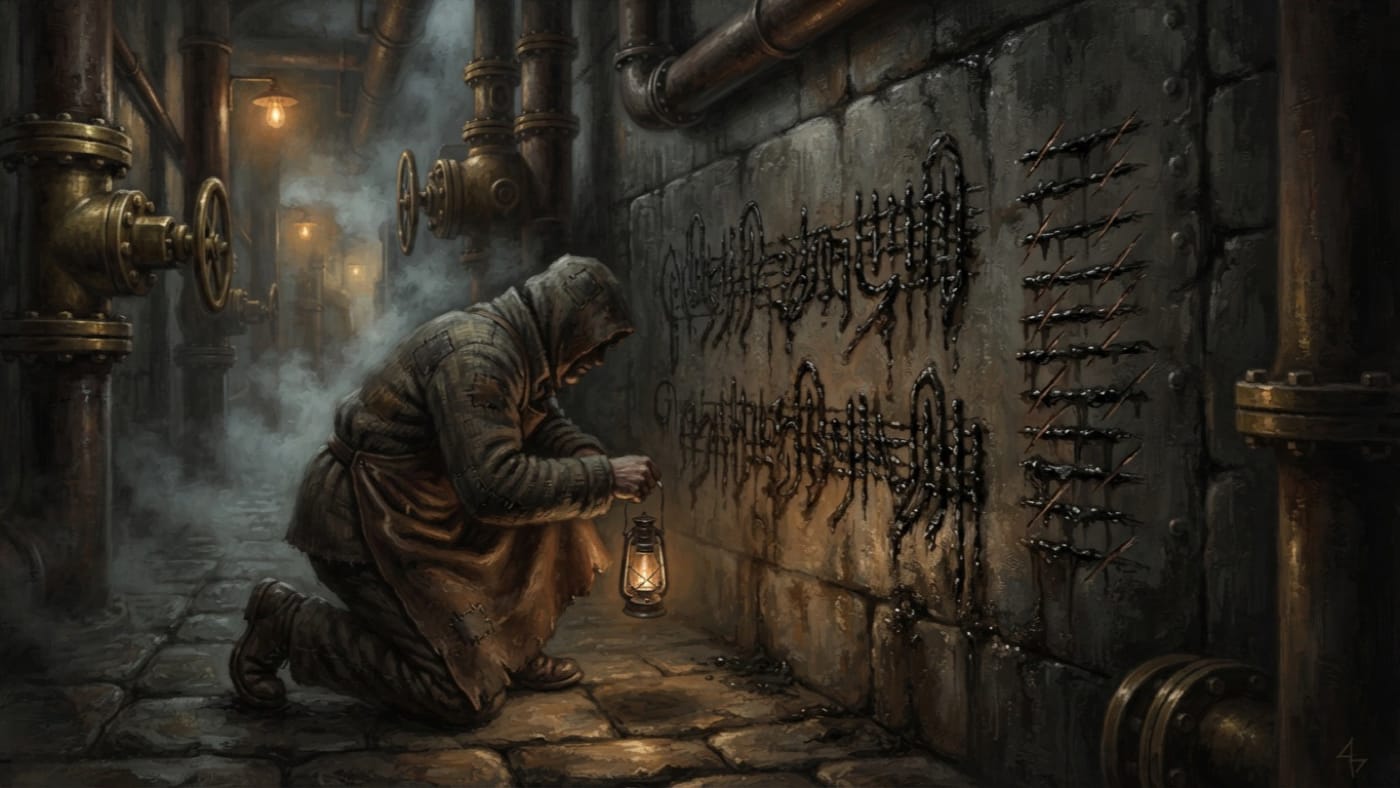
The notation belongs mostly to Reed. He has had no voice since he swallowed heated gasket compound after his revocation in A.S. 196. He writes counterkeys in the substance that took his speech. The writing surface is basalt in the Dead Gallery and the lesser sub-grade corridors, and the ink is black gasket grease from the Valve Quarter, thick, foul and stubborn under heat. The result is black on black. Held square to a lamp, the wall shows nothing. Held low, with the flame raking across the stone, it shows ridges, and the ridges make a script.
Recovered fragments record held notes, intervals that change with pressure readings, and adjustments for temperature. No complete alphabet has been recovered. No pitch table has been recovered either, and anyone who sells you one in the Underchords should also be asked about the provenance of his teeth. Alen Rill, named separately in the Irongate files, also writes keys in grease. Bells will not yet say whether his hand and Reed's follow one system or two.
The Choir Magistracy's first review classified the sub-grade wall-marks as "illiterate vandalism."
Reclassified as "illicit acoustic notation of uncertain field viability." The vandals turned out to be literate, which is far worse.
#On Reseating and Unseating
Purity's accusation is simple. Counterkeys are counter-frequencies, and counter-frequencies unseat seals. The marks themselves are less obliging. Some are crude, and some are dangerous in a way that needs no Bureau to explain it. A great many, by Reed's account and the Bureau of Bells' reading, are sequences intended to reseat a gasket that the licensed stanza has failed to hold. Treat these as attempts at maintenance and Purity loses its saboteur. Treat them as sabotage and Engineering has to explain why the saboteurs are doing its job.
Then there is the catalogue. Reed's account records that some of the counterkey patterns match resonant frequencies that Engineering catalogued in A.S. 94 and withheld from operational use. The Codex keeps the two facts separate. Engineering wrote those frequencies down eight score years ago and more. The Circle uses frequencies that agree with them now. Nothing in the file shows that Reed read the catalogue, that a secret school kept it alive for a century, or that anyone below has found the original chant-key, whose maker's name Irongate forbids anyone to speak. The Great Hush belongs to the same year, and that is the full extent of its relevance here.
The Circle goes much further. It is the Circle that teaches, and the Circle alone, that the mountain has been forced to sing the wrong note for a hundred years and may be held by harmonics outside the Magistracy's control. That is the faction's doctrine. This Codex has not authenticated it. Bells calls the recovered fragments "structurally coherent profiles of non-standard resonant frequencies," which is a judgment about grammar. A grammatical heresy can still bring down a ceiling. Minor collapses below are routinely "blamed on heretics," and the quotation marks are the Magistracy's own. The Dead Gallery's corridors no longer match their maps, and Morwen presses on Irongate from the Danube approaches. Neither fact appears anywhere in the evidence against a grease mark.
#On the Grammar Below
The Circle recruits from what the licensing system throws away. A chant worker who fails a licence test or coughs up enough stone dust to earn an ice-lung grade loses the warmth, food and lawful residence that went with the voice. He goes down. The Underchords sell him a quiet route. Reed gives him a grammar: silent-sign for instruction, tap-code on pipe and rail for summons, grease on basalt for doctrine. Discarded singers who were paid in heat and dismissed in paperwork find that their training survives their ruined throats.
Materials and passage come from the Underchord Cartel. Tap-King Jaro sells grease, quiet passes and the stolen hymn pages the Circle collates against its own notation, and Mira Slate trades in the same corridors with fewer illusions. Both deal with Reed. Doing business with him does not make them members, any more than selling candles makes a chandler a priest. The Shaft Priory sometimes shelters the unlicensed, broth and all. Purity has twice proposed reading that charity as complicity, and Doctrine has twice declined to rename a soup kitchen a conspiracy. The Circle keeps safe hollows below and an alcove somewhere near the Choir Nave. Where, the Magistracy would very much like to know.
#On the Bureau's Reading
Four offices have read the same wall and reached four verdicts. Bells calls it notation. Engineering calls it "sub-grade graffiti," in the tone of a man asked to inspect his own gallows. The Bureau of Purity calls it evidence, the Bureau of Medicine calls it a symptom, and my own Bureau calls it a folio that should be copied before anyone burns it. The Bureau of Records asks only whose name to file it under, and nobody can tell it.
The Hush Court did not wait for agreement. In A.S. 199 it issued Standing Order 34-K and ordered emergency licensing audits. Fourteen workers produced harmonics inconsistent with their assigned stanzas, and fourteen were executed. Purity's sealed post-mortem later judged four of them almost certainly Circle and six probably exhausted workers whose ice-lung and fear had cracked the note. The other four remain "indeterminate." There were fourteen condemned suspects. Nobody verified fourteen members. The audit could hear that a note was wrong. It could not tell whether the wrongness was doctrine or damage, and it hanged both to be safe.
Near the entrance to the Dead Gallery there are fourteen short grease lines, each crossed by a shallow diagonal. Bells analysts read the diagonals as harmonic cancellation, so to them the panel is a counterkey, perhaps a dangerous one. Priory witnesses read them as a tally of martyrs. Purity has had the lines scraped three times, and each time they came back wet. Perhaps both readings are correct, and the Circle has learned to write its grief in the same notation it uses for its engineering. Purity does not care which reading is right. It scrapes either way.
#On Preservation
As of A.S. 201, Reed remains below Irongate, still writing. No one has determined who invented counterkeys, when the first was performed, how many exist, or whether any of them reseats a gasket more reliably than the licensed hymnal. The Circle's account of the mountain remains the Circle's account. Bells keeps the fragments, Engineering keeps its catalogue, and Purity keeps a list of corridors it would like scraped.
The Bureau of Doctrine rules that recovered notation is to be recorded before it is destroyed. The surveyor works by lamp held low and records the ridges as he finds them, without completing, correcting or regularising them, and he hums nothing while he does it. Copies go under seal to Bells and to Doctrine. Engineering may consult the copies after explaining, in writing, why the A.S. 94 catalogue was withheld. Its explanation is awaited.