
#On the Warrant
Quod non videtur, non confitetur. — V.D., offered to the Bureau of Purity without charge
Confession of Pride is the Synod's practice of regular sessions in which the faithful acknowledge three things before a confessor: feelings of superiority, moments of contempt, and instances of looking down upon another soul. It stands among the countermeasures raised against Atheron, Sin-General of Pride, whose spires crown the eastern Carpathian passes opposite Bastion-Przemyśl. This survey describes the practice as it operates in A.S. 201 among the officers of that fortress, whose admissions pass to the Bureau of Purity.
The files I was given do not say who convened the first session, or in what year, or under whose seal. I decline to invent a founder for the convenience of the index.
The rationale is simple to state. Pride acknowledged, the Church teaches, loses its power. A sin dragged into speech before a witness is harder to mistake for a fact of nature.
One distinction comes before everything else, and the garrison chaplains get it wrong more often than they should. Competence is not Pride. A gunnery captain who knows he lays a battery better than his major is correct, and the Creator has no quarrel with arithmetic. The sin begins when the captain can no longer hear the major, and the corporal beneath him, and the frightened boy on the wire who has noticed what neither of them has, as voices belonging to persons of equal worth before the Creator. Atheron does not sell excellence. He sells deafness.
#On What Is Confessed
The categories are few, and the practice depends on how little they ask. The officer is not asked to confess that he is proud. He is asked to name a moment: the instant he dismissed a sapper's warning because it came from a sapper; the supper at which he found the conversation of junior men tiresome and let them see it; the report he signed without reading because its author had once misspelled his name.
These are small admissions. They are meant to be. A man can confess a moment who would never confess a condition.
The officer who feels overlooked is the hardest case, and the Church has learned to treat him gently, because he is usually right. Przemyśl promotes by seniority, rotation and the favour of distant committees. Engineers watch lesser designs approved. Captains watch their own plans adopted under a colonel's signature. The grievance is real and the injustice is documented, and the influence-demon arrives at exactly this point. It does not lie to him. It agrees with him. They do not see your worth.
The confession asks him to separate two things the demon has fused: the injustice done to him, which he may lawfully protest through every channel of the Synod, and the conclusion he has drawn from it, which is that no one beneath his true station may correct him again. The first is a complaint. The second is a coronation.
#On the Record
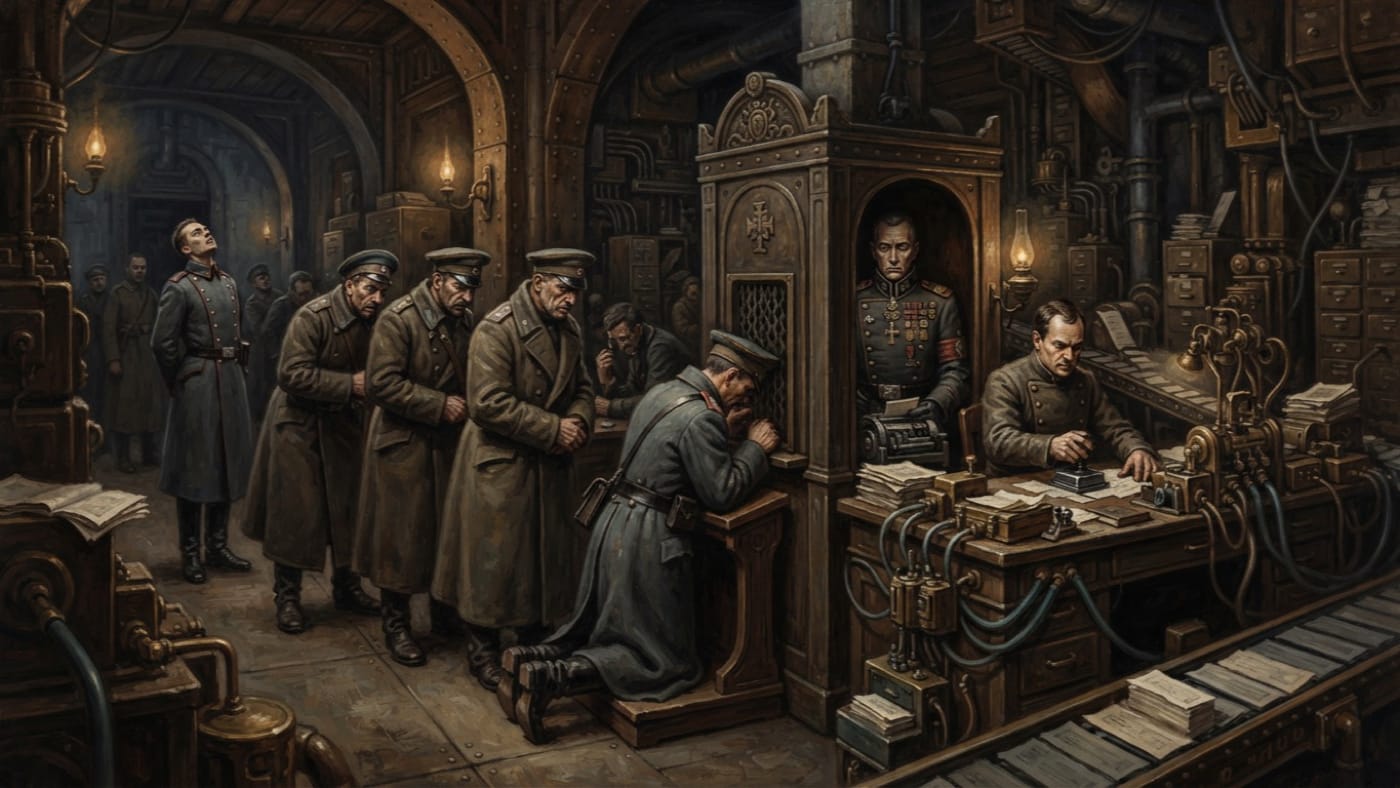
Confession in the Synod has always served two masters, the soul and the file, and neither has ever been jealous of the other. The parish Confessor-Penal is trained in absolution and in surveillance alike. What is spoken through the screen is forgiven, and then it is written down.
At Bastion-Przemyśl the machinery of that writing is visible to anyone who has queued at the Chapel of Counting, where the incense has been losing its argument with the mildew for as long as anyone remembers. Confession slips are indexed into vaults beneath the chapel, among them a vault reserved for Pride-contact records, under the keeping of Archivist-Prelate Odran Kelle. I describe this as the surrounding apparatus. Nothing in the files makes the chapel the birthplace or the headquarters of Confession of Pride, and Kelle has troubles enough without my appointing him its author.
The lay confessor-booth clerk belongs to this machinery as well: the rubric card, the counted receipt blanks, the stamp tapped three times before the shutter opens. A clerk's stamp proves that a confession was processed. It absolves nothing. Officers forget this with a regularity that ought to interest the Bureau of Purity more than it does.
What Purity receives from the Pride sessions is, by every account, the most candid material it collects from any programme. Officers write of contempt with a frankness they would never bring to a requisition form. The Bureau reads it, cross-indexes it, and draws its conclusions. I drew mine as well when I first studied the returns. An officer whose admissions arrive regular, specific and unforced across successive sessions has a mind open to inspection, and an officer with a clean return has a clean mind.
#On the Unconfessed
An officer with a clean return has a clean mind.
Withdrawn by the undersigned, who wrote it four paragraphs ago. A clean return establishes only that nothing was confessed. The matter is set out below.
The officers who confess contempt are the officers who can still see it. Every admission in the Bureau's files proves its author can still examine himself, and the man who can still examine himself is the man least at risk. Confession of Pride gathers a rich harvest from the field that needed it least.
The dangerous officer comes to the screen as well. He kneels, if he still can. He reports, without hesitation or guile, that he harbours no feelings of superiority toward anyone.
He is not lying. That is the horror of the thing, and it is why the usual inquisitorial instruments are useless against it. Ordinary deceit leaves marks: the rehearsed phrase, the eyes on the grille, the slip whose handwriting tightens. The Bureau knows how to read a liar. This man is not lying. He feels no superiority because, to his mind, superiority is a measurement, and nobody confesses a measurement. He does not look down on his subordinates any more than a surveyor looks down on a valley. The valley is simply lower.
The rite needs the one faculty Pride removes first: the capacity to hear correction from an equal and to believe the equal exists.
Late signs come in their own time, and by then the confessional is the wrong instrument. The spine straightens past its natural curve. The chin rises and will not come down. The man cannot bow, and after a while cannot remember when he stopped being able to. Crown-growths follow, and at the last the feet fuse to whatever raises them. Chaplains must learn the difference between this progression and the stiff back of a man who has slept four winters on a firing step. A rigid neck alone convicts nobody. I have seen it convict several.
Atheron's influence-demons tempt, flatter and make themselves necessary. They cannot possess a man or take his will from him. An officer whose spine has begun to set can still choose to name a moment of contempt, still choose to hear the sapper, still choose differently tomorrow than he chose today. The Bureau of Purity's field manual calls such men already lost. I record the phrase as the Bureau's, for the Bureau's purposes. The Church's own teaching leaves the choice open to the last.
What confession cannot do is give the spine its curve back. Mutation may outlast repentance, and the Synod prefers the scaffold to the long wait for repentance. The proud rarely accept the mercy. So, I note, do the merely suspected.
Vault index, Pride-contact series, Chapel of Counting: ████ sessions logged in the current survey year; ███ returns marked nil admission; of these, ██ subsequently transferred to Purity custody on physical indicators. Cross-reference withheld.
#On Its Present Application
Confession of Pride stands in a row of defences, and each fails in its own way.
The Doctrine of Equality Before the Divine, maintained by the Bureau of Doctrine, teaches that rank is earthly and temporary. Some hear it. Others conclude that they are the exception the Creator had in mind.
Humility Practices are required quarterly of officers above the rank of captain, under Purity's administration: the washing of feet, the serving of meals, the menial tasks of the lower ranks. Purity's own review found that a great many participants valued the exercises and changed nothing, and that some came away certain that submitting to them proved their superiority over men who would have refused. Those are findings about the exercises. They do not describe the confessional, and I will not let the two programmes share statistics because they share a fortress.
A Purity advisory of A.S. 199 separately subjects Przemyśl's garrison commanders to quarterly Humility Assessments, with relief of command for failure. Rotation keeps any officer from holding a Przemyśl post longer than eighteen months, which keeps men from setting into their chairs and costs the garrison the memory that wins campaigns. Peer accountability depends on peers, and the proud acknowledge none. The Catechism of Humility, recited at the first suspicion of one's own excellence, works for as long as the reciter suspects.
Across the wire, the Mirror-Lords attack self-perception directly, and every defence along this stretch of the Sagittal Line assumes an accurate self-perception that the enemy is busy dismantling.
The Bureau of Purity has called the programme's intelligence honest and useless. Honest, yes. The sessions catch the officer who is beginning to fall, and catch him while he can still hear the confessor. That is worth the ink. They miss the officers who no longer can, and those are the ones who end up giving sermons to empty naves.
#The Ratification
The Pride sessions are mandated for the garrison officers. A Hieromnemon of the Bureau of Doctrine is not on that roll. I have read the returns of men far junior to me, and I find the exercise instructive for them.
I have read every return in this survey and found myself in none of them. Above, I have demonstrated that this proves nothing. I note it anyway, for the record.
My spine is straight. I sit badly; it is a matter of posture. The kneeler in my study has been used, recently, for books.