
#On the Ratification
"Better one name struck than a district burned." — Bureau of Records, Concordat Annex 14-C, ratified A.S. 104
In A.S. 104, fourteen years after the Concordat of Strasbourg gave the Synod its constitution, the Bureau of Records and the Bureau of Doctrine agreed under joint seal that a quarrel could be fought on paper and that the result would bind. That agreement is Concordat Annex 14-C. It was appended to the Catechism Third Revision as a supplement to the Confession Reform. The Reform belonged to the Bureau of Rites, which was given nothing whatever to say about the Annex and has said a great deal about it since. There were three instruments in one year, and the one that mattered carried two seals. The surviving record does not say which of the three passed first, in which chamber, or under whose pen. I have looked. The Bureau of Records keeps everything except, occasionally, its own baptismal entry.
Its official justification is the maxim above. Records attached it to the Annex, and the Guild has since painted it on so many walls that it now sounds like scripture. It is policy. Mercy is the word Records chose for the arithmetic.
#On the Quarrel Before the Bell
Before A.S. 104, a dispute over an inheritance, a tithe arrear or a garrison's share of salted pork was settled with whatever the district had to hand. Usually that meant a garrison officer with a price, a cousin with a cudgel, and a clerk who could discover overnight a deed that had not existed at supper. Records later named this arrangement "adversarial filing." The phrase is a masterpiece. It describes arson, bribery and forgery as though they were a style of shelving.
The violence was never the difficulty. The Church has always found violence administrable. The difficulty was that improvised settlements produced improvised records, and improvised records travelled. A forged deed in one parish became a ration claim in the next and a marriage impediment in the third. Eventually the vaults beneath Strasbourg held three incompatible truths about the same widow's goat. Every local victory poisoned the central register a little further, and the central register is the only thing in the Synod that Records considers alive.
The Annex invented neither quarrelling nor bribery, nor the clerk who could be persuaded. It gave them a room, a bell and a sanctioned outcome. In exchange, it required that the outcome be written once, by the proper hand, in the proper ledger.
#On the Bounds of Combat
What the Annex standardised can be stated quickly, because Records likes its knives short.
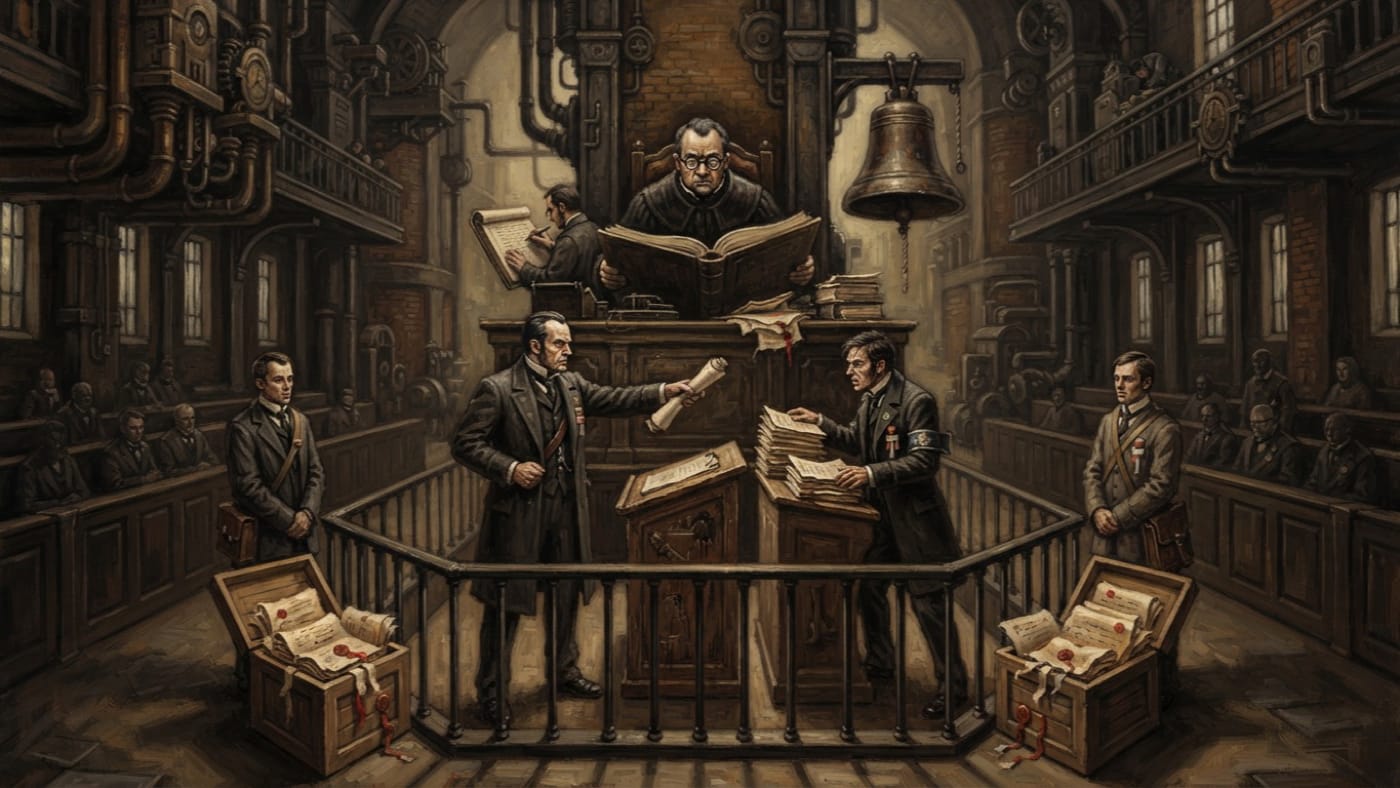
It provided for two parties and one presiding clerk, who held adjudication authority and with whom the argument ended. Rounds were timed and marked by a court bell. No register I can reach records the length of a round, and I decline to invent one for the convenience of gamblers. Each combatant could have at most two seconds. The word means attendants, not a span of time, although I have heard advocates speak as if it meant both. Each second could carry one crate of supporting documentation. Finally, the Annex set a range of remedies, from the freezing of assets to full erasure.
That was all, and it was enough. A quarrel has no natural end. Brothers will argue over a mill until both are buried beside it. The Annex supplied what a quarrel lacks: a limit on how long a man may speak, a limit on what he may bring, and a single voice whose ruling would be carried into the registers by people who did not care which brother had been right. A dispute fought within those bounds became a ruling, and the ruling became an entry. In the Synod, an entry is the nearest thing to fact available to the living.
The duel that grew within these bounds now runs in five stages. The profession teaches them, and I set them down here as later practice, not as clauses of A.S. 104.
- Standing: the advocate proves that his client exists in relation to the dispute. This requires a recognised identity and documents that agree with it.
- The Spine: prior rulings, decrees and fragments of doctrine are chained together until they make an argument.
- The Strike: the advocate moves against the opponent's position, whether his seals, his tithe record or his witness.
- Remedy: the victor asks for enforcement.
- Enforcement: the ruling is carried out through the registers.
The division of hands matters. Records Scribes authenticate and supply entries. Citation Advocates argue. The presiding clerk rules. Clerks carry out the ruling, and when it touches erasure, an Erasure Notary checks the identity anchors and applies the black seal. An advocate may ask that a name be destroyed, but he may not destroy it himself. The distinction is as thin as vellum and exactly as durable.
#On the Remedy
Under the Annex, a ruling falls on the papers by which a body is fed, housed, married and buried. In a theocracy, that comes to the same thing as falling on the body, with fewer stains.
Consider a freeze. A tannery's stock is sealed in wax. The tanner keeps his hands, his house and his name, but he loses the right to sell. With it go his ration surplus and the rent on the loft where his apprentice sleeps. Consider a revoked permit. The carter whose travel pass is cancelled still has a cart and a horse, and nowhere he may lawfully drive them. Bond annulment dissolves a debt or a marriage, depending on which bond was cited. Penal reassignment sends the loser somewhere the Bureau of War can use him. A partial name-strike amends particular registers and leaves the man standing, awkwardly, in what remains.
Full erasure takes everything else. The name leaves the Great Ledger of Souls. The ration papers are cancelled. The marriage was never valid, the children are reclassified, and the burial plot passes to someone whose existence is better documented. Records calls the notice sent to the family a "correction," and the correction is retroactive. Witnesses report that by evening the neighbours no longer recognise the erased. I can report that I have never met a neighbour who admitted to remembering. Make of that what your confessor permits.
Most losses in a citation pit do not end this way, whatever the gallery hopes. The older gallery accounts, in which every duel ends with somebody erased, flatter the theatre and slander the fee table. Most losers keep their names and lose a horse.
#On the Profession That Followed
The Annex created the duel. It did not create the Advocates Guild, although the Guild's charter descends from it and the Guild's own abstract, with admirable economy, gives the Annex year as its founding. What existed in A.S. 104 was a format. Within a decade there were men who did nothing but fight inside it for pay. Soon afterwards someone began a roster of who might argue, who might carry a seal, and who might touch the pit rail without being removed by the bailiffs. That roster grew into a fraternity. By A.S. 130 it had halls, apprenticeships, fees and funerary privileges. It also had the inscription Win clean or vanish over the Registry Court of Strasbourg, which was carved in that year and hung over no earlier door.
The Guild is licensed. It sits beneath Records and Doctrine, borrows their authority and feeds on their registers. In theory, it can be dissolved by the same two seals that brought its trade into being. It sometimes forgets this at banquets. Records reminds it at audits.
#On the Amended Practice
The crates were the Annex's weakness. It allowed one crate per second and said nothing about how the papers inside had come to be there. For seventy-four years the profession treated a document's presence in a crate as half of its authentication. Then came the Forgery Panic of A.S. 178. Fourteen advocates across three zones cited the same fabricated decree, and the Synod learned that precedent can be forged as easily as anything else and then shipped in a crate.
Records and Doctrine imposed discipline. Scribe licensing tightened. Every document entering a pit acquired a custody history, witness ribbons multiplied, and seal impressions were indexed by pressure. None of this is in the Annex. All of it now stands between the crate and the clerk. Advocates call it "charming," in the voice men use for gout.
Guild memorial tablets record the A.S. 178 reforms as "voluntary professional clarifications."
Corrected. Records and Doctrine imposed the reforms after licensed members of the Guild failed to detect a fabricated decree in their own citations. The tablets have not been removed. Brass is costly, and so is admitting to having been fooled.
Standing Order 22-R, revised in A.S. 199, now decides who must enter the pit. It covers disputes lasting more than three days or involving assets worth more than forty ration-units. Capital heresy, command disputes under active bombardment, and relic claims above seventeen femurs are referred elsewhere. Those thresholds belong to the standing order, not to the Annex. The Annex made the pit available. The standing order made it compulsory for a great many people who would have preferred the cudgel.
In A.S. 201, the Registry Court of Strasbourg hears forty to sixty duels a week. Each begins with a bell rung under an instrument older than anyone in the gallery, and each ends, as the Annex requires, with something entered in a register.